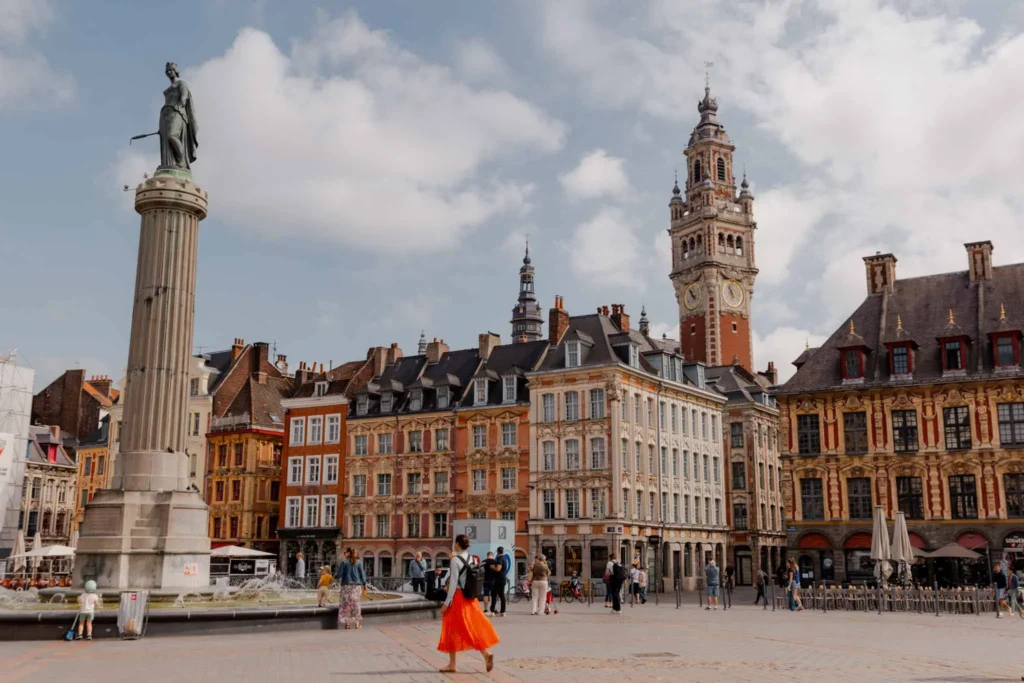
Standing on a cobbled lane somewhere between Rue de la Monnaie and Place aux Oignons, I realized Lille had completely shattered my preconceptions. What I’d dismissed as just another grey, industrial place on the Eurostar route turned out to be one of France’s most underrated cultural gems. The city’s character stuck with me long after that first weekend—a blend of Flemish heritage and French elegance that feels distinctly northern yet deeply historic, without tipping into anything too polished or contrived.
The centre is full of red-brick facades and stepped gables that give the streets a charm you won’t find in Paris. Brick row houses line narrow cobblestoned streets, while gabled facades create a distinctly Flemish atmosphere. This mix of old buildings and newer development reflects the day-to-day rhythm of life here, shaped by both Belgian influence and French tradition. After discovering it hosts Europe’s largest flea market every September, I started looking more closely and quickly realised how wrong my assumptions had been.
From London, the journey takes about 90 minutes on the Eurostar—quicker and far more pleasant than dealing with a late-night Stansted flight. Several trains run each day, making it usually cheaper than going to Paris. The station is central, and once you arrive, the whole city is easy to get around on foot. It’s a very manageable size for a weekend, especially if you like to walk and take your time. There’s a friendly, local feel here, less busy than the big-name destinations but full of charm and small discoveries.
The museums here rival those anywhere in the country. The food scene is top notch—a mix between traditional and inventive approaches that never feels forced. You can try local dishes at an estaminet one night (Lille’s version of a tavern) and then dine at a modern, fine dining spot the next. There’s no pressure to tick off a long list of must-sees, but instead a lot of room for cute pedestrianised streets, excellent bakeries, and a truly special art museum that’s a metro ride away in Roubaix. It feels like a real city, not just one curated for visitors. The kind of place that makes you think, “I could live here.” The city is charming yet current, with a trendy, cool vibe that convinced me it should be on everyone’s radar after just one long weekend trip. The food, art, and architecture alone make it worth the trip.
Grand’Place and the Heart of the City
Table of Contents
ToggleLille’s main square, officially known as Place du Général de Gaulle, serves as a lively focal point in the heart of the city. Surrounded by grand Flemish-Baroque buildings, including the Vieille Bourse, it’s a great place to sit with coffee and take in the atmosphere. On a sunny day, the square is full of people relaxing or meeting friends. The square often hosts events, and I found myself returning here multiple times, drawn by its energy and the way it anchors the old town.
The main square in Lille is truly a great spot to sit and people-watch, especially in the warmer months when café terraces fill up and the streets become lively. You’ll always know where you are thanks to the charming street signs hanging above all these historic streets—something I really like about Lille that adds both practicality and character.
Inside the Vieille Bourse Courtyard
This 17th-century building is one of the city’s most decorated buildings, and its brick façade is covered with Renaissance details—carved garlands and ribbons, sculpted fruit, and ornamental flourishes that reward close inspection. Built during Spanish rule, it stands as a testament to Lille’s layered history.
Inside the courtyard of the old stock exchange, you’ll find secondhand book and print sellers set up beneath the 17th-century arcades. The secondhand book market is open Tuesday to Sunday from 1:00 to 7:00 PM, and it’s full of vintage finds—old books, handwritten postcards, cinema posters, botanical prints, and even the occasional DVD. It’s a lovely, atmospheric spot to browse. When I visited, chess games were going on by the mirrored orb sculpture in the centre, adding an unexpected layer of local life to the scene.
The selection can be hit or miss, but a few sellers had great prints and posters I almost brought back to Paris with me. My favourite stalls had vintage toys and old educational illustrations—great to flip through, and even better if you’re looking for something to frame or take home as a souvenir.
Wandering Through Vieux-Lille’s Streets
Old Town Lille may be French at heart, but its Flemish roots are hard to miss. The neighborhood’s distinct charm comes from this tension—it feels more like the Marais, a trendy neighborhood in Paris, than a small city up north, yet it retains something uniquely its own. Cool eateries, design shops, and independent boutiques fill the cobbled lanes, which are lined with charming bakeries, beautiful shops, and unique architecture.
Rue de la Clef is a small street bustling with a few popular cafes, perfect for a mid-morning break. Rue de la Monnaie is a long, larger street filled with restaurants and designer shops—a lively street perfect for strolling and shopping. The Musée de l’Hospice Comtesse, a contemporary art gallery, sits just off this street (more about it later). Passage des Arts, also known as Rue de Vieux Murs, is a tucked-away passage that’s home to several art galleries, brunch spots, and estaminets (Flemish restaurants), plus an excellent bakery called L’Ogre de Carrouselberg.
Rue Basse is home to many fancy designer shops, including the beautiful Louis Vuitton shop covered in sea-themed mosaics. Even if luxury retail isn’t your thing, the building itself is worth seeing. These streets and squares offer endless opportunities to explore without a fixed agenda, letting the city reveal itself at your own pace.
The Palais des Beaux-Arts Experience
Lille’s major art museum is one of the most important in France outside Paris, and it holds a strong collection ranging from the Renaissance through to 20th-century painting. Housed in a grand Belle Époque building, the Palais des Beaux-Arts covers everything from the Middle Ages to the 20th century. Works by Rubens, Goya, Courbet, and Delacroix fill the galleries, plus a sculpture gallery featuring pieces by Rodin.
The building itself has a grand scale, with tall galleries and large-scale paintings well spaced out, making it easy to take in without feeling rushed or overwhelmed. I especially liked the ceramics hall and the sculpture gallery—both well curated and deserving of slow, careful attention. The museum is manageable in size; you can see the main collection in about 90 minutes, though you could easily spend a few hours here if you want to dig deeper.
When I visited, there was a temporary installation using optical illusions that interacted playfully with the building’s architecture, adding something unexpected to the experience. Though if you’re short on time and can only pick one museum in Lille, I’d personally choose La Piscine. For opening hours and ticket prices, visit the official website.
La Piscine: A Former Pool Transformed
One of the most memorable museums I’ve visited, La Piscine is housed in a former Art Deco swimming pool in the suburb of Roubaix. It’s easily one of the coolest museums I’ve seen in France. The architecture alone is reason to go, but the art collection more than lives up to it.
The pool itself has been beautifully preserved, with a stretch of water still running through the centre, lined with sculptures against the original blue and gold mosaic tiles. At the center, the original mosaic-tiled pool is flanked by sculptures and lit by two large sunburst windows that cast a soft, golden glow over the water. The old changing rooms around the edges have been transformed into galleries displaying ceramics, textiles, and fashion.
The old shower rooms exhibit ceramics, textiles, and vintage clothing. The ceramics collection was impressive, with pieces by Picasso and other notable modern artists. Other wings of the museum house a surprisingly rich collection of painting and 19th and 20th-century sculpture. One highlight is the recreated studio of sculptor Henri Bouchard, with plaster casts and tools laid out as though he’d just stepped out—an intimate glimpse into the working process.
It’s easy to get there on the metro from Lille—it takes about 30 minutes. This museum is located in Roubaix, which is 30 minutes outside of Lille by train. Take the M2 metro line from Lille Flandres, near the main train station, to Gare Jean Lebas. It’s a short walk from here to the museum. You can purchase metro tickets at the station via cash or card. Roubaix itself has an interesting industrial past, and if you have time, you can also stop by Ateliers Jouret, a former textile space now home to working studios and galleries. There’s also a large mural of Camille Claudel nearby, a nice nod to one of France’s most fascinating sculptors. For ticket prices and opening hours, visit the official website.
The Citadel and Green Spaces
La Citadelle is one of Lille’s largest green spaces, just a short walk from the old town. A huge green space surrounding the 17th-century Vauban fortress, the Citadel Park is a central part of daily life in Lille. On a sunny Sunday morning, it was full of people walking, jogging, cycling, or just enjoying the open air. There’s a small zoo, a tree-lined canal, plenty of shaded paths, and even a working military fortress.
There are boat rentals if you want to explore the canals, and some larger guinguette-style boats offering drinks and snacks. The citadel itself is a functioning military site, but the park around it is open and very popular. There’s also a small zoo and an amusement area for children, making it a good stop if you’re visiting with family or just want a break from the city streets.
If you’re planning a picnic, head over to the nearby Jardin Vauban. It’s smaller and more manicured, with wide grassy lawns that are perfect for spreading out a blanket for a lazy afternoon when the weather cooperates.
Wazemmes Market Energy
The Marché de Wazemmes is a covered market open daily (except Monday), while the larger open-air market takes place on Tuesday, Thursday, and Sunday mornings. This vibrant, multicultural market feels more local than touristy and is full of energy that reflects the city’s diverse population.
It’s best on Sundays, when the entire square and surrounding streets come alive with food stalls, fresh produce, flowers, spices, and household goods. But it’s also open on Tuesdays and Thursdays if you want to avoid the busiest crowds. You’ll find everything from Moroccan pastries and rotisserie chickens to rolls of colourful fabric and bargain baskets of herbs. It’s a great place to pick up something for lunch or simply take in the atmosphere and watch the vendors work their stalls with practiced ease.
Two Remarkable Churches
Notre-Dame de la Treille is a unique cathedral that unexpectedly blends neo-Gothic and modern design. It took 145 years to build, and the architecture reflects the mix of styles from across the two centuries it spans. Lille Cathedral, also known as Notre-Dame de la Treille, is one of the more unusual cathedrals in France. The building was started in the mid-19th century but only completed in the 1990s, so its architecture blends neo-Gothic structure with a strikingly modern facade in pale stone and translucent marble.
What really makes it stand out is the front facade. A large glass panel and a modern rose window by artist Ladislas Kijno flood the space with light, softening the weight of the otherwise gray structure. Inside, the stained glass windows cast soft light across the floor, and when I visited, a choir was rehearsing, which made the whole space feel incredibly peaceful.
Just a short walk away is the Église Saint-Maurice, a beautiful late Gothic church dating from the 14th to 19th century, built in stages over several centuries. A short walk from the main train station, this Gothic-style church was built over the course of four centuries. It has tall vaulted ceilings, narrow columns, and delicate stained glass throughout. It’s worth a quick look inside to see the colorful stained glass windows. The atmosphere is quieter here, and the stained glass is luminous with its jewel like colours against the dark stone—a contrast that creates an almost meditative quality.
Charles de Gaulle’s Early Years
Maison Natale Charles de Gaulle is the birthplace of General Charles de Gaulle, one of France’s most important historical figures. On a quiet street in Old Lille, the restored 19th-century home offers a glimpse into his early life with period furnishings, family photographs, and personal memorabilia.
Just a short walk from the old town, you can visit the house where Charles de Gaulle was born in 1890. The house has been turned into a small museum with rooms preserved in period detail, offering a glimpse into the early life of one of France’s most iconic figures. You can explore the rooms where de Gaulle spent his childhood and learn about his legacy through exhibits that trace his path from Lille to the French presidency.
There’s also a small garden and a thoughtful display of letters, photographs, and personal items that give a sense of the world he grew up in. For more information and opening hours, visit the museum’s official website.
Musée de l’Hospice Comtesse’s Quiet Character
Set in a former medieval hospital founded in the 13th century by Countess Jeanne of Flanders, this museum sits just off Rue de la Monnaie. The building still feels monastic in parts, with a chapel, cloisters, and vaulted ceilings all preserved from its former life. Today, it hosts a rotation of contemporary exhibitions, often installations or photography, in rooms that feel both quiet and characterful.
It’s not a huge museum, but that makes it easy to explore without feeling like a big commitment. The contrast between the medieval architecture and contemporary art creates an engaging dialogue that works surprisingly well. I found myself lingering longer than expected, drawn by the atmosphere as much as the exhibitions.
Views from the Beffroi
Towering 104 meters above lille, the top of the Belfry is where you’ll find the best views of Lille. You can either climb the whole way up or take the elevator after the first 109 steps—a compromise that gives you some of the experience without completely exhausting yourself.
Make sure to reserve tickets online in advance, as availability can be limited, especially during peak season. The panoramic perspective from the top helps you understand the city’s layout and appreciate how compact yet varied it is.
LaM’s Temporary Closure
Located just outside the city, LaM is Lille’s modern and contemporary art museum, with a bold collection that includes paintings, sculptures, and ceramics. The museum is currently closed for renovations and is expected to reopen in early 2026. For updates and reopening details, check the official museum website. It’s worth keeping an eye on if you’re planning a future trip, as it’s an important part of the city’s cultural landscape.
September’s Grande Braderie
If you’re visiting Lille in September, plan your trip around the Grande Braderie. Held every September, the Grande Braderie de Lille is said to be the largest flea market in Europe, and it completely takes over the city for a weekend. One of the largest flea markets in the world, it takes over the entire city for the weekend, with thousands of stalls selling everything from antiques to vintage clothes.
Thousands of stalls line the streets selling everything from antiques and vintage furniture to books, vinyl, and bric-a-brac. Shops clear out their basements, locals empty their attics, and the atmosphere turns festive. The dish of the weekend is Moules-frites—mussels and fries. You’ll find it everywhere, with mussels and fries served in every estaminet and live music spilling into the streets. Make sure to come ready to eat and shop.
I haven’t been yet, but it’s the kind of event that makes me want to plan my next trip around it. If you’re thinking about visiting Lille, September would be a brilliant time to go. Check the dates for the next market here.
Estaminets and Regional Cuisine
Lille has a rich food culture shaped by its Flemish roots. Estaminets are traditional northern taverns—usually cosy, wood-panelled spaces serving hearty, regional dishes and plenty of beer. You’ll find them all over the city, often tucked into little squares or side streets, and they’re a great place to try local specialities.
Carbonade flamande is a slow-cooked beef stew in beer that appears on nearly every estaminet menu—a hearty beef stew that’s perfect for cooler evenings. Potjevleesch is a terrine of white meats in vinegar jelly, an acquired taste but worth trying for the adventurous. Anything made with Maroilles cheese tends to be rich and comforting, with a pungent aroma that might surprise you at first.
Estaminet La CH’TITE BRIGITTE is one of the most well-known estaminets in Lille, with plenty of seating and good value dishes. I had a long list of restaurants and bakeries I wanted to try in Lille, and while I didn’t make it to all of them, the ones I did were fantastic. I highly recommend Estaminet la CH’TITE BRIGITTE to try traditional cuisine. We loved the carbonade flamande, the Flemish stew, and the leek flamiche. The chicken with Maroilles cheese was rich and comforting—exactly what you want from this style of cooking.
Brasserie Campion is a more elegant space with a vintage feel—less of a traditional estaminet and more of a stylish brasserie. The food was seasonal and well done. I had the white asparagus and sea bass, and both were excellent for the price. It’s a good choice if you want something a bit more refined without losing the local connection.
Other restaurants on my list to try in Lille include Bloempot, Estaminet Au Vieux De La Vieille, Bistrot Brigand, and Restaurant Suzanne. Additional spots worth checking out are Pulpe, Sympa, Paddo Caffe (for brunch—their breakfast toasts and granola bowls do not disappoint), and Bart-Foccacia.
Bakery Exploration
Lille has excellent bakeries and patisseries, and I spent most of my weekend happily visiting as many as I could. If you’re the type of traveller who plans their route around pastry stops, these are worth adding to your list. L’Ogre de Carrouselberg was my favorite bakery overall—a small, creative bakery turning out delicate patisserie. The pot au fraises was especially good.
Méert is a confectionary shop known for its beautifully packaged chocolates, elegant pastries, and signature vanilla-filled waffles. This 17th-century patisserie and tea salon is famous for their filled waffles—I tried the pistacho and cherry, which was my favourite. We gave the waffle a try and liked it, though I have to admit, I preferred the pastries. This was apparently Charles de Gaulle’s go-to treat, and the historic shopfronts and interior still feel grand but welcoming.
Grab a table in their tea room and order a few things to share. In the back, there’s seating for teas and patisserie. We especially liked the chocolate drinks, including the mocha and surprisingly good cold hot chocolate. We had the iced version of their hot chocolate, which was one of the best I’ve had. The shop’s interior is stunning, with ornate 18th-century details. Even if you’re not in the mood for something sweet, make sure to take a peek inside.
The French Bastards is well known in Paris and is a high quality bakery offering buns, pastries, and sandwiches. Great if you want something easy but very good—the kind of place where everything on display looks tempting.
NEJA is a contemporary patisserie with beautifully made, intricate desserts. A little pricey, but the flavours are very well balanced. The chocolate dessert with apricot jelly was my favourite, and I also liked the yuzu tart. Staff were warm and friendly, happy to explain their creations.
Bakeries on my list for next time include Oxalis et Bergamote, Maison Scarlett, Pâtisserie Croquet, and Sylvana Briocherie Gonflée. One weekend simply isn’t enough to properly explore the bakery scene here.
Getting Around the City
Walking is the best way to get around Old Town Lille. It’s compact, and everything is within 10 to 20 minutes on foot. There is an underground metro system, but if you’re staying in the center, you probably won’t need it. The main train station, Lille Flanders, is also very central—it’s only about a 5 to 10 minute walk to the main square from the station.
If you’re planning to visit La Piscine museum in Roubaix, you’ll want to take the metro to get there. You can purchase tickets at the metro station by cash or card. The system is straightforward and well-marked.
Arriving in Lille
The easiest way to get to Lille is by train. If you’re traveling within France, book a ticket to Lille Flandres station, which is right in the center of town. Coming from the UK, the Eurostar will bring you to Lille Europe station in 1.5 hours—just a 15-minute walk from the center. The convenience can’t be overstated; you step off the train and you’re essentially already in the city.
If you’re flying in, Lille Airport is about a 15-minute drive from the city center. You can also take the airport shuttle or hop on public bus #68 to get into town, both of which are reliable and affordable options.
Timing Your Visit
Spring through fall is the best time to visit Lille, though the city can be enjoyed year-round. We went in mid-June and had mostly rain and cloudy skies, which is pretty typical for the north of France. Since most of the city’s activities involve walking around and visiting museums, you can enjoy Lille in any season.
Still, I think it’s most enjoyable during the warmer months when café terraces fill up and the streets are lively with outdoor activity. The atmosphere changes considerably when people spill out onto terraces and the pace of life shifts outdoors.
Where to Stay
I recommend staying in Old Town Lille, where you’ll be within walking distance of everything. Here are a few hotel picks that offer different experiences at different price points:
Clarance Hotel is a luxury five-star hotel with elegant rooms and top-tier service—the kind of place where every detail is considered. Au Cœur de Lille is a charming boutique stay in the heart of the old town, offering personality and local character. Grand Hôtel Bellevue is classic and well-located, right on the main square with beautiful views that let you watch the city’s rhythm from your window.