Standing at Santa Maria Novella station with my espresso in hand, I watched the morning light paint Florence’s terracotta rooftops gold. The 9:00 AM departure board flickered—my train south to Siena was boarding. This wasn’t my first rodeo; I’d made this journey three times before, twice as quick day trips and once for a longer stay that left me craving more of those winding medieval streets.
Let me be straight with you: one day in Siena isn’t really enough. But if you’re doing the full Tuscany circuit, you’ll probably have to limit your time somewhere. The good news? This charming medieval city is small and walkable, and with solid research (like reading an excellent travel blog before you go—ahem), you can cram a lot in. Siena is the quintessential medieval Tuscan town, the largest of the hill towns scattered across this region, yet it maintains its own distinct charm that sets it apart.
What makes Siena special isn’t just the huge Piazza del Campo or the stunning Gothic architecture—it’s how those cobblestone streets make you feel like you’ve stepped back a few hundred years. The winding medieval streets, the delicious food and drink, the Gothic buildings shaping every corner—there’s truly no place like it in Italy. If you’re exploring the best of Tuscany, Siena is not to be missed.
But here’s the thing: a Florence to Siena day trip is very doable, though you must plan strategically to make the most of it. This guide is thoughtfully designed to help you easily plan your day, with advice on where and when to purchase tickets for the most popular sights. Consider it your opportunity to discover the best things to do in Siena for a day, all while navigating the logistics that can make or break your experience.
When Spring Meets Medieval Stone
Table of Contents
ToggleApril was perfect when I visited—Siena was bustling but not too overcrowded. Our favorite times of year to visit are spring and fall, specifically May, September, and October. The weather is fabulous during these months, and the city is much less crowded than the summer months. Summer is generally too sweaty—avoid it if you can.
I have to warn you though: if you’re coming from Florence, Florence itself is pretty much always busy due to how popular and touristy it is. The only time to go to Florence when it’s relatively calm is winter. But if you’re in Tuscany in spring or autumn, it’ll be busy. And Siena is going to be a welcome break from that, because it’s never quite as heaving.
It’s worth noting that if you want to visit the Palio di Siena, the famous horse race, you’ll need to plan your visit on July 2nd or August 16th. These are the two dates this event takes place every year. Side note: the piazza is home to Siena’s famous bareback horse race, the Palio de Siena, which is held twice a year. They do put sand on the tiled flooring of the piazza so the horses aren’t galloping directly on stone, but the turns are still incredibly tight. As an equestrian, it doesn’t sit right with me, so I’d not recommend planning a trip while it’s on.
Getting There Without Losing Your Mind
Siena sits 72km south of Florence—close enough for a day trip, far enough to feel like an escape. The train from Florence to Siena costs about 10 euro one way (they don’t tend to do return tickets in Italy) and leaves around once an hour, with the journey taking an hour and 30 mins. The 1.5 hours each way depart from Santa Maria Novella station. Trains depart, on average, twice per hour, so you have plenty to choose from. Prices are fixed and you can’t book a seat because it’s just a local regional train.
Here’s my take: I don’t ever recommend driving—anywhere, full stop. I don’t drive at home and have never driven on holiday; I can’t think of anything worse than the stress of being in a car when I’m trying to enjoy myself. But I especially don’t recommend driving from Florence to Siena. Driving in Italy is a feat in itself, plus both cities are nigh on impossible to park in. And you don’t need a car once you’re in either of them. Just no. Get the train!
That said, we have driven to Siena a couple of times and it’s fairly straightforward. Although, it is important to note that you cannot park directly in the city center. Instead, there are several parking lots situated down the hill from the old town. To find the best parking option, you can search for “parking” on Google Maps and a few options will pop up. We parked at Parking Santa Caterina on our last trip to Siena, and it was just a short walk to the center. Here are a few parking lots: underground parking garage, Viale della Vecchia Parking (outdoor paid parking), Parcheggio Stadio (parking near the stadium), and Parcheggio San Francesco (outdoor paid parking). If you’re looking to rent a car, we always book through Discover Cars, our go-to for renting cars in Europe.
There’s also the option of a bus, which actually can get you there slightly quicker—an hour and 15 mins—but I’d never choose a bus over a lovely train journey generally. The bus from Florence to Siena is quicker and cheaper than the train, making it the preferred option for some. If you do want to get the bus, choose the Rapida (the fast bus) not the Ordinaria (not so fast bus). The 131 R bus, also known as Line 131R, goes non-stop between Florence and Siena. Check the timetable before you plan your day.
The bus journey takes around 1 hour and 15 minutes each way and drops you off near Piazza San Domenico, which is just a 10-minute walk from Piazza del Campo. The 131 R bus departs from the Florence Bus Station, conveniently located across from Firenze Santa Maria Novella station. To help plan your journey, visit the trip planner page on the AT Website, which is the official bus site for Tuscany. Enter “Firenze Autostazione” into the Partenza (departure) field and “Siena” into the Arrivo (arrival) field, along with your travel date and preferred time of arrival. This will display a schedule and some bus options to choose from. Purchase your tickets at the bus station in Florence. If you are planning a return trip to Florence on the same day, buy round-trip tickets in the morning to simplify your travel.
You can purchase train tickets online at Trenitalia.com or at the train station. I always prefer to purchase my tickets online in advance. If you buy your train tickets at the station rather than on your phone via Trenitalia, remember to validate them before boarding.
Siena’s central train station is located at the base of the hill, around 2km on foot from Piazza del Campo. During my first visit to Siena, I made the mistake of walking this distance with my luggage, which took about 30 minutes and was mostly uphill. To save both time and effort, I recommend taking a taxi from the train station directly to your first stop.
Alternatively, you can use the city bus service. Several buses depart from the front of the station and drop you off just outside of the old town, where you’ll have to walk an additional 10 minutes. You can buy your tickets at the tobacco shop or newsstand inside of the train station. To find the best route, use Google Maps to check the bus options when you arrive. To get back to the train station by bus, Google Maps is again useful for finding the best route. You can also catch a bus from Piazza del Sale—just make sure to confirm with the driver that they are heading to the station.
Another option is to book a tour that takes you from central Florence to Siena. If like me, you like lingering and doing your own thing on your travels, an organised tour will not be for you. But it is a good choice if you’re a nervous traveller or less mobile. If you need to do an organised tour, here’s a good option: Siena half-day tour from Florence. This is a simple tour with a guide, straight to Siena. While I was looking for the best tour, I also found this: Chianti full-day tour by vintage Fiat 500. That looks really cool, and who doesn’t love a Fiat 500?! Cute. Both of those tours I’ve picked out because they’re really well rated. Be careful not to get ripped off with a tour—especially as the public transport is such a good and affordable option.
Pack Smart, Play Smarter
Before you even think about hopping on that train, let me share what I learned the hard way. Book tickets in advance—once you know your dates, reserve your tickets for the Siena Duomo Complex to ensure you get your preferred time and ticket type. Purchase combo tickets to save money by buying combo tickets that group several sights into one ticket. We recommend buying the Torre del Mangia plus Museo Civico plus Santa Maria della Scala ticket, which can be purchased at any of these sights.
Arrive early in the morning—try to arrive in Siena between 9:00 AM and 10:00 AM to maximize your time. I recommend aiming to arrive in Siena around 9:00 AM. Make restaurant reservations because Siena is an extremely popular destination and restaurants book up quickly. Call ahead to reserve a table in advance. If you are nervous about making restaurant reservations in Italy, or don’t have the option to call on your phone, ask your hotel to make the reservation for you instead. This is extremely helpful, and they’ve always been happy to do it for us when we ask.
Your Day Unfolds
Below is an overview of your Florence to Siena day trip itinerary. All of the activities are in order from start to finish: Piazza del Campo, Torre del Mangia, Civic Museum (Optional), Santa Maria della Scala, Lunch, Siena Duomo Complex, Wander the Streets, Dinner.
The Heart Beats in Il Campo
Any day in Siena is best begun in the Piazza del Campo, so follow the road here as soon as you get off the train. It’s a good 20 to 25 minute walk, but you’ll get to see plenty of pretty streets on the way, and if it’s not too early you could duck into one of the many gelato shops to keep you going.
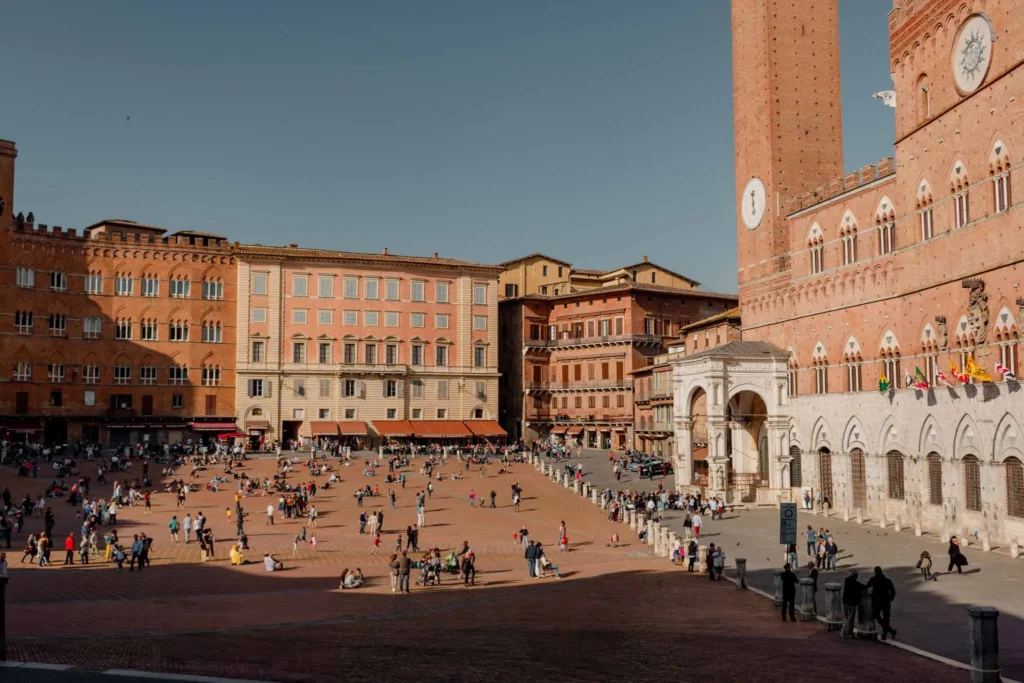
Make your way to one of Italy’s most iconic and grand squares to start off your day trip. The Piazza del Campo is the heart of the city, with both the City Hall and Tower (Torre de Mangia) at its center. When you get to the Piazza del Campo, you’ll see why it’s so well known and well loved. It’s a semi-circular piazza, in a bowl-like shape, surrounded by beautiful red-brick buildings. This is the heart and soul of Siena, not to mention one of its most distinct landmarks.
Il Campo is Siena’s social hub, where locals and tourists gather to enjoy a drink or bite to eat. It was built with the intention of all the locals being able to meet there for events, games and socialising. It’s still doing its job of bringing people together, as you’ll see from the amount of people sitting on its curved base, eating, drinking and chatting. During the summer, the square transforms into a race track for the Palio di Siena. This popular horse race takes place twice a year and is undoubtedly one of the most spectacular events to witness in Italy.
At the top center of the square is the Fonte de Gaia, or Fountain of Joy. This elegant marble fountain is a replica of the original masterpiece sculpted by Jacopo della Quercia in the 15th century. The Fonte Gaia fountain (also in the Piazza del Campo) has been watering the locals since the 15th century. The original is now held in the Loggia of the Palazzo Pubblico though and the fountain you see today was built in the 19th century. Still pretty old though. Watch out for aggressive local pigeons. For those interested in seeing the original, it is located inside the Santa Maria della Scala, which is part of your itinerary later in the day.
If you’re looking to have breakfast in Siena, then head to my favorite cafe near Il Campo for a bite to eat. Torrefazione Fiorella is a truly local cafe that makes delicious cappuccinos and offers a selection of traditional Italian pastries. My go-to is the brioche stuffed with crema.
Where Power and Beauty Converge
The Piazza del Campo is where you’ll find the Palazzo Pubblico, the city hall, and within that, the Museo Civicio, civic museum. The latter houses a famous fresco called ‘Allegory of Good and Bad Government’, dating to the 14th century when it was commissioned by the secular government rather than the church—very unusual for its time and for Italy. Of course, there’s also a chapel inside with its own religious frescoes. If this sounds like your cup of tea, you can buy a combined ticket that also lets you go up the following landmark.
Climbing Toward the Sky
After a quick walk around Il Campo, make your way to the Palazzo Pubblico (City Hall) where you’ll need to purchase tickets to climb the city’s famed tower, Torre del Mangia. The crowning glory of the Piazza del Campo is the Torre del Mangia, which is probably the most instantly recognisable thing in Siena.
Tickets to climb the tower often sell out by mid-day, so we recommend arriving right at 10:00 AM when ticket sales open. If you’re planning on climbing the tower later in the day, it’s best to purchase your tickets first thing in the morning before visiting other sights. Standing at 334 feet (102 meters), the Torre del Mangia is one of the tallest towers in Italy.
Constructed in the mid-14th century, it earns its nickname “mangia” from its Giovanni di Balduccio, the tower’s first bell ringer. He was known for wasting away his earnings, which is aptly reflected in its name. Torre del Mangia literally translates to “tower of the earnings-eater.” Be prepared for a climb of over 400 steps. The reward at the top of the tower is well worth it, with incredible panoramic views of Siena. Time at the top is limited to 15 minutes per group, so make the most of it. In total, your visit will last 30 minutes.
You can climb up the tower, as mentioned above, if you really want to. However, as you’ve only got one day in Siena and this can take up a fair chunk of time, I’d recommend saving your tower-climbing energy and time for later, when you absolutely must climb to the top of the cathedral.
As we mentioned previously, tickets for the tower are not available online. You must visit the City Hall and buy your tickets in person from the ticket office. During peak season, from May through September, tickets often sell out by the afternoon. To avoid missing out, we recommend arriving at the ticket office as early as possible, ideally right when it opens at 10:00 AM. You have the option to reserve a time slot for later in the day as well.
From March to October, the tower is open daily between 10:00 AM and 7:00 PM. The ticket office closes at 6:15 PM. From November to February, the tower is open daily from 10:00 AM to 4:00 PM. The ticket office closes at 3:15 PM. Time slots are available every 45 minutes, and the visit is limited to 30 minutes per group.
You can either purchase a single ticket for the tower, or you can buy a combined ticket to visit the tower plus a couple of other sights. Torre del Mangia costs €10. Torre del Mangia plus Museo Civico is €15. Torre del Mangia plus Museo Civico plus Santa Maria della Scala is €20. We recommend purchasing option number three to save money.
When Frescoes Tell Stories
The Civic Museum is also located inside of the Palazzo Pubblico and is home to some of the city’s most exquisite frescoes. These remarkable artworks, painted by the Sienese pictorial school from the 14th to the 19th centuries, adorn the series of grand halls. It takes about an hour to go through the palace. I only recommend visiting if you have a full day in Siena; otherwise, skip it for the other activities below.
From November to February, the museum is open from 10:00 AM to 6:00 PM. From March to October, opening hours are 10:00 AM to 7:00 PM. Single tickets cost €6 per person. Combined ticket options are available—we recommend getting the second option below. Torre del Mangia plus Museo Civico is €15. Torre del Mangia plus Museo Civico plus Santa Maria della Scala is €20.
Where Pilgrims Once Rested
Situated in Piazza del Duomo, Santa Maria della Scala is a former hospital dating back to the Middle Ages. For centuries, it served as a refuge for pilgrims and children, and was in operation until the late 1900s. This building is one of the oldest hospitals in Europe, but is now an unusual (and massive) museum.
Today, you can explore this historic complex and its various attractions, including medieval frescoes, a Children’s Art Museum, an Archaeological Museum, a church, and the Piccolomini Spannochi art collection. It’s full of frescoes, underground tunnels, relics and art—be warned, get a map of it when you enter or you may get lost and miss your train! So only venture in if you have an hour or so spare.
There is so much to see here that it can be a bit overwhelming. Two highlights not to be missed are: the original marble pieces of the Fonte Gaia, whose replica is located in Il Campo square, and Pellegrinaio Hall (Pilgrim’s Hall), which is covered in vibrant 15th century frescoes that tell stories of the hospital’s past.
When I visited, there wasn’t much in English, so if you’re into reading about the history then you might need to brush up on your Italian. But it’s more about the atmosphere than anything else. Some of the frescoes show daily life from when it was a working hospital, such as a surgeon sorting out some poor chap’s infected wounds and someone else giving a urine sample. Lovely stuff for just after your lunch.
If you are short on time, make sure to visit the two sights above. Otherwise, you can take your time to visit the other museums within the complex. From March 15 to October 31, the complex is open from 10:00 AM to 7:00 PM. Between November 1 and March 14, opening hours vary. Check the official website for up to date information. Full price tickets cost €9. We recommend purchasing the combined ticket below to save money: Torre del Mangia plus Museo Civico plus Santa Maria della Scala for €20.
Fueling Up the Tuscan Way
Taking a day trip to Siena gives you the opportunity to try some local Sienese cuisine! If you eat meat and cheese, you’re probably going to be in your element in Tuscany, and in Siena. It’s home to a lot of dishes involving boar, sausages, hare, and of course the local pecorino cheese.
For a quick lunch, Pizzeria Poppi Ivano is a solid choice for pizza by the slice. Try the Ciaccino, a local specialty made of thin foccacia bread stuffed with Prosciutto and mozzarella. Both Osteria degli Svitati and Compagnia dei Vinattieri are good sit-down restaurant options that serve homemade pasta dishes. Make sure to call ahead and reserve a table in advance.
If like me, you don’t eat meat or cheese, don’t worry. There’s plenty of Chianti wine. What do you mean you need to eat as well as drink? If you want a vegan or veggie lunch in Siena, I’d recommend Oasi Verde. At the time of both my visit and of writing this blog post, vegan options were thin on the ground in Siena. Much the same as the rest of Tuscany, you have to do your research. Such as by reading an excellent travel blog before you go—ahem.
This was the only central option. Luckily it was a good one. Oasi Verde is a little deli café and you can sit in or take some food away to eat outside if the weather’s good. Most of the deli options are vegan, and there are even vegan desserts.
If you’re in Siena with non-veggie friends and end up finding yourself in a very meat-and-cheese-based restaurant situation, a good option to look out for on any Tuscan menu is always ribollita, a tasty soup thickened with bread. Just be careful it’s definitely not had any meat added. Traditionally it’s just veg, but I noticed a few cafés around Tuscany had snuck pancetta on top. Ribollita is a popular Tuscan soup that is made with cannellini beans and thickened with bread. It’s one of my favorite Italian dishes!
Wild Boar is something you’ll find—this popular Tuscan meat in both pasta dishes, served as a ragu, and second courses. It may not sound the most appetizing, but when cooked right, it’s extremely tender and flavorful. Pici is a thick and round noodle pasta that is served all over Tuscany. You’ll find it with all sorts of sauces, but the most popular dish in Siena is Pici all’Aglione, made with a garlic and tomato sauce.
The Cathedral Complex That Steals Afternoons
After lunch, the bulk of your afternoon will be spent at the Duomo di Siena, the city’s magnificent cathedral. Plan on spending 2-3 hours to see everything here. Siena’s Gothic cathedral is considered one of the most beautiful in Europe. Even if you’re not into cathedrals, it’s worth seeing and is one of the highlights of the city. Its green-and-white-striped interior is even more impressive than Florence’s duomo, and the exterior is pretty snazzy too, with one of the most detailed facades I’ve seen on all my travels.
With several ticket options, it can be a bit confusing deciding which one to choose, so let’s simplify it. There are three main ticket types for the Duomo. Cathedral ticket at €7 full price—this pass grants entry to the Cathedral and Piccolomini Library. Opa Si Pass at €16 full price—this option includes access to the Cathedral, Piccolomini Library, Cathedral Museum, Crypt, Baptistry, and Panorama. Gate of Heaven Pass at €23 full price—includes all the benefits of the Opa Si Pass, plus exclusive access to the cathedral’s rooftop.
So what pass should you get? It depends on your budget and time. If you have 2-3 hours, we highly recommend getting the Gate of Heaven Pass for its amazing views from the cathedral’s roof. However, if you only have an hour, either the Cathedral Ticket or Opa Si Pass is still worth it to get a glimpse at the interior! Purchase your tickets online in advance, especially during the peak season from May to September. To avoid waiting in line or missing out on the Gate of Heaven, try to secure your tickets at least a few weeks before your visit.
While you’re there, you can also pop into the adjoining Piccolomini Library, which has a very impressive ceiling. It was closed when I was there, so make sure you visit on a day it’s open if you want to see it. Unless you’re there at a very busy time (like the middle of summer), you don’t need to book a ticket ahead. When I went, there was no queue to get in.
There is a lot to see inside of Siena’s Duomo complex, and you need to be strategic in planning your visit. If you opt for the Gate of Heaven Pass, the reserved time on your ticket is the starting time of your rooftop tour. Make sure to arrive 20 minutes early to get to the starting point on time.
If you purchase the Opa Si Pass, arrive at the reserved time and proceed directly to the line for the Panorama, located inside the Cathedral Museum. This line can get long and you may end up waiting 30 minutes to an hour, which is why we suggest starting your visit with this. After you’ve finished your tours, feel free to wander through the rest of the complex at your leisure.
Constructed in the 13th century, Siena’s cathedral is one of the most magnificent in Italy. It features striking black and white marble, with striped marble columns and intricately inlaid marble floors. The cathedral’s pulpit was designed and sculpted by Nicola Pisano in the mid-1200s. Additionally, there are many artworks throughout the building by famous artists, such as Michelangelo, Donatello, and Bernini.
Adjacent to the cathedral, the Piccolomini Library was established in the late 1400s to honor Pope Pius II (Aeneas Silvius Piccolomini). The library is renowned for its vibrant frescoes by Pinturicchio, which decorate the walls and ceilings above the historic manuscripts.
In 1339, ambitious plans to expand the cathedral were set in motion, but the project was tragically cut short by the Black Death in 1348, leaving the “New Cathedral” unfinished. Today, you can stroll atop the remaining walls of the outer facade, enjoying breathtaking panoramic views of Siena’s city center.
The Duomo Museum offers an intimate look at some of the cathedral’s most significant artworks, including the Rose Window by Duccio di Buoninsegna and sculptures by Donatello, Pisano, and Jacopo della Quercia.
Beneath the cathedral lies the crypt, originally the site of the 12th-century church that preceded the existing structure. It houses exquisite 13th-century frescoes that are worth seeing.
The Baptistry of San Giovanni Battista is a fine example of Renaissance art. The Baptismal Font, built by notable artists including Donatello and Jacopo della Quercia, was sculpted in the 15th century. Its ceiling is adorned with frescoes that were painted by several Sienese artists, also in the 15th century.
Views That Make You Forget Time
Siena has a good few viewpoints around the city, but if you only have one day there then I’d recommend prioritising the best one, which I reckon is the Porta del Cielo, on the rooftop of the duomo. The views here are unbeatable. Get your camera at the ready.
The District Game
Before the end of your Florence to Siena day trip, keep your eye out for what contrada you’re in as you stroll round the city. Siena’s contrade (districts) are all marked by some kind of insignia. There’s an eagle, a wave, or a crested porcupine (obviously?!). These are on flags usually, so look up! There used to be over 50 contrade but there are only 17 in the modern day. No excuse not to spot at least half of ’em.
When the Sun Starts Setting
After a full day of sightseeing in Siena, take some time to stroll through the charming medieval streets of the old town. I love getting lost in historic places and taking it all in. If you are up for another church visit, then we recommend walking to the other side of Siena to the Basilica of San Domenico. Take a quick look around this massive Gothic church. It’s pretty basic inside, but the walk to get here is lovely. If you’re looking for the best panoramic views of Siena, head to this viewpoint.
For dinner, we recommend La Taverna di San Giuseppe, one of Siena’s most acclaimed restaurants, which is also included on the Michelin Guide. Call ahead to reserve a table—it’s popular and difficult to get a last minute reservation. Order one of their seasonal dishes or try something local like wild boar.
Beyond the Day Trip
If one day in Siena isn’t enough, you can stay there. Imagine waking up and looking out of the window at all the beautiful rooftops and hearing the church bells pealing out. Actually no, scrap that last bit. Church bells waking you up first thing in the morning is enough to drive anyone to murder. But the nice image still stands.
There aren’t many affordable places to stay in Siena, but here are a couple of good options that won’t break the bank too much. Prices are at the time of writing, as ever. Relais degli Angeli—just a 10-minute walk from the cathedral, this swanky little number ticks all the Italian charm boxes. It’s not cheap at £97 a night (mid-week in April) but it’s highly rated. Hotel Palazzo di Valli—slightly less painful at £88 a night, this one is just as lovely (again, mid-week in April prices). It’s bang in the centre, too—a stone’s throw from all the good stuff.
If you’re staying in Siena longer, you could also cover more of the surrounding areas like the lush green valley of Val d’Orcia.
Tours Worth Considering
Siena Cathedral and City Walking Tour—visit the Duomo and other historical sights with an expert guide on this 2-hour walking tour. Siena Walking Food Tour—enjoy a taste of Siena’s delicacies on this food tour, which includes a glass of Chianti wine. Tuscan Cooking Class—cook an entire Tuscan meal, including hand-made pasta, during this cooking class in the heart of Siena. Cooking Class at a Winery—enjoy an authentic cooking class at this countryside estate, where you’ll prepare your Tuscan meal with stunning views of the vineyards.
The Map You Need
This map includes the best things to do on your Florence to Siena day trip, including restaurants, sights, and parking options. To save the map to Google Maps on your phone or computer, click on the star next to the title. Once you do this, you’ll be able to find the map in your “saved maps” list on your phone. To see a list of all the items on the map, click the box with arrow on the left. To enlarge the map, click the box on the right.
Essential Italy Planning
Italy Travel Insurance—we always get travel insurance before all of our trips for peace of mind. Check out Travel Insurance Master to find the best plan for you. Italy Rental Cars—we’ve rented a car in Italy many times, and it’s definitely the most convenient way to get around the countryside. We rented our car through Discover Cars (our go-to rental agency), which helps you find the best rates no matter where you are traveling.
Italy Phone Plans—if your phone plan does not offer free coverage in Italy, then we suggest getting an eSIM. We used Airalo during our trip to Italy, and we had fantastic coverage the entire time. It’s easy to download and you can even top up via the app if needed. Italy Hotels—wondering where to book your accommodations for Italy? We’ve been reserving all of our hotels through Booking for years. Their messaging tool makes it easy to communicate with the hotels, and there are endless options to choose from.
Is a day trip to Siena from Florence worth it?
Yes, a day trip to Siena is worth it! One day is the perfect amount of time to explore the city’s main attractions. Plus, Florence is just a short distance away, so the travel time between cities isn’t overwhelming. Keep in mind that this itinerary is packed. It will be a full, non-stop day of sightseeing. Make sure to arrive in Siena early in the morning at 9:00 AM and plan on leaving later at night—8:30 PM to 9:00 PM.