Updated February 2025 | By The Travel Wolf
While tourists crowd Parma’s prosciutto shops and queue for Bologna’s towers, smart travelers are discovering Piacenza—just 45 minutes from Milan but worlds away from tourist prices and selfie sticks. This perfectly preserved Renaissance city offers five museums under one roof, PDO-protected food at local prices, and a Klimt painting with a theft-and-recovery story that rivals any art heist movie.
The best part? You’ll have spectacular frescoed churches and medieval piazzas almost entirely to yourself.
After spending two days exploring Piacenza during a spontaneous Emilia-Romagna road trip, I discovered why this “Firstborn of Italy” (the first city to vote for Italian unification) remains blissfully absent from most tourist itineraries—and why that’s exactly what makes it special.
Quick Facts About Piacenza
Table of Contents
Toggle| Detail | Information |
|---|---|
| Region | Emilia-Romagna, Northern Italy |
| Population | ~103,000 |
| Distance from Milan | 61 km (38 miles) |
| Train Time | 22-64 minutes (depending on service) |
| Known For | Coppa Piacentina DOP, Palazzo Farnese museums, Via Francigena pilgrimage route |
| Historic Significance | Called “Primogenita d’Italia” (Italy’s firstborn) |
| Best For | Authentic Italy, art museums, food lovers, Milan day-trippers |
Is Piacenza Worth Visiting?
Short answer: Absolutely—if you value authentic experiences over Instagram hotspots.
Here’s why Piacenza deserves your time:
✅ Unbeatable Milan proximity – Closer than Florence, Venice, or Cinque Terre (45 minutes vs 2+ hours)
✅ Five museums, one €10 ticket – Palazzo Farnese houses archaeology, paintings (including Botticelli), carriages, medieval weapons, and the Etruscan Liver—a bronze divination tool from 100 BC that’s genuinely one of the coolest artifacts you’ll see in Italy
✅ PDO food at local prices – Coppa Piacentina and Grana Padano cheese cost 30% less than in Parma, with zero tourist markup
✅ Klimt’s stolen masterpiece – The Ricci Oddi Gallery displays Gustav Klimt’s “Portrait of a Lady,” which was stolen in 1997 and mysteriously reappeared in 2019
✅ Zero crowds – As one Reddit traveler put it: “After spending 2 days in Piacenza last month, we both agree that the town was a really pleasant surprise. Totally cut off from tourist itineraries but very pleasant.”
When to skip Piacenza: If you only have 3-4 days in Northern Italy, prioritize Verona, Parma, or Modena first. But if you’re spending a week or more—or looking for a perfect Milan day trip—Piacenza delivers authentic Emilia-Romagna charm without the tour buses.
How Many Days Do You Need in Piacenza?
The ideal time depends on your travel style and what you want to combine:
| Duration | What You Can See | Best For |
|---|---|---|
| 3-4 Hours (Half Day) | Piazza Cavalli, Duomo interior, Palazzo Farnese (2 museums), quick lunch at an osteria | Milan day-trippers with limited time |
| 6-8 Hours (Full Day) | All main attractions + Ricci Oddi Gallery, proper lunch with pisarei e fasò, Sant’Antonino, leisurely exploration | Most recommended; perfect balance |
| 2 Days | All city sights + day trip to Val Trebbia river (swimming/nature) OR Castell’Arquato medieval borgo + wine tasting | If staying overnight or combining with nearby destinations |
| Combo Strategy | Piacenza (morning) + Cremona (afternoon) in one day—they’re only 30 minutes apart by train! | Hidden gem itinerary few travelers discover |
My recommendation: Budget a full day (6-8 hours). You could technically “see” the highlights in 3 hours, but Piacenza rewards slow exploration. The joy here isn’t checking boxes—it’s lingering over a 2-hour lunch at Osteria del Trentino while locals debate football, or climbing the Cathedral dome to see Guercino’s frescoes up close.
Best Time to Visit Piacenza
Piacenza works year-round, but timing affects your experience significantly:
Month-by-Month Guide
| Season | Months | Temperature | Pros | Cons |
|---|---|---|---|---|
| Winter | Dec-Feb | 40-50°F (4-10°C) | €1 museum entry (first Sunday), Christmas markets, zero crowds | Cold, some restaurants close for holidays |
| Spring | Mar-May | 55-70°F (13-21°C) | BEST OVERALL – Ideal weather, food festivals, Val Trebbia season starts | Easter crowds (still minimal) |
| Summer | Jun-Aug | 75-86°F (24-30°C) | Val Trebbia swimming at peak, long daylight hours, aperitivo culture thrives | Hot midday sun, some locals away in August |
| Fall | Sep-Nov | 60-70°F (16-21°C) | Wine harvest season, comfortable temps, Piacenza Jazz Fest | November = rainiest month |
Special Events Worth Timing
- Piacenza Jazz Fest (Spring) – Nationally important jazz event
- Colli Piacentini Wine Festivals (September-October) – Harvest celebrations in surrounding wine country
- First Sunday of Every Month – Palazzo Farnese entry drops to just €1 (normally €10)
- Christmas Market (December) – Traditional Emilian market, much less touristy than German-style markets
Best months: April-June and September-October deliver ideal weather without extremes. If you’re planning Val Trebbia river swimming (highly recommended), visit June-September when water levels are perfect.
Avoid if possible: November (rainiest month, though Piacenza still charms in the rain).
Getting to Piacenza: The Complete Transportation Guide
Piacenza’s strategic position between Milan, Bologna, and Genoa makes it surprisingly accessible—but there are important tricks to know.
From Milan to Piacenza: The 45-Minute Advantage
This is THE reason to visit Piacenza. It’s closer to Milan than most famous Italian destinations:
- Piacenza: 45 minutes
- Florence: 2 hours
- Venice: 2.5 hours
- Cinque Terre: 3+ hours
Train Options Compared
| Train Type | Duration | Cost (One-Way) | Frequency | Best For |
|---|---|---|---|---|
| Frecciarossa (High-Speed) | 22-27 min | €9-11 | ~33 trains/day | Speed & comfort; worth the small premium |
| Intercity | 48 min | €10-13 | Every 4 hours | Mid-range option |
| Regionale (Regional) | 45-64 min | €7.40-10 | Hourly | Budget travelers; nearly as fast as Intercity |
⚠️ CRITICAL WARNING: Some trains labeled “Regionale” take 2+ hours. On Trenitalia, check the actual duration before booking—the name doesn’t always match the speed!
Train Strategy for Day Trips
Morning departure options:
- 05:05am – First train (for early birds wanting full day)
- 08:05am – Sweet spot (arrive ~9am, beat crowds)
- 09:31am – Still works (arrive for 10am museum openings)
Evening return options:
- 19:43pm – Early return (good if tired)
- 21:05pm – Standard return (catch sunset + aperitivo)
- 23:31pm – Last train (allows full dinner + night walk)
Pro tip: The 23:31pm last train gives you incredible flexibility. Unlike other day trips where you rush to catch 6pm trains, Piacenza lets you enjoy a proper Italian dinner, watch the city light up at night, and still make it back to Milan.
Where Trains Depart/Arrive
- Milan: Milano Centrale (main station)
- Piacenza: Piacenza station (15-minute walk to historic center, or 10-minute bus)
Book tickets: Trenitalia.com or at the station. Tickets don’t sell out for regional trains, but high-speed Frecciarossa has limited seats—book 1-2 weeks ahead for best prices.
From Bologna to Piacenza
- Train time: 90 minutes direct (some routes take 2 hours—check duration)
- Cost: €12-19 depending on service
- Frequency: Hourly connections
- Driving: 2 hours via A1 autostrada
Insider strategy: If driving from Bologna, stop in Parma (1 hour from Bologna, 24 minutes to Piacenza) for a “two cities, one day” itinerary. Bologna → Parma (morning) → Piacenza (afternoon) works beautifully.
From Parma to Piacenza
This is the most underrated connection in Emilia-Romagna:
- Train time: 37-48 minutes
- Cost: €6 (cheapest route!)
- Frequency: Every 30-60 minutes
- Driving: 45 minutes via SS9
Why combine them: Parma gets all the fame, but Piacenza offers 80% of the charm at 60% of the price with 5% of the crowds. Spending half a day in each gives you the full Emilia-Romagna experience.
From Other Cities
| Origin | Train Time | Cost | Driving Time | Notes |
|---|---|---|---|---|
| Cremona | 30 minutes | €6-8 | 40 minutes | Rarely mentioned but perfect combo trip! |
| Genoa | No direct train | N/A | 2 hours | Must drive or connect through Milan |
| Verona | 2 hours | €15-20 | 1h 45min | Possible but not ideal as day trip |
Hidden gem alert: The Piacenza + Cremona combo (30 minutes apart) creates a perfect “two hidden cities” day that almost no tourists discover. Piacenza in the morning, Cremona’s violin museums and torrone in the afternoon.
Driving to Piacenza: Parking & ZTL Guide
If you’re driving:
✅ Pros: Flexibility to explore Val Trebbia, Castell’Arquato, and wine country ❌ Cons: ZTL (Limited Traffic Zone) restrictions in historic center
Parking Options
- Free parking: Near train station (Piazzale Marconi area)
- Paid parking: Parcheggio Facsal (Via XXIV Maggio) – €1.50/hour, €12/day
- ZTL hours: 8am-7pm daily with camera enforcement
Pro tip: Park near the station and walk 15 minutes into the historic center. Piacenza is completely flat and walkable—you don’t need a car once you arrive.
Local Transportation in Piacenza
Good news: You won’t need it.
- Walkability: The entire historic center fits within a 1.5km radius
- Longest walk: Train station → Palazzo Farnese = 20 minutes maximum
- Terrain: Completely flat (great for all fitness levels)
- Bike rental: Available but unnecessary for city sightseeing
Exception: If visiting Val Trebbia river (45km away), you’ll need a car or organized tour.
17 Best Things to Do in Piacenza, Italy
Now let’s dive into what makes Piacenza special. I’ve organized these from must-see attractions to hidden gems, with realistic time estimates and insider tips based on my visits and extensive traveler research.
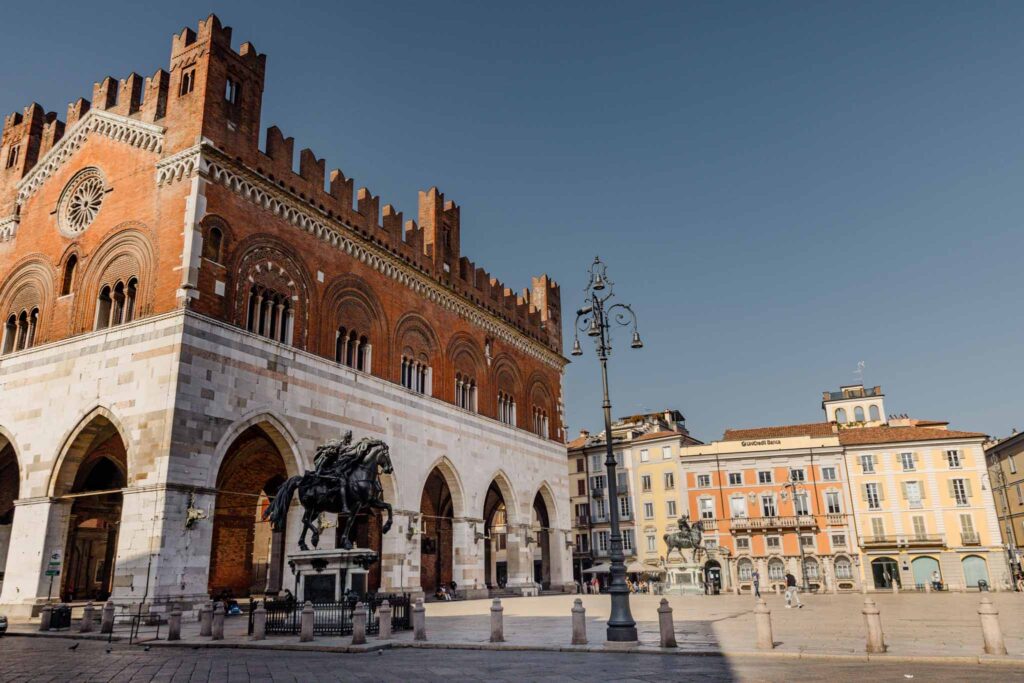
1. Marvel at Piazza Cavalli (Horses Square)
What it is: The dramatic heart of Piacenza, dominated by two bronze equestrian statues and the Gothic Palace backdrop.
Why visit: This is where Piacenza reveals its character. The square takes its name—”Horses Square”—from two imposing 17th-century statues representing Pope Alexander and his son Ranuccio, both members of the Farnese family who ruled Piacenza for nearly 200 years. Local legend claims these father and son, immortalized together for eternity, actually despised each other during their lifetimes.
The atmosphere here shifts beautifully throughout the day. Morning brings locals grabbing espresso before work, afternoon sees tourists photographing the Gothic architecture, and evening transforms the square into aperitivo central as golden light spills across ancient stones.
Time needed: 30-45 minutes (longer if you stop for coffee or aperitivo)
Insider tip: Visit at three different times if possible—early morning for that perfect photo without other tourists, midday to see it bustling with local life, and just before sunset (around 7pm in summer) for the best light on the Palazzo Gotico facade.
Practical info:
- Location: Historic center, where Via Emilia crosses Via XX Settembre
- Cost: Free
- Best photo spot: Northwest corner captures both horse statues with Palazzo Gotico behind them
What surrounds the square:
- Palazzo Gotico (see #2 below)
- Palazzo del Governatore opposite
- San Francesco basilica visible to the side
- Cafés and restaurants lining the perimeter (Caffè Grande recommended for morning cappuccino)
2. Admire Palazzo Gotico (Gothic Palace)
What it is: A stunning 13th-century civic palace representing northern Italy’s medieval tradition of citizen-governed “communes” rather than imperial rule.
Why visit: This building symbolizes something profound: local freedom. Unlike many Italian cities ruled by foreign powers or aristocratic dynasties, Piacenza’s citizens administered their own justice and governance here. The local newspaper is still called “La Libertà” (Freedom) in honor of this heritage.
Architecturally, it’s fascinating—only the north side was completed before plague halted construction. The contrast is visible: pink marble (sometimes appearing white depending on light) forms the bottom, while brick completes the upper section. This “unfinished” quality gives it character that perfect Renaissance symmetry lacks.
Time needed: 15-20 minutes (exterior only; interior not open to public)
Insider tip: Look for the replica statue of Virgin with Child in a niche on the facade. The original now rests safely inside the Civic Museum, protected from weather damage. A 14th-century chronicle claimed that when the tower was completed, “three hundred crows and heels appeared” on it—whether literally true or metaphorical, it reinforced the building’s importance to local identity.
Practical info:
- Location: Piazza Cavalli (same square as the horse statues)
- Cost: Free (exterior viewing only)
- Interior access: Unfortunately closed to public; now municipal offices
- Architecture style: Lombard Gothic with unfinished sections
- Height: Tower rises ~40 meters with spiral staircase inside (not accessible)
Historical context: Known elsewhere in Italy as “Broletti” or “Palazzi della Ragione,” these civic palaces represented medieval democracy in action—a sharp contrast to the Farnese dynasty’s later authoritarian rule.
3. Explore Palazzo Farnese: 5 Museums Under One Roof
What it is: The former palace of the Farnese dynasty, now housing five separate museums with collections spanning archaeology to Renaissance art to royal carriages.
Why visit: This is Piacenza’s crown jewel and where you should allocate most of your museum time. For €10, you get access to an overwhelming variety: Etruscan artifacts, medieval weapons, Botticelli paintings, ornate carriages, and one of the coolest archaeological objects you’ll see anywhere—the Etruscan Liver (Fegato Etrusco).
This bronze model of a sheep’s liver from ~100 BC was used for divination, with sections labeled for different gods. One traveler on Reddit called it “one of the coolest exhibits I’ve ever seen”—and they weren’t wrong. It’s incredibly specific, beautifully preserved, and completely unique.
The palace itself tells a story of dynastic ambition cut short. Margherita d’Austria, consort of Ottavio Farnese, wanted a palace worthy of their power. Construction began in the 1500s by expanding a previous Visconti fortress, but when the capital moved to Parma, interest evaporated. Work was abandoned after ~40 years, leaving the building permanently “unfinished.” Yet this incomplete state has its own appeal—raw ambition frozen in stone.
Time needed: 3-4 hours for all five museums; 60-90 minutes if you focus on 1-2 sections
The Five Museums Inside:
- Archaeological Museum – Roman finds, the famous Etruscan Liver
- Carriage Museum – Elaborate royal transportation through the centuries
- Medieval Weapons Collection – Arms and armor from various periods
- Civic Paintings Gallery – 14th-19th century art including Botticelli’s “Madonna Adoring Jesus with San Giovannino”
- Risorgimento Museum – Italian unification history (Piacenza was “Italy’s firstborn”)
Insider tips:
- First Sunday of every month: Entry drops to just €1 (normally €10)—incredible value!
- Free guided tours: Saturdays and Sundays at 10am, 11:30am, 3pm, and 4:30pm (included with ticket)
- Don’t skip the Archaeological section: Most visitors rush to the paintings, but the Etruscan Liver and Roman artifacts are equally fascinating
- Staff are helpful but limited English: Basic Italian phrases or a translation app helps
Practical info:
- Hours: Tue-Fri 10am-1pm & 3pm-6pm; Sat-Sun 10am-6pm; Closed Mondays
- Cost: All 5 museums €10; Single section €3
- Special deal: First Sunday monthly = €1 entry!
- Location: Just off Piazza Cavalli, impossible to miss (it’s huge)
- Website: Check Musei di Palazzo Farnese for current exhibitions
Multi-day passes available:
- “Un anno di bellezza” (Year of Beauty): €50 for unlimited annual access to 10 museums
- “Tre giorni al museo” (3-day pass): €35 (€20 reduced for ages 6-26 & 65+)
4. Visit Cattedrale Santa Maria Assunta e Santa Giustina (The Duomo)
What it is: Piacenza’s stunning 12th-13th century Romanesque cathedral, built with the same pink regional marble that defines Emilia-Romagna’s architectural identity.
Why visit: Those who claim the great Romanesque cathedrals along Via Emilia exist only in Parma and Modena are making a genuine mistake. True, Piacenza’s cathedral doesn’t immediately announce itself with the same theatrical plaza setting, but once you step inside, the soaring pillars, Latin cross layout, and magnificent frescoes reveal why it deserves equal billing.
The building was commissioned by a pope preparing to hand the Duchy over to his son—he wanted Piacenza to look more beautiful for the transition. That papal vanity created something remarkable: a cathedral that rewards close attention rather than demanding it from a distance.
What makes it special: The frescoes decorating the vaults and tiburium (the dome structure) are breathtaking, though they’re distant and challenging to appreciate from ground level. Which brings us to the cathedral’s secret weapon…
Time needed: 30-45 minutes for interior; add 45-60 minutes if climbing the dome (recommended!)
Insider tip: The real magic happens when you climb inside the dome (see #5 below for details). From ground level, you’re squinting at distant ceiling paintings. From inside the dome structure, you’re standing inches from Guercino’s masterful frescoes, seeing brushstrokes and details impossible to appreciate otherwise.
Practical info:
- Hours: Daily 8:30am-12:30pm & 3:30pm-7:30pm (open 7 days/week)
- Cost: Free entry to cathedral
- Location: Via XX Settembre leads directly from Piazza Cavalli to the Cathedral
- Architecture: Romanesque, 12th-13th century
- Material: Pink marble from the region (appears white in certain lighting)
- Layout: Classic Latin cross plan
Don’t miss inside:
- Guercino frescoes in the dome
- Impressive pillar thickness and proportions
- Central nave vault paintings
- The quiet side chapels (less visited but beautifully decorated)
5. Climb the Duomo Dome (Cathedral Dome Tour)
What it is: A guided climb up 136 steps inside the Cathedral dome structure to see Guercino’s frescoes at eye level—an experience few Piacenza visitors know exists.
Why visit: This is hands-down one of the most underrated experiences in all of Emilia-Romagna. While everyone stares up at ceiling frescoes from church floors across Italy, Piacenza lets you climb inside the dome structure itself. Suddenly, you’re face-to-face with 17th-century artworks, seeing details, brushstrokes, and perspective tricks that are completely invisible from below.
The frescoes by Guercino (Giovanni Francesco Barbieri) are magnificent—his dramatic use of light and foreshortening creates illusions of depth that only make sense when viewed from multiple angles. Being able to walk around at dome level transforms this from “pretty ceiling paintings” to “holy shit, how did he calculate these perspectives?”
Time needed: 45-60 minutes total (includes guided portion)
Insider tip: Access begins from the garden at Via Prevostura 7 (behind the church), where you’ll also find the Kronos Cathedral Museum offering multimedia presentations. From 12:30pm to 3:30pm on Saturdays, volunteer members of the Italian Touring Club (TCI) lead guided climbs through their “Open for You” initiative—essentially free with your €10 dome ticket.
The 136 steps aren’t particularly challenging (spiral staircase), but the narrow passages mean this isn’t ideal if you’re claustrophobic or have severe mobility limitations.
Practical info:
- Access point: Via Prevostura 7 (garden behind cathedral)
- Hours: Saturday 12:30pm-3:30pm (Italian Touring Club volunteers)
- Cost: €10 for guided dome climb
- Steps: 136 (spiral staircase, manageable for most fitness levels)
- Not suitable for: Severe claustrophobia, very limited mobility, young children
- Language: Italian primarily, but visual experience speaks for itself
- Bonus: Kronos Cathedral Museum at same location (multimedia presentations)
What you’ll see:
- Guercino’s frescoes at eye level (incredible detail)
- Dome structure and Renaissance building techniques
- 360-degree views from upper levels
- Perspective tricks that only work from specific viewing angles
6. Discover Klimt’s Stolen Masterpiece at Galleria Ricci Oddi
What it is: A modern art gallery housing 700+ works (18th century to present), famous for Gustav Klimt’s “Portrait of a Lady”—which was stolen in 1997 and mysteriously recovered in 2019.
Why visit: The art heist story alone makes this worth visiting. In February 1997, thieves stole Klimt’s “Portrait of a Lady” during gallery renovations. For 22 years, it vanished. Then in December 2019, a gardener working on the gallery’s exterior discovered a hidden panel in the building’s wall. Inside? The missing Klimt, wrapped and protected, sitting exactly where someone had concealed it two decades earlier.
Was it hidden by the thieves? A remorseful accomplice? An inside job? The mystery remains unsolved, but the painting is back—and seeing it after knowing its story adds layers of intrigue to Klimt’s already mesmerizing work.
Beyond the Klimt, this collection represents Italian art beautifully. The Tuscan Macchiaioli movement is particularly well-represented (Giovanni Fattori, Telemaco Signorini, Silvestro Lega), along with works by Boldini, Boccioni, Carrà, and Morandi.
Time needed: 60-90 minutes
Insider tip: The route from the Cathedral to Ricci Oddi takes you past Basilica Sant’Antonino with its curious octagonal tower—worth a 15-minute detour. You can also stop at Santa Maria in Cortina on Via Giuseppe Verdi (opens Saturdays in early afternoon via Italian Touring Club volunteers).
Practical info:
- Hours: Closed Mondays; Tue-Thu mornings only; Fri-Sun 10am-1pm & 3pm-6pm (break 1-3pm)
- Cost: €6-8
- Location: Via San Siro (former San Siro convent, converted by architect Giulio Ulisse Arata)
- Collection size: 700+ pieces (200+ on display at any time)
- Best for: Modern art lovers, mystery enthusiasts, anyone wanting a break from medieval/Renaissance focus
Artists represented:
- Gustav Klimt (the stolen “Portrait of a Lady”)
- Giovanni Boldini (stunning “Portrait of a Lady” – different from Klimt’s)
- Macchiaioli masters: Fattori, Signorini, Lega
- Italian moderns: Boccioni, Carrà, Campigli, Morandi, De Pisis
7. Visit Basilica Sant’Antonino (Octagonal Tower Church)
What it is: One of Piacenza’s most important churches, recognizable by its unusual octagonal bell tower and significance as a Via Francigena pilgrimage stop.
Why visit: This basilica connects Piacenza to the ancient pilgrimage route stretching from Canterbury to Rome—the Via Francigena. For medieval pilgrims walking hundreds of miles to reach the Holy City, Piacenza represented a crucial waypoint with lodging, food, and spiritual respite. Sant’Antonino served as one of the key pilgrimage churches where travelers could pray, rest, and receive blessings before continuing south.
Today, the Via Francigena is experiencing a renaissance as modern pilgrims (and hikers seeking meaningful long-distance walks) rediscover this historic route. Understanding Piacenza’s role in this centuries-old tradition adds depth to your visit—you’re walking streets that millions of faithful feet have trod over 1,000+ years.
The octagonal tower is architecturally unusual for Emilia-Romagna and creates a distinctive profile on the city skyline.
Time needed: 30-45 minutes
Insider tip: If you’re interested in the Via Francigena pilgrimage culture, this church is your entry point. Staff sometimes have information about the route, modern walking stages, and local pilgrimage traditions. Even if you’re not walking the full trail, learning about it transforms Piacenza from “random Italian city” to “crucial link in European spiritual geography.”
Practical info:
- Location: On the route from Cathedral to Ricci Oddi Gallery (Via Chiapponi/Via Scalabrini)
- Cost: Free entry
- Architecture: Romanesque with distinctive octagonal tower
- Pilgrimage context: Major Via Francigena stop between Canterbury and Rome
- Best combined with: Stop here while walking between Cathedral (#4) and Ricci Oddi Gallery (#6)
8. Admire Pordenone’s Frescoes at Santa Maria di Campagna
What it is: A 16th-century Renaissance jewel designed by local architect Alessio Tramello, featuring an exceptional fresco cycle by Giovanni Antonio de Sacchis (il Pordenone).
Why visit: Il Pordenone’s dramatic frescoes deserve far more international recognition than they receive. His style—bold, theatrical, with incredible foreshortening and dynamic compositions—rivals the better-known Renaissance masters. The fresco cycle here represents some of his finest work, preserved in remarkable condition.
This church also held special significance for the Farnese dynasty, functioning as their ducal church where they celebrated baptisms, military victories, and family events with appropriate ceremony. A plaque commemorates Isabella Farnese, buried here alongside references to her brother Francesco—a reminder of the family’s grip on Piacenza for nearly 200 years.
In religious terms, the church houses the ‘Madonna della Campagnola,’ a polychrome wooden image considered miraculous by generations of pilgrims.
Time needed: 45-60 minutes
Insider tip: The church sits outside the immediate historic center (about 20 minutes on foot from Piazza Cavalli via Via Roma → Via Mazzini → Via S. Tomaso → Via Campagna). If you’re driving, you’ll find it near Porta Borghetto outside the old city walls. Similarly positioned on the opposite end of town is Collegio Alberoni (18th-century building with an Antonello da Messina painting)—both represent major art venues peripheral to the centro storico.
Practical info:
- Location: Via Campagna (outside ramparts, near Porta Borghetto)
- Walking time from Piazza Cavalli: ~20 minutes
- Cost: Free or €5 combo ticket with Cathedral (varies)
- Architect: Alessio Tramello (local Renaissance master)
- Main attraction: Il Pordenone fresco cycle
- Historical role: Farnese family ducal church
- For art lovers: Essential; for casual visitors, consider time/distance tradeoff
9. Wander Via Roma (Ancient Via Emilia)
What it is: The historic thoroughfare corresponding to the ancient Roman Via Emilia, lined with centuries-old palaces, churches, and hidden architectural gems.
Why visit: While most visitors naturally gravitate toward the pedestrianized Via XX Settembre (the main shopping street), Via Roma offers something deeper: a walking route through layers of history where every building seems to have a story.
At the intersection with Via Giosuè Carducci, Chiesa di San Pietro stands next to a late 16th-century portico that once served as the Jesuit College. When religious orders were expelled from Piacenza at the end of the 18th century, this college became the Passerini-Landi Library—which preserves the earliest surviving manuscript of Dante’s Divine Comedy, dated to 1336. You can’t casually view it while walking by, but knowing it exists adds weight to your steps.
Further along Via Roma, architectural highlights include:
- Via del Consiglio crossing: Palazzo Landi (15th century) displays a beautiful marble portal shaped as a triumphal arch
- Number 80: Imposing Palazzo Costa in rococo style
- Number 99: Palazzo Anguissola di Grazzano (late 18th century) with baroque window frames
Time needed: 30-60 minutes (depending on how many buildings you stop to admire)
Insider tip: Take Via Legnano (right turn off Via Roma) and you’re less than 200 meters from the Duomo—this creates a nice loop: Piazza Cavalli → Via Roma → Via Legnano → Cathedral → Via XX Settembre → back to Piazza Cavalli.
Practical info:
- Location: Parallel to Via XX Settembre, couple blocks toward Palazzo Farnese
- Route: Runs from Piazza Cavalli toward Palazzo Farnese
- Notable buildings: Palazzo Landi (Via del Consiglio), Palazzo Costa (#80), Palazzo Anguissola (#99)
- Hidden treasure: Passerini-Landi Library (1336 Dante manuscript – not on public view)
- Best approach: Walk slowly, look up, read plaques, get pleasantly lost
10. See Basilica San Francesco d’Assisi
What it is: A 13th-14th century Franciscan church exemplifying Lombard Gothic style, with an all-brick facade and curious architectural illusion.
Why visit: The building showcases a fascinating medieval architectural trick: the facade rises much higher than the roof of the interior space, meaning the area behind the elevated section is completely empty. This theatrical gesture was common in the era—creating visual drama and making the church appear larger and more imposing from the street than its actual interior dimensions would suggest.
The warm reddish brick facade shifts beautifully as sunlight moves across its surface throughout the day, creating constantly changing plays of light and shadow that medieval builders understood intuitively.
Originally built to serve the Franciscan order (hence the dedication to St. Francis of Assisi), it now operates as a standard Roman Catholic parish church open to all.
Time needed: 20-30 minutes
Insider tip: The neo-Gothic facade of San Francesco is visible from Piazza Cavalli along the side of the square—you’re already seeing it when you first arrive. But walking over for a closer look reveals the brick details and the height illusion much more clearly.
Practical info:
- Hours: Daily 8:30am-6pm (with lunch break noon-3pm)
- Cost: Free
- Architecture: Lombard Gothic, 13th-14th century
- Material: Entirely brick facade (warm reddish tones)
- Location: Visible from Piazza Cavalli, short walk from main square
- Architectural curiosity: Facade rises higher than actual roof (empty space behind top section)
11. Explore Ancient Mosaics at Basilica of San Savino
What it is: A basilica dating to the 1st century (originally built as a monastery), featuring remarkably preserved mosaics uncovered during 20th-century restorations.
Why visit: While the 18th-century facade replacement represents typical architectural evolution, the real treasures lie beneath your feet and in the restored floor sections. Two particularly remarkable mosaics survived centuries hidden under later additions:
- The Rotation of Time – Men trying in vain to stop time’s continuing flow, a philosophical theme rendered in colored stone with sophistication far beyond what most people expect from “old church floor decorations”
- Signs of the Zodiac – Set against stylized waves, connecting celestial patterns to earthly elements in ways medieval viewers found deeply meaningful
These aren’t just decorative—they’re theological and philosophical statements made permanent in stone, created by craftsmen who understood that illiterate pilgrims could “read” complex ideas through images.
Time needed: 30-45 minutes
Insider tip: The mosaics are the main draw, but take time to observe the sculptures and carvings throughout the interior—this space received artistic attention across many generations, and each era left its mark.
Practical info:
- Hours: Weekdays 9:30am-6pm (lunch break noon-4pm); Weekend hours more limited
- Cost: Free
- Date: Founded 1st century; current facade 18th century
- Main attractions: Two major mosaics (Rotation of Time; Zodiac signs)
- Discovery: Mosaics uncovered during 20th-century restoration work
- Historical note: Originally a monastery before becoming a basilica
12. Take Advantage of the First Sunday €1 Museum Deal
What it is: On the first Sunday of every month, Palazzo Farnese drops its admission from €10 to just €1—one of Italy’s best museum bargains.
Why visit: If you’re flexible with travel dates, timing your Piacenza visit for the first Sunday of the month means you can explore all five Palazzo Farnese museums (normally €10) for the price of an espresso. That’s access to the Etruscan Liver, Botticelli painting, carriage collection, weapons, and Risorgimento exhibits for €1.
This isn’t just “free museum day” chaos—Piacenza doesn’t get overwhelming crowds even on these discounted days. You’ll still enjoy a relatively peaceful museum experience while saving significant money.
Time needed: 3-4 hours to fully explore all five museums
Insider tip: Arrive when doors open (10am) on first Sundays. While crowds won’t be Florence-level insane, mornings are always calmer than afternoons. The free guided tours (Saturdays/Sundays at 10am, 11:30am, 3pm, 4:30pm) also run on first Sundays—incredible value at €1 entry + free expert tour.
Practical info:
- When: First Sunday of every month
- Special price: €1 (normally €10)
- What’s included: All 5 Palazzo Farnese museums
- Hours: 10am-6pm (no lunch break on Sundays)
- How to use it: Build your Piacenza trip around first Sunday if possible
- Booking: No advance booking needed; pay at entrance
Budget traveler strategy:
- First Sunday: Palazzo Farnese (€1)
- Regular days: Free churches, piazzas, architecture walks
- Total museum cost for comprehensive Piacenza visit: ~€7-10 instead of €25-30
13. Shop & Stroll Via XX Settembre
What it is: Piacenza’s main pedestrianized shopping street, connecting Piazza Cavalli directly to the Cathedral through a lively mix of shops, cafés, and clubs.
Why visit: This is where local life happens. Unlike Via Roma’s palace-heavy historical vibe, Via XX Settembre pulses with everyday Italian energy—locals shopping for clothes, teenagers meeting for gelato, businesspeople grabbing quick espresso, elderly couples taking their passeggiata (evening stroll).
The street provides the perfect balance between purpose (shopping, eating) and atmosphere (people-watching, soaking up Italian street culture). It’s also the most direct route between Piacenza’s two main anchors: Piazza Cavalli and the Cathedral.
Time needed: 30-60 minutes (depending on shopping interests)
Insider tip: Italian shops typically close 1-3:30pm for lunch/siesta, then reopen until 7-8pm. Plan your Via XX Settembre shopping accordingly. The street is liveliest during the evening passeggiata (roughly 6-8pm) when it seems like the entire city comes out to walk, see, and be seen.
Practical info:
- Location: Connects Piazza Cavalli to Cathedral
- Type: Pedestrianized shopping street
- What you’ll find: Mix of chains and local boutiques, cafés, gelaterias
- Best time: Evening passeggiata (6-8pm) or post-siesta reopening (3:30-7pm)
- Parallel alternative: Via Roma (see #9) offers historic buildings instead of shops
Shopping note: Don’t expect luxury boutiques—this is everyday Italian shopping (clothing, shoes, household goods) mixed with cafés and bars. For high-end shopping, Milan is only 45 minutes away.
14. Grab Lunch or Souvenirs at Eataly
What it is: A massive Italian food hall (one of 12 Italy locations) combining restaurant, market, and take-away options under one roof.
Why visit: The Piacenza Eataly is reportedly one of the biggest installations in Italy, offering an almost overwhelming array of choices. Whether you want a quick pizza slice at the counter, a proper sit-down plate of fresh pasta, or packaged regional specialties to bring home, this delivers efficient, quality Italian food without the sometimes-intimidating traditional restaurant experience.
Everything remains authentically Italian—no adaptation to international tastes, no dumbed-down “tourist versions.” The food honors regional culinary heritage using traditional methods.
Time needed: 30-90 minutes (depending on quick bite vs. full meal)
Insider tip: This works brilliantly as a pragmatic lunch option if you’re short on time or intimidated by Italian restaurant culture (menus without English, multi-course expectations, 2-hour lunch pacing). Eataly lets you grab what you want, eat at your own pace, and get back to sightseeing—all while eating genuinely good Italian food.
Practical info:
- Hours: Daily 9am-8pm (consistent schedule)
- Location: Check specific address (not in immediate historic center)
- Options: Counter pizza, sit-down restaurant, take-away prepared foods, packaged goods
- Price range: €8-25 depending on what you order
- Best for: Quick lunch, food souvenirs, less formal dining experience
- Language: Staff generally speak some English (more than traditional osterias)
15. Experience Piacenza at Night (Evening Walk)
What it is: A self-guided evening stroll through Piacenza’s historic center after sunset when strategic lighting transforms familiar buildings into something magical.
Why visit: So many Italian cities look different after dark—but most tourists miss this by eating dinner, heading back to hotels, and calling it a night. Piacenza puts genuine effort into architectural lighting: Palazzo Gotico, the Cathedral, Palazzo Farnese, and churches glow against the dark sky, creating dramatically different perspectives than daytime visits provide.
The atmosphere shifts completely, too. Crowds (such as they are in non-touristy Piacenza) vanish. Locals come out for post-dinner passeggiata. Piazza Cavalli’s cafés buzz with aperitivo and after-dinner drinks. You experience the city as residents do—alive, social, and beautifully lit.
Time needed: 45-90 minutes (leisurely evening stroll)
Insider tip: If you took the 23:31pm last train back to Milan (see transportation section), you have TIME for this. That’s the beauty of Piacenza’s late train connections—unlike other day trips where you’re rushing to catch 6pm trains, here you can enjoy a proper Italian dinner, watch the city transform at night, maybe have a digestivo at a Piazza Cavalli café, and STILL catch your train home.
Suggested route:
- Start at Piazza Cavalli around 8:30pm (after dinner)
- Walk Via XX Settembre toward Cathedral (beautifully lit)
- Loop through Via Roma (lit palaces)
- Return to Piazza Cavalli for final drink/gelato
- Walk to train station for late departure
Practical info:
- Best time: 8pm-11pm (summer); 7pm-10pm (winter)
- Cost: Free (optional café/bar stop €3-10)
- Safety: Piacenza is very safe; normal city awareness applies
- Photography: Bring tripod or steady hands; architectural lighting is spectacular
- Dress code: Italians dress up slightly for evening passeggiata (no beach wear/gym clothes)
16. Day Trip to Val Trebbia (Crystal River Swimming)
What it is: A spectacular river valley 45km from Piacenza, featuring crystal-clear turquoise water, swimming spots, and stunning countryside—unknown to 99% of tourists.
Why visit: While tourists crowd Cinque Terre beaches, locals escape to Val Trebbia for swimming in one of Italy’s most beautiful rivers. The turquoise water looks almost tropical, flowing through dramatic valleys that filmmaker Francis Ford Coppola chose as settings in his films.
This represents authentic local life: Italian families picnicking, kids jumping from rocks into cool water, teenagers grilling on riverbanks. You won’t find tour buses, souvenir shops, or inflated prices—just stunning nature and the gentle rhythm of summer days.
Time needed: Half day minimum (4-6 hours including drive/travel)
Insider tip: You need a car for this—no practical public transportation exists. If you’re not driving, consider this a reason to rent a car for your Piacenza stay, or look into organized tours (though they’re rare). Best months: June-September when water levels are ideal for swimming and weather is warm.
Practical info:
- Distance from Piacenza: 45km (~45 minutes driving)
- Transportation: Car required (no public transit)
- Best season: June-September (swimming weather + good water levels)
- What to bring: Swimsuit, towel, picnic supplies, water shoes (rocky riverbed)
- Facilities: Minimal; bring your own food/drinks
- Swimming spots: Multiple access points along the valley (locals will be swimming—follow them)
- Combine with: Stop at small mountain villages for lunch (Bobbio recommended)
Reddit quote: “Crystal-clear turquoise water, called ‘one of the most beautiful rivers’ with stunning countryside and swimming spots.”
17. Day Trip to Castell’Arquato & Wine Country
What it is: A perfectly preserved medieval borgo (village) 35km from Piacenza, surrounded by Colli Piacentini wine region producing DOC wines.
Why visit: If Val Trebbia delivers nature, Castell’Arquato provides postcard-perfect medieval Italy. Cobblestone streets wind uphill past stone buildings unchanged for centuries. The castle (rocca) crowns the hilltop with panoramic views over wine country. Unlike overtouristed Tuscan villages charging €15 entry fees, this feels authentic and uncrowded.
The surrounding Colli Piacentini wine region produces Gutturnio (red) and Malvasia wines with protected DOC status. Several wineries offer tastings, creating a perfect combination: medieval exploration + wine sampling.
Time needed: Half day (4-5 hours including drive + wine tasting)
Insider tip: Combine Castell’Arquato morning visit with afternoon wine tasting at Villa Oppi 1524 or other local wineries. Many don’t require advance booking for casual tastings (though calling ahead is polite). This creates a “medieval borgo + wine country” day that rivals anything Tuscany offers—without the crowds or prices.
Practical info:
- Distance from Piacenza: 35km (~35 minutes driving)
- Transportation: Car strongly recommended (minimal bus service)
- What to see: Rocca (castle), Palazzo del Podestà, Collegiata church, medieval streets
- Entry fees: Individual monument tickets €3-5; combined ticket available
- Wine tasting: Villa Oppi 1524 and other local cantinas offer DOC wine tastings
- Combine with: Vigoleno (another medieval village nearby)
- Best for: Medieval architecture lovers, wine enthusiasts, photographers
Budget note: Castell’Arquato + wine tasting day costs roughly €30-50/person (monument entries + tasting + lunch).
Where to Eat in Piacenza: Complete Food Guide
Piacenza’s food culture is SERIOUS. This region invented some of Italy’s most beloved ingredients—and here you’ll eat them at local prices without tourist markups.
What Makes Piacenza Food Special?
Protected Designation Products (PDO/DOP):
- Coppa Piacentina DOP – Cured pork shoulder, sweet and delicate
- Pancetta Piacentina DOP – Rolled, spiced bacon
- Salame Piacentino DOP – Traditional salami
- Grana Padano DOP – Hard cheese (Piacenza is in production zone)
Dishes Found ONLY Here:
- Pisarei e Fasò – Bread gnocchi + beans (De.CO protected recipe)
- Anolini Piacentini – Stuffed pasta (two styles: beef stew OR cheese/breadcrumbs)
- Tortelli con la coda – “Pasta with a tail” – ricotta/spinach filling
- Piccola ad cavall – Traditional horse meat dish
Reddit testimony: “The food… kind of like little gnocchis in a tasty tomato sauce… One of the best salami I’ve ever had” + “Best food in Italy”
The Piacenza Food Map: What to Eat WHERE
| Dish | What It Is | Best Restaurant | Why This Place | Price |
|---|---|---|---|---|
| Pisarei e Fasò | Bread gnocchi + borlotti beans, tomato, lard | Osteria del Trentino (Via del Castello 71) | Most mentioned by locals; authentic preparation | €10-14 |
| Anolini Piacentini | Stuffed pasta with beef stew or cheese | Antica Trattoria dell’Angelo (Via Tibini 14) | Family-run, traditional recipes | €12-16 |
| Tortelli con la coda | Ricotta/spinach pasta with “tail” | Osteria d’una Volta | Fresh pasta made daily | €12-15 |
| Coppa Piacentina DOP | Protected cured pork shoulder | Any authentic osteria | Antipasto plate | €8-12 |
| Piccola ad cavall | Horse meat (traditional secondo) | Ristorante Vecchia Piacenza | Where locals go for traditional dishes | €16-22 |
| Mixed Grill/Secondi | Various meat dishes | Osteria del Trentino | Consistently praised | €14-20 |
Restaurant Deep Dives
🥇 Osteria del Trentino da Marco
Via del Castello 71
Why go: THE most mentioned restaurant in all my research. Locals, travelers, and food forums all point here for authentic Piacenza cooking. The pisarei e fasò is exceptional, the salumi platter showcases all the DOP products, and the atmosphere feels genuinely local (not performing for tourists).
Specialties: Pisarei e fasò, anolini, coppa piacentina, traditional secondi Price range: €25-40 per person (full meal + wine) Atmosphere: Traditional osteria, can be loud and lively English menu: Limited; embrace it—point and smile works Reservation: Recommended for dinner, especially weekends
🥈 Antica Trattoria dell’Angelo
Via Tibini 14
Why go: Family-run for generations, this trattoria keeps recipes exactly as grandmothers made them. The anolini preparation here follows the traditional beef stew filling method (as opposed to the cheese variation), and the pasta is hand-rolled daily.
Specialties: Anolini piacentini, traditional pasta dishes, local secondi Price range: €25-35 per person Atmosphere: Intimate, family-feeling, older clientele (good sign!) Reservation: Highly recommended; small space
🥉 Ristorante Vecchia Piacenza
Why go: Where actual Piacenza residents bring visiting relatives when they want to show off local food culture. The name says it all: “Old Piacenza.” No fusion experiments, no modern reinterpretations—just dishes made the way they’ve been made for decades.
Specialties: All traditional Piacenza dishes, particularly good for piccola ad cavall (horse meat) Price range: €30-40 per person Atmosphere: Classic Italian restaurant, slightly more formal than osterias English: Limited
🏆 Osteria d’una Volta
Why go: Small restaurant making everything fresh daily. The tortelli con la coda here is exceptional—you can taste the difference when pasta is rolled that morning rather than pulled from a bag. The intimate size means personal attention and consistent quality.
Specialties: Fresh pasta (tortelli, anolini), daily specials Price range: €25-35 per person
Atmosphere: Cozy, small (maybe 20-30 seats max) Reservation: Essential; they fill up quickly
🚀 Eataly (Quick Alternative)
Daily 9am-8pm
Why go: When you need efficient, quality food without traditional restaurant timing/formality. Perfect for:
- Quick lunch between museums
- Taking food back to hotel/train
- Buying packaged regional products as souvenirs
- Less intimidating than traditional osterias
What to get: Pizza al taglio (by the slice), pasta dishes, antipasto selections, packaged coppa/salami Price range: €8-20 depending on choices Atmosphere: Food hall, casual, some English spoken
Essential Piacenza Food Tips
1. Lunch Timing
Italians eat lunch 12:30-2:30pm. Restaurants close kitchens by 2:30pm, don’t reopen until 7pm for dinner. Budget 90-120 minutes for a proper osteria lunch—Italians eat SLOWLY.
2. The “No Menu” Sign
If a traditional osteria doesn’t have a written menu, that’s GOOD—it means daily specials based on what’s fresh. The waiter will recite options (in Italian). Point, ask questions, embrace the adventure.
3. Course Structure
Traditional Italian meals: Antipasto (appetizer) → Primo (pasta) → Secondo (meat) + Contorno (sides) → Dolce (dessert). You don’t have to order all courses, but ordering ONLY primo is common and acceptable.
4. Coperto (Cover Charge)
Expect €2-3 per person coperto (bread/table charge). This is standard, not a scam.
5. Dress Code Matters
Piacenza is more conservative than touristy cities. Dress smartly for restaurants—no beachwear, gym clothes, or overly casual attire. This improves service noticeably.
6. Tipping
Not expected like in US. Rounding up or leaving €5-10 for exceptional service is generous.
Sample Itineraries: Copy-Paste Plans
Half-Day Piacenza (3-4 Hours)
Perfect for: Milan day-trippers with limited time
9:00am – Arrive Piacenza train station (45-min ride from Milan)
9:20am – Walk to Piazza Cavalli (15 min), grab espresso + cornetto at café
9:45am – Quick Piazza Cavalli photos, admire Palazzo Gotico exterior
10:00am – Duomo Cathedral interior (30-45 min)
11:00am – Palazzo Farnese: Focus on 2 museums—Archaeological (Etruscan Liver!) + Paintings (Botticelli) – Skip carriages/weapons to save time
1:00pm – Lunch at Osteria del Trentino (pisarei e fasò + coppa antipasto) – Budget 90 minutes
2:30pm – Quick Via Roma walk back toward station (20 min)
3:00pm – Train back to Milan
Total cost: ~€60-70 (€20 train RT + €10 museum + €25-30 lunch + €5-10 misc)
Full-Day Piacenza Itinerary
Perfect for: Thorough exploration without rushing
9:00am – Arrive Piacenza, walk to Piazza Cavalli
9:30am – Coffee + pastry at Piazza Cavalli café, photograph square
10:00am – Palazzo Farnese opens – All 5 museums (budget 3 hours)
1:00pm – Lunch at Antica Trattoria dell’Angelo (full meal: antipasto + primo + secondo)
3:00pm – Post-lunch walk: Via Roma historic palaces
3:30pm – Duomo Cathedral interior
4:15pm – Climb Cathedral Dome (if Saturday – see tip section)
5:00pm – Ricci Oddi Gallery (Klimt’s Portrait)
6:30pm – Gelato + passeggiata on Via XX Settembre
7:30pm – Aperitivo at Piazza Cavalli
8:30pm – Dinner at Ristorante Vecchia Piacenza
10:00pm – Evening architecture walk (lit buildings)
11:00pm – Train back to Milan (23:31 last train)
Total cost: ~€95-120 (€20 train + €10 museums + €50-60 food + €10-15 misc)
Two-Day Piacenza + Nature/Wine Itinerary
Perfect for: Overnight stay, deeper exploration
DAY 1: City Sights
Follow “Full Day” itinerary above, but end with dinner around 8pm, then retire to hotel.
DAY 2: Choose Your Adventure
Option A: Val Trebbia River Day (Nature/Swimming)
- 9:00am – Pick up rental car, drive to Val Trebbia (45 min)
- 10:00am-3:00pm – Swimming, picnicking, exploring river valley
- 3:00pm – Stop in Bobbio village for late lunch
- 5:00pm – Return to Piacenza
- Evening – Light dinner, early night
Option B: Medieval Borgo + Wine Tasting
- 9:30am – Drive to Castell’Arquato (35 min)
- 10:00am-12:30pm – Explore medieval village, castle, churches
- 12:30pm – Lunch in borgo (local trattoria)
- 2:30pm – Wine tasting at Villa Oppi 1524 or local cantina
- 4:30pm – Return to Piacenza
- Evening – Farewell dinner at best restaurant you didn’t try Day 1
Total cost (2 days): €200-300/person (accommodation + meals + museums + car rental if doing Day 2 trip)
The “Three Hidden Cities” Combo (Advanced Itinerary)
Perfect for: Ambitious day-trippers, train enthusiasts
8:00am – Depart Milan for Piacenza (arrive ~8:45am)
9:00am-1:00pm – Piacenza highlights (Piazza Cavalli, Duomo, quick Palazzo Farnese visit – 2 museums only)
1:00pm – Lunch at Eataly (quick option) or pack food
2:00pm – Train to Cremona (30 minutes!)
2:30pm-6:30pm – Cremona (Torrazzo tower, violin museums, Duomo, torrone tasting)
7:00pm – Train back to Milan via Piacenza
8:30pm – Arrive Milan
Why this works: Piacenza and Cremona are only 30 minutes apart by train—yet almost NO tourists combine them. You get two authentic Lombard/Emilian cities in one day for less than most people spend on a crowded Florence day trip.
Total cost: ~€80-100 (€25 trains + €20-25 museums + €30-40 food + misc)
Practical Information & Comparisons
Budget Breakdown: What Does Piacenza Actually Cost?
| Expense Category | Budget Option | Mid-Range | Splurge |
|---|---|---|---|
| Train (Milan RT) | €15 (Regionale slow) | €20 (Intercity) | €22 (Frecciarossa) |
| Museums | €1-10 (first Sunday deal + 1-2 museums) | €16 (Palazzo Farnese + Ricci Oddi) | €25 (all museums + dome climb) |
| Breakfast | €3-5 (espresso + cornetto) | €8-10 (cappuccino + pastries) | €15-20 (hotel breakfast) |
| Lunch | €12-18 (Eataly/pizza) | €25-35 (osteria full meal) | €45-60 (fine dining) |
| Dinner | €15-25 (simple trattoria/pizza) | €35-45 (traditional osteria) | €60-80 (best restaurants, wine) |
| Snacks/Gelato | €5-8 | €10-15 | €20 (aperitivo + gelato) |
| Souvenirs | €0-10 (nothing or small items) | €20-40 (salumi, wine) | €60+ (premium products) |
| TOTAL PER DAY | €60-80 | €100-130 | €180-230 |
Accommodation (if staying overnight):
- Budget: €50-70 (guesthouse like Antica Piacenza)
- Mid-range: €80-120 (Grande Albergo Roma)
- Splurge: €150+ (boutique hotel)
Piacenza vs Parma vs Cremona: Which Should You Visit?
| Factor | Piacenza | Parma | Cremona |
|---|---|---|---|
| Crowd Level | ⭐️ Very Low | ⭐️⭐️⭐️ Moderate | ⭐️⭐️ Low |
| From Milan (Time) | 🏆 45 min | 60 min | 60 min |
| From Milan (Cost) | 🏆 €9-11 | €15-18 | €12-15 |
| Time Needed | Half to full day | 1-2 days | Half day |
| Top Food | Pisarei e fasò, coppa DOP | 🏆 Prosciutto, Parmigiano | Torrone, mostarda |
| Must-See Attraction | Palazzo Farnese (5 museums) | 🏆 Duomo + Teatro Regio | Torrazzo tower, violins |
| Tourist Infrastructure | ⭐️⭐️ Limited English | 🏆 ⭐️⭐️⭐️⭐️⭐️ Very tourist-friendly | ⭐️⭐️⭐️ Moderate |
| Food Prices | 🏆 Local rates | 30% more expensive | Local rates |
| Combine With | Cremona (30 min) | Reggio Emilia | Piacenza (30 min) |
| Best For | Art lovers, authenticity seekers | Food pilgrims, opera fans | Music/craft enthusiasts |
| UNESCO Site? | No | Yes (Duomo baptistery) | No |
When to Choose PIACENZA:
✅ You’re based in Milan (it’s closest)
✅ You want authentic Italy without crowds
✅ You love art museums (5 in one palace = great value)
✅ Food quality matters more than food fame
✅ You’re on the Via Francigena pilgrimage
✅ You want better prices (30% less than Parma)
✅ You’re combining with Cremona (perfect 30-min connection)
When to Choose PARMA Instead:
✅ You have 2+ days to spend
✅ Opera/classical music is priority (Teatro Regio)
✅ You want internationally famous food (Parmigiano factory tours)
✅ You need English-friendly tourist services
✅ UNESCO World Heritage status matters to you
When to Choose CREMONA:
✅ You love music/instruments (violin-making capital)
✅ You want Italy’s tallest bell tower (Torrazzo: 112m)
✅ You’re doing the Piacenza + Cremona combo day
✅ You want sweet treats (torrone nougat originated here)
My recommendation: If you only have ONE day for this area and are coming from Milan, choose Piacenza OR do the Piacenza + Cremona combo (they’re only 30 minutes apart!). Parma deserves 2 days minimum—save it for when you have more time or are doing a longer Emilia-Romagna road trip.
Where to Stay in Piacenza
Grande Albergo Roma ⭐️⭐️⭐️⭐️
Best for: Central location, comfort, traditional hotel experience
- Location: Heart of Piacenza, steps from Piazza Cavalli
- Price range: €80-120/night
- Pros: Spacious rooms, modern amenities, perfect location for walking everywhere
- Cons: Can feel slightly dated despite renovations
- Best for: Travelers who want reliable 4-star comfort in perfect location
Antica Piacenza ⭐️⭐️⭐️
Best for: Budget travelers, solo travelers, intimate atmosphere
- Location: Short walk from main attractions
- Price range: €50-70/night
- Pros: Economical without sacrificing location, more personal than big hotels
- Cons: Smaller rooms, fewer amenities
- Best for: Budget-conscious travelers who spend minimal time in room
Palazzina Scotti (Apartment) 🏠
Best for: Families, groups, longer stays
- Type: 1-bedroom apartment (sleeps up to 4)
- Price range: €80-110/night
- Pros: Central location, kitchen, more space/privacy than hotels, good value for groups
- Cons: No hotel services (cleaning, breakfast, reception)
- Best for: Families with kids, groups of friends, anyone wanting apartment flexibility
Staying in Piacenza vs Day Trip from Milan?
Day trip makes sense if:
- You already have Milan accommodation
- You want to see Piacenza in 4-8 hours
- You’re doing multiple Italian cities (not staying anywhere long)
- You prefer variety over depth
Overnight makes sense if:
- You want to do Val Trebbia or wine country day trips (need car anyway)
- You want evening + morning in the city (best light, fewer day-trippers)
- You’re combining with Parma/Cremona for multi-day regional exploration
- You want slower, deeper experience
My recommendation: Piacenza works brilliantly as either option. The late 23:31 train back to Milan means day-trippers don’t feel rushed. But overnight lets you experience morning light in Piazza Cavalli (magical and empty at 7am) plus gives you flexibility for countryside trips.
Frequently Asked Questions
Is one day enough for Piacenza?
Yes, absolutely. A full day (6-8 hours) covers all major attractions comfortably: Piazza Cavalli, Duomo (including dome climb), Palazzo Farnese’s main museums, Ricci Oddi Gallery, and a proper lunch at a traditional osteria. You won’t feel rushed or like you’re just checking boxes.
Half a day (3-4 hours) also works if you focus on highlights: Piazza Cavalli, Duomo interior, and 2 of Palazzo Farnese’s 5 museums, plus a quick lunch.
Two days only makes sense if you’re adding countryside trips (Val Trebbia river, Castell’Arquato, wine tasting) or combining with Parma/Cremona.
Is Piacenza better than Parma?
They’re different, not better—and which you prefer depends on your priorities:
Choose Piacenza for:
- Fewer crowds + authentic local atmosphere
- Better value (food 30% cheaper)
- Art museums (Palazzo Farnese’s 5-in-1 setup)
- Closer to Milan (45 min vs 60 min)
Choose Parma for:
- Internationally famous food products
- Opera/music culture (Teatro Regio)
- More polished tourist infrastructure
- UNESCO World Heritage sites
Reality check: Parma has more fame and arguably better overall food reputation. But Piacenza offers 80% of the experience at 60% of the price with 5% of the crowds. If you have time for both, do both—they’re only 24 minutes apart by train!
Can I do Piacenza as a day trip from Milan?
Absolutely—it’s one of the BEST Milan day trips. Here’s why:
✅ Only 45 minutes by train (closer than Lake Como, Bergamo, or any famous destination)
✅ Last train back is 23:31pm (unlike other day trips that force 6pm departures)
✅ Trains run every hour (33 daily total)—flexible scheduling
✅ Complete city experience in 6-8 hours (not rushed)
✅ Costs €60-80 total (train + museums + food)
Sample day trip: 9am Milan departure → Full Piacenza day → 11pm Milan return. You get breakfast through dinner, museums, churches, proper lunch, aperitivo, AND the city lit up at night.
What is Piacenza famous for?
Food products:
- Coppa Piacentina DOP (cured pork shoulder)
- Pisarei e fasò (bread gnocchi dish)
- Grana Padano cheese (production zone)
Historical significance:
- “Primogenita d’Italia” (Italy’s firstborn)—first city to vote for unification in 1848
- Via Francigena pilgrimage route (Canterbury to Rome)
Art/Culture:
- Palazzo Farnese (5 museums including Etruscan Liver, Botticelli)
- Klimt’s stolen-then-recovered “Portrait of a Lady”
- Romanesque Cathedral (rival to Parma/Modena)
Is Piacenza touristy?
No—that’s exactly the appeal. Piacenza is “totally cut off from tourist itineraries” (Reddit traveler’s words), which means:
✅ Restaurants serve locals, not tourists (authentic food, local prices)
✅ You can photograph Piazza Cavalli without 50 other cameras
✅ Churches/museums feel peaceful, not crowded
✅ Shop owners actually have time to chat
✅ You experience real Italian life, not performance for visitors
Trade-off: Less English spoken, fewer tourist services, more conservative culture (dress codes matter more). But if you value authenticity over convenience, this is PERFECT.
How do I get from Milan to Piacenza?
Train is best (and easy):
- Go to Milano Centrale station
- Buy ticket to Piacenza on Trenitalia.com or at station
- Choose train type:
- Frecciarossa (high-speed): 22-27 min, €9-11 ✅ BEST
- Intercity: 48 min, €10-13
- Regionale: 45-64 min, €7.40-10 (⚠️ avoid 2+ hour “Regionale” trains—check duration!)
- Trains run ~every hour (33 daily total)
- Last train back: 23:31pm (gives you full day + evening!)
From Piacenza station to historic center: 15-minute walk OR 10-minute bus.
What are the must-try foods in Piacenza?
The “Big 4” you MUST eat:
- Pisarei e Fasò – Bread gnocchi with beans, tomato, lard (unique to Piacenza) → Osteria del Trentino
- Coppa Piacentina DOP – Sweet, delicate cured pork shoulder (protected designation) → Any authentic osteria as antipasto
- Anolini Piacentini – Stuffed pasta (beef stew OR cheese filling) → Antica Trattoria dell’Angelo
- Gutturnio Wine – Local red wine from Colli Piacentini → Pair with everything!
If you’re adventurous: Try piccola ad cavall (horse meat) at Ristorante Vecchia Piacenza—it’s traditional here.
Is Piacenza worth visiting if I’m already going to Parma?
Depends on your available time:
If you have 3-4 days in Emilia-Romagna: Yes, add Piacenza! They’re only 24 minutes apart by train, offer different experiences (Parma = famous food + opera; Piacenza = art museums + authentic vibe), and combining them gives you fuller regional understanding.
If you only have 1-2 days total: Skip Piacenza, focus on Parma. Parma has more concentrated attractions and UNESCO sites.
Smart combo strategy: Parma (1.5 days) + Piacenza (half to full day) + Modena or Bologna (1 day) = perfect Emilia-Romagna trip.
Is Piacenza safe?
Very safe. It’s a mid-sized provincial Italian city with low crime rates. Normal urban awareness applies (watch belongings in crowded areas, don’t leave valuables in cars), but you’ll feel comfortable walking around day or night—including the evening architecture walk (#15).
Do I need to speak Italian to visit Piacenza?
Helpful but not required. Key realities:
- English level: Lower than in Florence/Venice/major tourist cities
- Hotels: Basic English usually fine
- Restaurants: Traditional osterias often don’t have English menus; some staff speak limited English
- Museums: Signage primarily Italian; Palazzo Farnese has some English
- Getting around: Very walkable; navigation apps work great
Survival strategies:
- Download Google Translate (camera function translates menus!)
- Learn basic phrases: “per favore” (please), “grazie” (thank you), “il conto” (the bill)
- Point at food/menus (universally understood!)
- Eataly offers English-friendly alternative if traditional restaurants feel intimidating
Reality: The language barrier is part of the authentic experience. Embrace it—hand gestures + smiles go far in Italy!
Final Thoughts: Why Piacenza Deserves Your Time
I’ll be honest: when I first stumbled into Piacenza during that Emilia-Romagna road trip, I expected a quick coffee stop and photo op before moving on. Instead, I spent two unexpected days discovering why this “Firstborn of Italy” remains one of the region’s best-kept secrets.
Piacenza won’t blow you away with UNESCO plaques or Instagram-famous views. It won’t offer the culinary pilgrimage status of Parma or Bologna. You won’t fight crowds for museum tickets or restaurant reservations.
What it WILL give you:
- Genuine Italian life unfiltered by tourism
- Five museums for the price of one
- Food that tastes like someone’s grandmother made it (because someone’s grandmother probably did)
- Piazzas where you can actually sit and think without tour groups circling
- That increasingly rare feeling of discovering a place rather than consuming it
The 45-minute train from Milan makes it almost too easy to visit. The last train back at 11:31pm means you don’t have to choose between a proper Italian dinner and catching your ride home. The €1 museum entry on first Sundays feels like a gift the city offers to curious travelers willing to show up.
Here’s what surprised me most: Piacenza doesn’t try to be anything other than itself. There’s no performance, no polishing for visitors, no English-menu-with-pictures desperately trying to accommodate tourists. It’s just… Piacenza. A mid-sized Italian city that happens to have world-class art, spectacular food, and architecture that makes you stop mid-stride to stare up at frescoed ceilings.
If you’re the type of traveler who:
- Values authentic experiences over famous ones
- Enjoys discovering places before everyone else does
- Appreciates art museums, good food, and quiet churches
- Wants real Italy, not Disneyland-Italy
Then Piacenza might just become your favorite “secret” Italian city.
And honestly? I hope it stays a secret just a little bit longer.
Quick Reference Summary
🎯 Best for: Milan day-trippers, art lovers, foodies, authenticity seekers
⏱️ Time needed: Half day minimum; full day ideal; 2 days for countryside trips
🚂 From Milan: 45 min by train, €9-11
💰 Daily budget: €60-130 depending on style
🍝 Must-eat: Pisarei e fasò, Coppa DOP, Anolini
🏛️ Don’t miss: Palazzo Farnese (5 museums, €10), Duomo dome climb, Piazza Cavalli
💎 Hidden gems: €1 first Sunday museums, Val Trebbia river, Piacenza+Cremona combo
📅 Best months: April-June, September-October
👔 Dress code: More conservative than touristy cities—dress smart for restaurants
🗣️ English level: Limited; embrace the adventure!
Have questions about visiting Piacenza? Found your own hidden gems? Share in the comments below!
Pin This Guide: [Pinterest-optimized image description: Piazza Cavalli with bronze horses and Gothic Palace at golden hour, text overlay “17 Best Things to Do in Piacenza Italy: The 45-Minute Milan Day Trip You’re Missing”]
Related Articles You Might Enjoy:
- Best Day Trips from Milan: Beyond Lake Como
- Emilia-Romagna Food Guide: What to Eat in Northern Italy
- Parma vs Piacenza: Which Should You Visit?
- Hidden Gems of Northern Italy: 10 Cities Tourists Miss
Last Updated: February 2025
Disclosure: This post contains no affiliate links. All recommendations based on personal travel experience and extensive research.