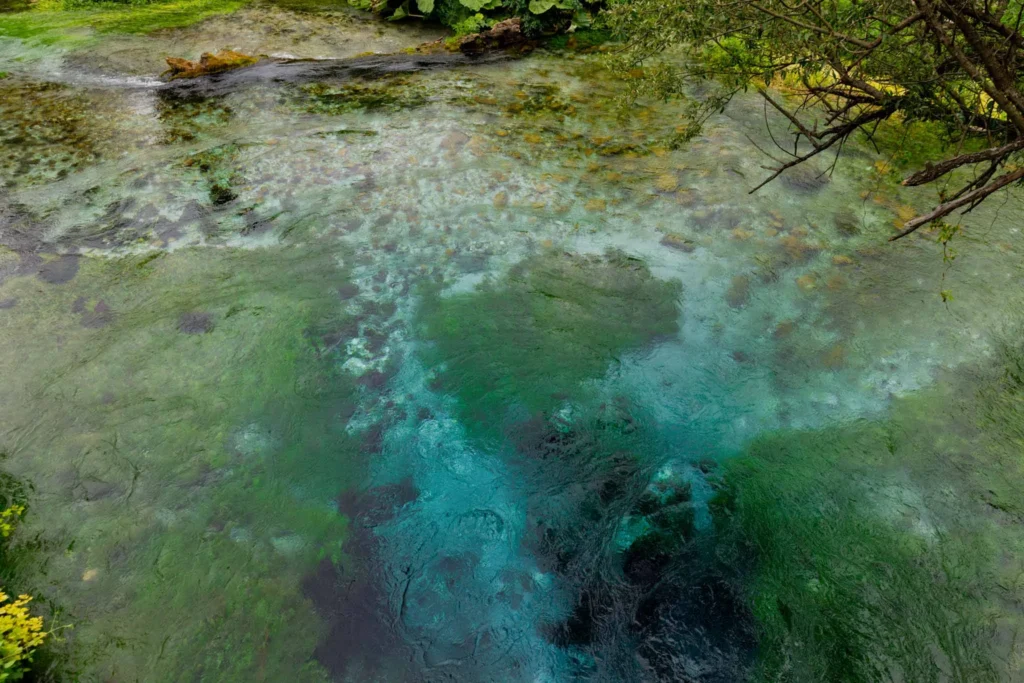
Standing at the observation deck above one of Albania’s most talked-about natural phenomena, I found myself genuinely speechless – and that rarely happens. The Blue Eye, or Syri I Kalter as locals call it in Albanian, isn’t just another tourist trap destination despite what the crowds might suggest. This oval-shaped natural spring near the coastal town of Saranda displays shades of aqua and dark blue so intense they seem almost unreal, resembling a giant blue eye staring back at you from the depths below.
My third time visiting Albania finally convinced me to make the trip, and boy, what a decision that turned out to be. The spring’s mysterious visual spectacle had peaked my interest for years, but honestly, I’d heard it was extremely busy and kept putting it off. The thought of over-tourism tainting the natural beauty made me hesitate during my previous visits to southern Albania. Yet here I was in September, standing beside this unimaginably deep freshwater spring, watching water surge upwards with a force that defies logic.
Understanding What Makes This Natural Phenomenon So Special
Table of Contents
ToggleThe source of the Bistrica River begins right here, flowing all the way to the Ionian Sea south of Saranda. What sets this apart from Albania’s 100 karst springs is the incredible depth and force of water being pumped to the surface at a rate of 18,400 litres per second – that’s 18,400 liters per second of crystal-clear water rushing up from unknown depths. Divers have explored down to around 50 metres, but the pressure and force of water stopped them from going deeper, meaning the actual depth remains unknown to this day.
Located within Blue Eye National Park, which covers a total surface area of 180 hectares with 13.5 hectares of that being water, the landscape here is beautifully hilly and made up of oak trees alongside other Mediterranean fauna. The main attraction inside the national park draws visitors who spend a few hours taking in the beautiful landscapes and that insanely clear water. The lush greenery surrounding the hills creates an atmosphere that goes beyond just seeing a spring – it’s about experiencing a complete natural setting.
The water temperature stays close to a consistent 10 degrees Celsius year round, which is colder than some people expect when they arrive. At 53.5º fahrenheit (12º celscius), it’s pretty chilly even on the hottest summer day. This remarkable depth of more than 50 meters combined with the water flow rate makes it one of Albania’s most extraordinary natural sites, earning its spot high on any Albania bucket list.
Finding Your Way to This Protected Nature Park
The Blue Eye sits within a protected nature park close to the small village of Muzina, perfectly positioned between the popular touristic towns of Saranda and Gjirokaster. At a distance of 22km east of Saranda on the other side of the Mali I Gjera mountain range and 37km south of Gjirokaster, this scenic spot serves as a convenient stop en route to the southern beach towns if you’re travelling from Tirana to Saranda via Gjirokaster during your Albania road trip.
Google Maps Pin will guide you directly there, making navigation straightforward whether you’re coming from Saranda, Ksamil, or Gjirokaster. The location makes it a perfect half-day trip or day trip from any of these towns, fitting nicely into most Albania road trip itinerary plans.
H3: Transportation Options to Reach the Spring
Driving Your Own Rental Car
The best way to get there is definitely by car, offering the most flexible and convenient option for your visit. Renting a car in Tirana at the airport or in Saranda city center gives you complete control over timing. The drive from Saranda takes around 35 to 40 minutes (some say 40 minutes) on the SH99, where roads are in good condition and mostly smooth and flat with epic views of the mountains until the last section which becomes a steeper ascent.
We rented our car through DiscoverCars at the Tirana Airport and had a wonderful experience throughout our one month exploring the country. It’s the best way to see Albania, hands down. You can also book your car rental online with Rental Cars for that peace of mind that comes with a reputable company, especially if you want to experience some stunning coastal drives along the Albanian Riviera.
The large car park at the entrance to the nature reserve fills up quickly – even on our visit in September it was not far off being full. I can only imagine the difficulty getting a space in the peak summer months of July and August, which is just another reason to get there early. Current parking prices, which you can pay at the small cabin, are as follows: 0-3 hours costs 300 lek, 3-4 hours runs 400 lek, 5-8 hours goes for 600 lek, and 9-24 hours will set you back 1200 lek. For campers, there is a flat fee of 800 lek to park for anytime up to 24 hours.
Using Public Transport from the Main Bus Station
Even if you don’t have your own wheels, reaching the Blue Eye on public transport is possible, though Albanian public transport isn’t as structured as other places. The cheapest way involves catching one of the local buses heading from Saranda towards Gjirokaster (or vice versa if visiting from Gjirokaster). Just make sure to double check that the bus definitely goes past the Blue Eye as some now take a more direct route between the two towns using a new road that was completed recently.
We bought Saranda to Blue Eye return tickets in the main bus station office in Saranda, which cost 400 lek per person each way. Payment is cash only and I’d recommend buying tickets in advance in the summer season if you can. Let the driver know that you’re only travelling as far as the Blue Eye, and he’ll stop and let you off at the entrance to the car park.
There are two daily departures from Saranda at 10am and 2:15pm, returning from the Blue Eye twice at 2:25pm and 5:40pm – but double check this in the station office as timetables can change frequently. Make sure to be back at the entrance early as with only a couple of return times you don’t want to risk missing your bus. We took the 2:15pm bus and returned at 5:40pm and found this to be a perfect amount of time to walk to the Blue Eye, have a coffee, and loop back on a different trail. Note that there’s no direct bus from Ksamil so you would first have to take a bus to Saranda and then change to a Gjirokaster bus from here.
The KMG Blue Eye Shuttle Service
Another convenient option is using the KMG Blue Eye shuttle (also known as KMG Tourism Group) which runs regular trips between Saranda and the Blue Eye throughout the day. Departing from outside Hotel Mallara, the price for this shuttle is more expensive at 1400 lek (14 euros) return. However, there are many more departures compared to the public bus and they also start earlier at 8am if you want to beat the crowds.
It’s also a more comfortable journey with air conditioning – which is nice in the summer when temperatures climb. I’d recommend reserving a place in advance, but you can also just turn up. More details can be found on their Facebook page where they post updated timetables. Honestly, 1400 lek is pretty reasonable considering the convenience and the fact that we found taxis to be quoting as much as 50 euros for a return trip.
Hiring a Private Taxi
Taking a taxi to the Blue Eye is convenient and easy if you prefer door-to-door service. Ask the taxi driver to wait for you in order to take you back to Saranda – they will usually wait for 2 hours. The cost of a round-trip taxi ride is usually around 35,000 – 40,000 Lek ($35-$40). Make sure to negotiate and settle on a price beforehand and bring cash to pay at the end.
Joining an Organised Tour
If you’re short on time or prefer to have all the logistics taken care of, visiting the Blue Eye as part of an organised tour is a great option. This is the most expensive option but allows you to use your time efficiently by visiting multiple attractions in one day.
Several highly rated tours you can book online include: “Visit The National Park of Blue Eye” which lets you explore the Blue Eye with a guide on this 3-hour tour from Saranda. There’s also “Explore Blue Eye- The Monument of Nature” with several departures leaving from Saranda per day, making it a great tour option with a private guide if you’re looking for flexibility.
For those wanting to see more, try the Half Day Trip Blue Eye only from Saranda only, or go bigger with the Full Day Trip to the Monastery of Saint Nicholas, the Blue Eye, Gjirokaster, and Lekursi Castle from Saranda or Ksamil. Another popular choice is the Full Day Trip to Butrint, Ksamil, the Blue Eye, and Lekursi Castle from Saranda only.
Entry Costs and Operating Schedule
The entrance fee is just 50 lek per person ($0.50), which must be paid in cash. This is much cheaper than we were expecting for such a popular tourist attraction – all too often we see natural sights become touristy and much higher fees get introduced. You can pay the 50 lek at the official ticket office, which you’ll reach in about five minutes from the car park after passing a few stalls selling some food, drinks, and souvenirs.
Opening hours are 7:00 am – 7:00 pm (or 7am until 7pm) year round, daily, all year without seasonal changes. The park never closes regardless of weather conditions.
What Your Walking Experience Will Actually Be Like
The first thing to note, which some people don’t realise until they arrive, is that the Blue Eye itself is located about 2.2km (roughly 2 kilometers) from the car park. Bear this in mind, especially if you’re visiting in the hottest months as there is minimal shade on the main trail and it would be a very sweaty walk without preparation.
After you pay your entrance fee at the ticket office reached through an uphill walk, you’ll cross a bridge which takes you to the wide and well-paved trail. The trail is made up of a wider road for scooters and E-bikes as well as a curbed pavement split in two for two-way pedestrian traffic. Following along this paved path, the route takes around 20 to 30 minutes to walk with a few up and downs, but overall it’s not a strenuous hike.
If you don’t fancy walking the entire distance, you can opt for the new shuttle in the shape of a small train for 300 lek per person or hire an electric scooter for 5 euros per hour. Eventually you’ll reach public toilets and also the Blue Eye Restaurant which looks over the mesmerisingly clear river – and trust me, it could be the clearest water I’ve ever seen anywhere in my travels.
From the restaurant, it’s a very short walk to reach the actual spring. You can either keep following the main trail before crossing a small bridge or there is also a bridge to the left of the restaurant, which then follows a dirt track to the Blue Eye. I’d recommend going the latter way as it has a couple of openings that look out to the crystal clear river with stunning views you won’t get from the main path.
Once you’ve made it to the Blue Eye you can wander around and admire the natural spring up close. There are a couple of spots where you can see the water pulsing out of the dark blue abyss and begin to flow down the river, creating that surging effect that’s so captivating to witness. However, the best place to view it is on the observation deck above. Here, you can look down and see why it’s been named the Blue Eye with an awesome view of the deep, oval-shaped spring. You can also see the different shades of blue, aqua, and green that make it such an epic and unique sight.
After taking some photos here (and believe me, you’ll take plenty), I recommend following along the dirt trail behind the platform for even better views of the entire river. You’ll reach some stairs, head up the stairs, and the view is just a short walk from the top – absolutely worth the extra effort.
Available Facilities and What to Expect
There’s a public toilet block just before you reach the Blue Eye, providing necessary facilities for visitors. The restaurant serves drinks all year and food in the summer, offering a place to rest and refuel. We enjoyed a quiet late afternoon coffee here in what I can only describe as a beautifully scenic spot overlooking the riverside.
There’s also a hotel next to the Blue Eye with an attached restaurant, for anyone who would like to stay overnight here – although I personally wouldn’t feel the need since most people are satisfied with a few hours exploring. As much as I was impressed that the nature park hasn’t been completely ruined by commercialisation, you can of course find a small souvenir shop directly next to the Blue Eye spring selling magnets, postcards, and other items with a Blue Eye theme if you’re interested in purchasing something.
There are also a few interesting information signs about the area and biodiversity to read around here that add educational value to your visit.
If you’re planning to eat a full meal, there is a restaurant called “The Blue Eye” near the pool. The ratings aren’t the best from what I’ve seen online, but it’s something in case you’re visiting during lunch time and need more than just coffee.
The Swimming Question Everyone Asks
This is a bit of a debated question that deserves a clear answer. I can 100% confirm that swimming is not permitted anywhere in the nature park, but especially around the Blue Eye spring itself. There are many signs everywhere stating this, so while it may have been allowed in the past, it definitely isn’t now.
Prior to visiting, we were under the impression that you could swim at the spring and around the river. We had read about it online and had seen various photos of other people swimming there from earlier years. However, as of our visit in May 2023 and continuing through today, signs everywhere say swimming is not allowed. The reason being that they are trying to preserve the national park and keep the area clean.
You may see some people ignoring this rule and having a dip in the cool water anyway – we did see one person do this when we visited. However, I encourage you not to swim for a couple of reasons that go beyond just following rules.
First, the rule is in place to protect the nature reserve as the Blue Eye plays a big part in supporting the biodiversity of the area. The delicate ecosystem depends on maintaining water quality and minimizing human interference.
Second, the fact that there was nobody swimming in the natural spring meant that we could all clearly observe the Blue Eye, its stunning colours, and the surging effect of the water rushing up to the surface. I can only imagine how frustrating it would be if you couldn’t get a good view due to people crowding in the water, blocking the phenomenon everyone came to witness.
Before visiting, we read online that you are permitted to swim at the restaurant area, but there were many signs around saying not to enter the water. So even if the icy water is inviting you in on a hot summer day, swimming is a hard no I’m afraid. The constant water temperature of about 12º celsius (53.5º fahrenheit) is pretty chilly anyway, which would make for an uncomfortable experience even if it were allowed.
Understandably, we agree with this preservation approach and chose not to swim in order to do our part in helping to preserve the natural area. We also visited on a cooler day, so no one was swimming anyways, making the whole experience more peaceful.
Making the Most of Your Time at the Park
While the main attraction is of course the natural spring itself, there are a couple of things you can do to make the most of your visit to the nature park beyond just snapping photos.
Obviously, Admire The Blue Eye
If there’s only one thing you manage to do here, let it be observing the phenomenon from the viewing platform and snapping a few photos and videos while you’re there. It really is a unique sight to witness, especially from above where the full “eye” effect becomes apparent. The viewing platform provides the perfect vantage point to understand why this natural wonder captivates so many visitors.
Have Lunch Or A Coffee Overlooking The River
Whether you’re feeling peckish or need a caffeine boost for the walk back, I’d recommend taking some time to sit back in the riverside restaurant. Taking your time here adds value to the overall visit rather than rushing through. We found that relaxing with a coffee at the restaurant created a more memorable experience than just doing a quick photo stop.
Hike The Natural Trail Loop
From the Blue Eye viewing platform, you have the option to keep hiking as the trail keeps going beyond the main viewing area. We decided to follow this and found that it loops back to the main car park on the opposite side of the river to the main path, offering different views of the river you won’t see otherwise.
If you’re up for an adventure, then I’d recommend taking this route back as it’s more interesting than just retracing your steps. This route is slightly more challenging than the main path as it’s an uneven dirt track but it also offers more shade as it’s mostly covered by trees, which is perfect in summer heat. It’s quite easy to follow this trail but you can find the exact trail on maps.me. Travel Tip: Download the trail on maps.me before your visit as internet signal in the park can be poor or nonexistent.
Time Management for Your Visit
If you’re here to simply hike in to the Blue Eye, admire it and snap some photos before heading back, then you’ll need no more than 90 minutes total. This covers the walk in (20-30 minutes), time at the viewing platform (15-20 minutes), and the return walk.
However, we enjoyed taking our time throughout the visit. Following the other trail back and stopping for coffee, this took us around 2.5 hours in total and we found it to be a perfect amount of time without feeling rushed. This also worked in perfectly for us to catch the last public bus back to Saranda at 5:40pm, making the timing ideal for those using public transport.
Overall, you should plan to need about 2 hours total at the Blue Eye if you want a relaxed pace, or up to 3 hours if you’re hiking the loop trail and stopping for food or drinks.
Managing Crowd Expectations
I know it’s hypocritical to complain about crowds at tourist attractions when I too am a visitor and contributing to this. But let’s be real, overcrowding can completely ruin an experience, especially at nature spots where the whole point is connecting with the natural environment.
So it’s important for managing your own expectations to be aware that, while you can take steps to visit at quieter times, the Blue Eye is one of the most famous attractions in Albania and you can always expect to have to share it with others – and at peak times a whole lot of others coming from Saranda, Ksamil, and beyond.
However, I will say I was pleasantly surprised that it didn’t feel overcrowded at all during our visit in September. Yes, it was fairly busy, but people weren’t lingering for too long and there was a steady flow of tourists with even some quiet moments mixed in too. The platform can get crowded, so be prepared to wait for your turn at the best photo spots.
I have heard from others that it can get jam packed in the peak summer months of July and August, especially around midday when tour groups arrive. So it’s important to expect this if visiting during this time. The crowds shouldn’t deter you completely, but timing your visit strategically makes a huge difference in your overall experience.
Optimal Timing for Your Visit
The best time of year to visit the Blue Eye is in May to June or September to October – basically the shoulder season periods. In these months you’ll still have great weather with clear, warm, and sunny days but the crowds won’t be as large as in July and August when peak travel season brings the busiest time of year to southern Albania.
The weather during these periods is warm and sunny, creating ideal conditions for enjoying the clear blue waters and the lush surrounding landscape without the peak summer intensity. We recommend going in May, June, September, or October for a more pleasant experience overall, avoiding both the peak crowds and the most extreme heat.
You also want to try and visit on a clear sunny day as this is when you’ll be able to see the best shades of aqua and dark blue in their full glory. On our visit, a few clouds came over at one point and the vibrant blues noticeably faded away until the sun came back out – the difference was dramatic and really showed how much lighting affects the appearance.
In terms of the time of day, the colours of the Blue Eye are best around midday when it’s bright and sunny, with sunlight penetrating the water to show off those intense blue and aqua shades. However, this is also the busiest time too, creating a trade-off between optimal lighting and minimal crowds. So I’d actually recommend going either early morning (arriving right at 7am opening) or late afternoon for the best overall experience, balancing decent lighting with fewer people.
Beginning in May through October gives you the longest window, though some visitors brave it year round since the park operates daily in all seasons.
Is This Natural Wonder Actually Worth Your Time?
The Blue Eye was one of the top things on our Albania bucket list, and it did not disappoint despite our initial skepticism. It is definitely worth visiting if you are traveling or travelling around southern Albania – I’ll stand by that statement completely.
Both the Blue Eye in Theth up north and the one near Saranda down south are beautiful natural sites, but we preferred the Blue Eye down south more. In our opinion, it’s more stunning and unique, as you get to see the water bubbling up from the spring with that incredible surging effect. The Blue Eye up north in Theth is mainly a pool of water that is being fed from a waterfall, which is still worth visiting if you are in the area, but if you have to choose between the two – we recommend the Blue Eye in Saranda without hesitation.
After visiting for ourselves, I definitely recommend making the trip here! It really is a unique attraction that in my eyes is absolutely worth visiting, surpassing those tourist trap expectations we had going in. Not just for the natural spring itself, but the whole environment of the lush nature park and the clear river that flowed like liquid glass contributed to a fantastic visit.
It may have been a different story if it was somewhere that you simply parked up, walked a few meters to a viewpoint and job done. But the journey through the nature park, the river views, the lush green forest surroundings, and the overall beautiful setting all added up to something memorable. We hadn’t thought much past the spring itself before arriving, but the wider nature reserve is genuinely a pleasant experience.
So as well as making time for the beaches in Saranda and Ksamil, and visiting Butrint National Park, the Blue Eye should be on your southern Albania itinerary without question. It’s touted as one of the top attractions in the whole of Albania for good reason, earning its reputation through that unique natural phenomenon status.
Essential Tips Before You Go
Bring Cash for Everything
The entrance and parking fees must be paid with cash – no cards accepted anywhere. Make sure to bring enough for this and any other purchases during the day, including food, drinks, souvenirs, and the shuttle if you use it. This is absolutely critical since there are no ATMs at the site.
Pack Water and Stay Hydrated
During the summer months, it can get pretty warm here along the trail. Bring water to stay hydrated, especially since there’s minimal shade on the main trail during that walk in. We learned this the hard way on previous Albania trips.
Wear Walking Shoes You Trust
The walk up to the Blue Eye is 2 kilometers one way, and the other trails like the loop trail are made of dirt and can be uneven. We recommend bringing comfortable shoes since you’re looking at over 4 kilometers of walking round trip at minimum. Flip-flops or sandals won’t cut it, especially if you tackle that dirt track loop.
Don’t Expect to Swim
Swimming is technically not allowed at the Blue Eye anymore; however, some people swim anyways despite the signs. The rules are always changing based on what we’ve heard, so you may not be able to swim if you were planning on it. Best to go with the expectation that swimming won’t happen and be pleasantly surprised if enforcement is lax, rather than being disappointed.
How Deep Is The Blue Eye In Albania?
The depth of the Blue Eye remains unknown despite modern diving technology. Previously divers have managed to explore as deep as 50 metres before being forced back by the incredible pressure and force of water surging upwards. This makes it one of the deepest springs in the region, though the actual bottom has never been reached or measured accurately.
Can You Swim In The Blue Eye?
No, there are many signs stating that you are not allowed to swim in the Blue Eye Spring for both safety and nature preservation reasons. The rule is in place to protect the biodiversity of the area and ensure all visitors can clearly observe the natural phenomenon without obstruction. While some people ignore this rule, it’s important to respect the preservation efforts.
What Is The Temperature Of The Blue Eye?
The water in the Blue Eye stays at a consistent temperature of around 10 degrees Celsius year round, never varying significantly regardless of the season. This makes it pretty chilly even on hot summer days at 12º celscius, which would be quite a shock to anyone expecting warm swimming conditions.
How Long Does It Take To Walk Around The Blue Eye?
The round trip trail to the Blue Eye from the car park is nearly 5km and takes around 40-60 minutes to complete just the walking portion. However, you also need to add on any time for taking rests, observing the spring from different angles, and taking photos, which typically adds another 30-60 minutes minimum for most visitors.
Planning the Rest of Your Albanian Adventure
KSAMIL – If you’re planning to head down south to explore more beaches, check out the best things to do in Ksamil and discover the 13 best beaches in Ksamil. The area offers some of the most incredible coastal scenery in the Mediterranean, rivaling anything in Greece or Croatia.
HIMARE – Read about the most incredible beaches in Himare and the top things to do in Himare to help plan your trip along the Albanian Riviera. The coastal drive alone is worth the journey, offering epic views around every curve.
BERAT – Plan your trip to this UNESCO World Heritage city with the 15 best things to do in Berat post. The “City of a Thousand Windows” offers a completely different vibe from the coastal areas.
KRUJA – If you are looking for a day trip from Tirana, or if you’re driving to Theth, make sure to stop in Kruja on your way. It has the most amazing shopping bazaar in Albania where you can find authentic souvenirs and local crafts.
THETH – Heading to the mountains in northern Albania? Check out posts about driving the Road to Theth, which is an adventure in itself through some of the most dramatic mountain scenery in the Balkans.
Albania Travel Planning Essentials
Albania Travel Insurance
Should you get travel insurance for Albania? YES! We always get travel insurance before all of our trips for peace of mind, no matter the destination. Check out Travel Insurance Master to find the best plan for your specific needs and trip length. Things happen, and it’s better to be covered.
Albania Rental Cars
Is it safe to rent a car in Albania? Yes! We rented a car in Albania for one month and it is hands down the best way to see the country and reach places like the Blue Eye independently. We rented our car through Discover Cars (our go-to rental agency), which helps you find the best rates no matter where you are traveling. The flexibility of having your own wheels makes such a difference, especially when visiting places outside major towns.
Albania Phone Plans
If your phone plan does not offer free coverage in Albania, then we suggest getting an eSIM for data connectivity. We used Airalo during our trip to Albania, and we had fantastic coverage the entire time throughout the country. We even had to rely on it for data to get some work done remotely, and it worked great without any dropout issues.
Albania Hotels
Wondering where to book your accommodations for Albania? We booked all of our hotels through Booking and found the platform reliable throughout our travels. All of the hotels were responsive through the messaging tool, and there are endless options to choose from across all price ranges. Note – some hotels in Albania require you to pay in cash upon arrival. Make sure to message the hotel in advance to be prepared with the correct form of payment and avoid any awkward situations at check-in.
Drinking Water in Albania
Wondering if you can drink the tap water in Albania? We were advised to not drink the water directly from taps by our hotels in multiple cities, so we ended up buying bottled water instead throughout our stay. It’s inexpensive and available everywhere, so this isn’t a major inconvenience but something to budget for.
The Blue Eye near Saranda stands as one of those rare places where the hype actually matches the reality. Despite being one of the most famous and popular tourist attractions in the whole country, the natural wonder maintains its ability to impress. The mysterious depths, the surging water, the intense colors – it all comes together in a way that justifies its place on every Albania itinerary. Whether you arrive by bus, taxi, shuttle, or rental car, whether you visit in May or September, whether you spend 90 minutes or 2.5 hours exploring – this remarkable natural site delivers an experience that sticks with you long after leaving southern Albania behind.