I’ll never forget my first glimpse of Puglia’s coastline—that moment when the Adriatic Sea stretched endlessly before me, its waters shimmering under the Mediterranean sun. This region, tucked away in Italy’s heel, has transformed from what was once considered the shame of Italy into one of the country’s most prized jewels. After spending considerable time exploring this sun-drenched corner of Southern Italy, I’ve come to understand why it captivates every traveler who ventures here.
Lecce: The Baroque Marvel
Table of Contents
ToggleLecce dazzles visitors with its stunning Baroque architecture and lively cultural scene. I spent a week using this honey-hued limestone village as my home base to explore the Salento peninsula in the southern part of Puglia. Known as the Florence of the South, the city’s historic center is a maze of beautiful churches, palaces, and vibrant piazzas, all crafted from the local golden limestone that seems to glow in the afternoon light.
The intricate Basilica di Santa Croce stands as one of the highlights, alongside the impressive Roman amphitheater and the grand Piazza del Duomo. Streets lined with traditional trattorias and artisan shops create the perfect place to taste authentic Puglian cuisine and shop for unique local goods. Don’t leave without trying the local specialty—pasticciotto, a delicious pastry filled with custard that melts in your mouth.
Strolling through the narrow cobblestone streets, you’ll find rich history evident everywhere, from Roman ruins to ornate churches with their elaborate facades. The charming city offers a perfect blend of architectural sights and modern retreat options. For accommodation, consider Palazzo Bozzi Corso for the best luxury old-world hotel experience, La Fiermontina for a modern retreat, or Palazzo Guido for a sophisticated luxury city hotel stay. I’d recommend spending 2 nights here to fully appreciate what the area offers.
Ostuni: The White City Base
This whitewashed town became my personal favorite during my travels—a fantastic spot to base yourself for a week in Puglia. The White City, with its pristine white walls and buildings gleaming against the azure sky, is truly one of the gems of Puglia. Close to the coast, you’re within an hour’s reach by car to must-see towns like Alberobello, Locorotondo, and Polignano a Mare in Valle d’Itria, which isn’t far from Ostuni.
Evenings spent wandering the town’s quaint streets offer endless views as you search for authentic Puglian cuisine. The variety of dining options ranges from Michelin guide restaurants to casual spots. For eating, try Osteria Del Tempo Perso, or enjoy an aperitivo at Borgo Antico Bistrot, a neat spot reached via a steep zig-zagged path that rewards you with stunning views of the Adriatic Sea.
The famous white city serves as a prized postcard town, where the centro storico provides sea views over rolling hills and olive groves—pure magic in this Puglian town. Beyond the city itself, the experiences nearby make it a great base to end your time exploring towns like Ceglie Messapica. You can easily reach the best beaches and beach clubs within 20-30 minutes away from the area.
For the best hotels and vacation rentals, consider La Sommità Relais Chateaux for the best in-town luxury hotel, I 7 Archi Guest House for an in-town studio or apartment stay, Masseria le Carrube for the best countryside hotel, Casa Boccadoro for overall countryside vacation rental, Trullo Silentio for a new countryside vacation rental option, or Masseria Moroseta for a modern masseria stay. I’d suggest a recommended time of 2-3 nights as an easy win for experiencing this area properly.
Alberobello: The Trulli Wonderland
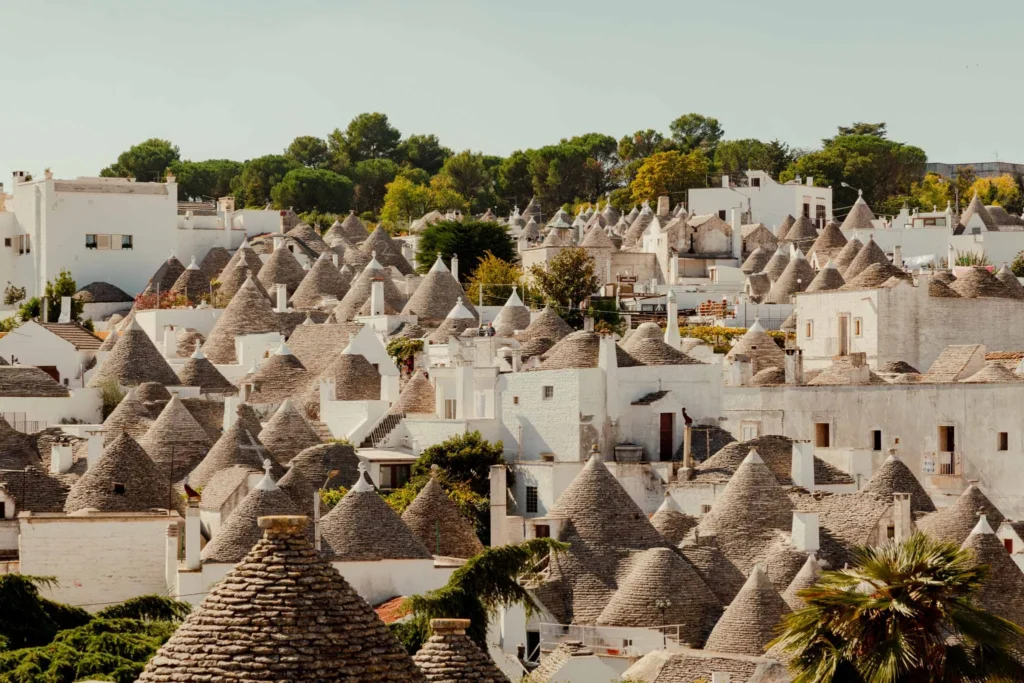
Among the most uniquely recognizable towns in Puglia, Alberobello stands out with its distinct white, conical-roofed buildings called Trulli (singular: Trullo). These fairytale-like structures make it a top destination in the region. The cylindrical-shaped dwellings were constructed using an ancient dry-wall technique without mortar to bind the stones together, featuring steep pyramid-like roofs made from thin limestone slabs.
These architectural features earned the town UNESCO World Heritage Site status. Valle d’Itria is particularly famous for its dense concentration of these buildings—over 1,500 Trulli populate the Rione Monti and Aja Piccola neighborhoods. For the best views, head to the viewpoint. Several buildings are open to visitors where you can peek inside for a small fee, though some are free.
Locorotondo: The Circular Beauty
This circular hilltop town surrounded by olive groves and vineyards offers stunning panoramic views of the Itria Valley. Among the quieter towns in Puglia, it’s perfect if you want to escape the bustling tourist spots. Worth an afternoon stop during your travels, take time to stroll the winding streets past historic buildings and soak in the quaint atmosphere.
Stop for lunch at a local Puglian restaurant, or opt for wine tasting at wine shops around town like Vinifera Vini Affini, where sampling the wines produced in the region takes just a couple of hours—but you’ll have plenty of reasons to fall in love with Locorotondo. Listed among Borghi più belli d’Italia (Italy’s most beautiful towns), there’s good reason to visit.
Less busy than other towns yet surrounded by vineyards and washed in white, you’ll discover the prettiest corners at every turn. Great restaurants sit a short distance from Alberobello and Martina Franca, making it a must-visit. Crowned as one of Italy’s most beautiful villages, the narrow streets are lined with potted cacti, flower-adorned staircases, and flower boxes.
Nearby coastal hotspots like Monopoli are loved destinations to visit when you have time. The centro storico’s round area features cobblestone streets and narrow white buildings—an ideal escape from crowds where you can enjoy local restaurants and shopping. The true beauty of Locorotondo isn’t in doing too much; it lends itself perfectly to slowing down and enjoying the area, including nearby towns like Cisternino.
For a recommended time of 3 nights, consider Trullo Fumarola for the best country trulli home stay, Relais Villa San Martino for a luxury hotel experience, Masseria San Michele for a traditional budget-friendly hotel, Masseria Trulli e Vigne for a trulli hotel, or Ottolire Resort for luxury resort accommodations.
Polignano a Mare: Cliffside Drama
Set atop jagged limestone cliffs, this sun-drenched coastal town ranks among the most sought-after destinations in Puglia. With iconic beaches and a spectacular coastline, it embodies the definition of an Italian summer holiday. Hidden beaches with turquoise waters and al fresco dining opportunities make it perfect to spend a day exploring.
The famous Lama Monachile Beach draws crowds, so arrive early to secure a decent spot with wonderful views overlooking the town and sea. Visit Pietra Piatta or Belvedere su Lama Monachile for breathtaking vistas. The town itself is enjoyable—walk through the narrow streets dotted with small shops to explore and grab a bite at the local favorite, L’Osteria di Chichibio, known for delicious seafood.
Monopoli: The Overlooked Coastal Gem
This laid-back seaside town features a picturesque harbor and old town conveniently located within walking distance or a short drive from pristine beaches in the region. I highly recommend visiting for an afternoon—visit the town’s cathedral, historic castle, and Palmieri Palace to taste the local culture while watching fishermen bring in the daily catch at the old port.
It’s perfect for a leisurely day trip, which you can combine with a visit to Polignano a Mare, just 15 minutes away by car. Or opt to spend the morning exploring the old town before heading to the afternoon beaches nearby, like Cala Porto Rosso.
Often overlooked for its more popular neighbor, Monopoli has a lot more to offer as a coastal introduction. It provides a beautiful gateway as a historic coastal port with an active fishing harbor, sans the touristy things you’ll find in other towns. There’s lots to discover among the historic sights and incredible restaurants, all minutes from the best sandy beaches on the Adriatic Sea.
Spending 2-3 nights here lets you easily see the town itself and beach hop on day trips. For a recommended time of 2-3 nights, consider Villa Susca for the best vacation rental (where we stayed), Orazio 33 B&B for a bed and breakfast stay, Hotel Don Ferrante for an Old Town luxury hotel, Dimora Pietrabianca for a boutique hotel, or Masseria Torrepietra for a family-friendly hotel just outside town.
Matera: The Ancient Cave City
The oldest city in Italy—and thought to be the third oldest city in the world, dating back over 10,000 years—Matera was once considered a source of shame for Italy. Today, Matera has become one of the country’s jewels, an incredible city known for its ancient cave dwellings called Sassi.
The historic districts of Sasso Caveoso and Sasso Barisano are characterized by houses carved directly into the limestone cliffs. In the 1950s, due to poor living conditions, the Italian government evacuated the Sassi and began revitalizing the area. Today, Matera has transformed into a major tourist destination.
Explore the historic center either on your own or via a guided tour. I suggest spending at least one night in the city—it’s especially magical when lit up in the evening, with the ancient stones glowing under carefully placed lights.
Martina Franca: The Hidden Treasure
Among the most beautiful towns in Puglia and the largest in the Itria Valley, Martina Franca remains a hidden gem that few tourists visit, offering a traditional and authentic experience. Meander through Martina Franca’s squares, especially the lively Piazza Maria Immacolata, where you can enjoy an afternoon drink beneath the half-moon-shaped loggia.
Highlights include the elegant Palazzo Ducale, a 17th-century palace adorned with vibrant paintings and Baroque touches. Martina Franca is known for preserving authentic regional character while offering sophisticated charm.
Otranto: Where East Meets West
One of the easternmost towns in Italy, Otranto has a storied past—it transitioned from a Greek town to Italian before being conquered by the Ottoman Empire. Today, this sparkling coastal town is mainly known for its exceptional beaches, making it a summer hot spot that boasts some of the best beaches in Salento, including Porto Badisco and Torre dell’Orso, where you can enjoy stunning Adriatic waters.
For culture-seekers, take a morning or afternoon to explore Otranto and admire the intricate mosaic floors in the cathedral, marvel at the frescoes inside Chiesa di San Pietro, or visit the Aragonese Castle, a focal point of the town that offers a glimpse into its rich history.
Tucked away on the rugged coastline, this coastal gem’s natural beauty and history intertwine beautifully. Striking turquoise waters, white pebble beaches, and medieval charm create a captivating atmosphere. The iconic Otranto Cathedral features a breathtaking mosaic floor in its crypt that stands as a testament to the region’s storied past.
Wander the ancient stone streets past quaint cafés and artisan shops that offer a taste of authentic Italian life. Venture to the 15th-century castle that overlooks the sparkling Adriatic Sea. For a recommended time of 2 nights, consider Masseria Muntibianchi AgriResort for the best countryside stay, Baglioni Masseria Muzza for luxury rural accommodations, Masseria Prosperi for a chic boutique stay, Le Capase Resort Salento for coastal stays south of town, or Masseria Montelauro for a traditional masseria stay.
Gallipoli: Island Fortress
The old town, located on a limestone island off the western coast of Italy’s heel, is small and requires only 1-2 hours to see it all. I recommend visiting as a short day trip from Lecce or nearby towns. Start with a visit to the medieval Castello di Gallipoli, then proceed to make your way through the town’s winding streets, and finally walk along the seafront walls for wonderful views.
On the other side of the island, La Spiaggia della Purita offers a picturesque beach where you can swim and sunbathe. The coastline boasts some of Puglia’s most beautiful beaches with crystal-clear water and golden sands. Popular spots include Baia Verde and Punta della Suina, both a 15-20 minute drive from Gallipoli.
Perched on the Ionian Sea in the heart of Puglia, this coastal town is where turquoise waters meet a rich tapestry of history and charm. The town’s name, meaning “beautiful city,” is a fitting description. The old town is situated on a small island with narrow alleys and whitewashed buildings offering captivating views of the shimmering sea.
The imposing 13th-century fortress stands guard over the harbor while elegant Baroque churches add a sense of timeless beauty to the landscape. For a recommended time of 2 nights, consider Palazzo Presta for the best affordable chic stay or Tenuta Negroamaro for a luxury countryside stay.
Galatina: The Fresco Masterpiece
This small town located in Salento became a visit by happy accident for me—while looking at a map, I randomly pointed and said, “Let’s check it out.” At first glance, Galatina feels very local and off the beaten path. Being among a handful of tourists provided a refreshing change from the more crowded destinations like Lecce and Ostuni.
The true gem and main reason it’s worth visiting is the Basilica di Santa Caterina d’Alessandria. From the outside, it may look like any other church, but step inside and you’ll understand why the detour is worth it. The 13th-century church is covered in breathtaking frescoes depicting different biblical scenes.
Having visited hundreds of churches throughout my travels, I can confidently say this is one of the most memorable ones. Galatina offers a unique and authentic glimpse into local Puglian life, away from the typical tourist trail. Its hidden charm and awe-inspiring interior make it a must-visit in our books.
Bari: The Authentic Capital
Puglia’s capital city may not captivate at first sight, but its authenticity and rawness will grow on you. Weave your way through the labyrinth of narrow streets in the historic old town to find Strada delle Orecchiette, where you can watch the nonnas making fresh orecchiette pasta (a local specialty) right outside their homes.
Along the seafront Lungomare, scenic views of the Adriatic reveal many ships coming out of the harbor—one of the busiest ports in Italy, with numerous ferries taking passengers to Greece and Croatia. Bari is known for delicious street food, particularly panzerotti and focaccia. For the best focaccia, head to Panificio Fiore. You’ll find people selling Sgagliozze (fried polenta squares), which are a tad flavorless but remain a traditional Bari snack worth a try.
I recommend visiting Bari as a day trip from Polignano a Mare, Monopoli, or Ostuni rather than using it as a base—the countryside and smaller towns are much more beautiful for extended stays.
Trani: The Northern Wonder
Located north of Bari, this postcard-worthy town is known for its stunning medieval architecture and historic harbor. The town’s iconic landmark, the Cathedral of San Nicola Pellegrino, stands majestically by the sea, making it an ideal photo stop.
Many travelers don’t make it this far north in the region, but if you’re hoping to experience a less-touristy town, a day trip from Bari to Trani is very doable—just 40 minutes by car.
Vieste: The Dramatic Peninsula
If you’re looking for a place to go for a truly authentic Puglian experience, Vieste delivers. Located 2.5 hours north of Bari near the border between Molise and Puglia, it’s perched on the rugged Gargano Peninsula, renowned for its dramatic cliffs and stunning sandy beaches.
The town’s scenic beauty is best appreciated from Punta San Francesco, where you can enjoy breathtaking views of the coastline. Just outside town, Spiaggia del Castello beach is perfect for sunbathing and swimming while you admire the iconic Pizzomunno—a towering limestone monolith that stands majestically on the beach.
If you’re looking to experience natural beauty alongside historical sites, I highly recommend adding Vieste to your Puglia itinerary.
Castro: Marina Magic
From afar, Castro may seem like any other hilltop town in Italy. Its main appeal isn’t the historic whitewashed center you’ve seen in other towns around Valle d’Itria. Instead, the real draw is the stunning marina surrounded by crystal-clear turquoise waters, with numerous bathing decks set among the rugged rocks lining the coast.
Off-season, Castro feels peaceful and serene. During summer months, it transforms into a bustling resort town where you can enjoy swimming and sunbathing in pristine waters or exploring the rocky coastline. The marina area offers a variety of cafes and restaurants where you can savor fresh seafood and local cuisine while enjoying scenic views.
Santa Maria di Leuca: Land’s End
Perched at the southernmost tip of Italy’s Salento Peninsula, this destination offers a blend of coastal charm and ancient allure. The town’s dramatic cliffs meet both the Ionian and Adriatic seas, offering views that seem to stretch infinitely toward the horizon.
Santa Maria di Leuca is a place that captures the soul of the Mediterranean perfectly, ideal for travelers who want to sit back and relax. For a recommended time of 2 nights, consider Palazzo Daniele for the best design stay, located just outside town.
Premium Accommodations Across Puglia
Beyond individual town recommendations, several exceptional properties deserve mention. Borgo Egnazia in Savelletri is the luxury hotel that put Puglia on the map—its sense of place is unmistakable at every corner. Full of character that reflects the region, local craftsmanship adorns the rooms where simple yet spectacular landscape stretches as far as the eye can see.
Naturalis Bio Resort & Spa in Martano offers a refreshing escape for those seeking a seamless blend of nature, wellness, and understated luxury, tucked away in the tranquil heart of Salento. Masseria Torre Maizza in Fasano is set against a backdrop of sun-dappled hills and offers a sophisticated yet effortlessly welcoming retreat where timeless elegance of an Apulian farmhouse meets the polished comforts of modern luxury.
Masseria Calderisi in Valle d’Itria provides a serene and intimate escape, blending 18th-century charm with modern comforts for a truly memorable stay.
Choosing Your Perfect Base
During my two weeks in Puglia, I based myself in Lecce to explore the southern tip of the region, then moved to Valle d’Itria near Ostuni to access northern Puglia. From both towns, you can easily take day trips to most places nearby—typically 30 minutes to an hour away.
I suggest booking accommodation in Ostuni if you want to visit Bari, Locorotondo, Alberobello, Polignano a Mare, and Monopoli. For a seaside experience, consider staying near the coast. Lecce provides a great central location for exploring southern Puglia, where you can easily visit Gallipoli, Castro, and many beautiful beach towns in the area.
For the best area to stay, I can’t recommend enough that you split up your stay 2-3 times, depending on the total amount of time available. If you only have one week, focus your time on either coastal stops and hilltop villages or venture to the further southern regions around Otranto if you want more time by the sea.
Timing Your Visit
When trying to decide when to visit Puglia, it really depends on your style of travel and what you hope to experience. June to September is ideal if you’re looking for beach weather with sunny days and warm water. However, be prepared for crowds—it’s the busiest and most expensive time of year.
I visited in October and felt like we had the entire region to ourselves. The weather was quiet and calm but chilly—not warm enough for swimming. Many shops and restaurants in coastal towns were closed for the season. Winter in Puglia is very quiet, and I’d only recommend visiting during this time if you want to explore the towns but aren’t interested in the beach. It can be a bit dreary and not ideal for sightseeing.
April to May offers a lovely time of year with fewer crowds and pleasant weather, making it a great time to explore both coastal and inland areas without the summer rush. Ultimately, the best time to visit depends on whether you prefer beach days or a quieter, more relaxed atmosphere for exploring the region.
Planning Your Duration
Two weeks is the ideal amount of time to fully experience Puglia, though one week is the minimum to get a good taste of the region. If you only have one week, I recommend basing yourself in Ostuni to explore the northern area thoroughly.
With two weeks, split your time between north and south—spend one week in the northern region, then head to the southern region for your second week. In Salento, base yourself in Lecce to explore the nice beaches and towns in that area at a comfortable pace.
Getting There
There are several options for getting to Puglia, depending on your starting point and travel preferences. If you’re visiting from afar, the best way to reach the region is by plane. Puglia has two major airports—Bari and Brindisi. Bari typically offers more connecting flights, though either airport is a good choice depending on your travel itinerary and final destination within the region.
For those already visiting Italy, traveling by train is an excellent option to reach Bari from Rome—about four hours while enjoying a scenic journey through the Italian countryside. Finally, if you’re coming from the Balkans, such as Croatia, Albania, or even Greece, you can catch a ferry directly to the region’s ports.
Transportation Within the Region
The best way to get around Puglia is by car. Unlike the more populated areas of Italy, Puglia is not well connected by train, making public transportation less convenient for exploring the region thoroughly. While you can take a bus to some major destinations like Lecce and Ostuni, having a car gives you the freedom to visit smaller towns and off-the-beaten-path locations at your own pace.
Initially, I was worried about driving in Southern Italy due to stories about aggressive drivers. However, while I did encounter some spirited driving, overall it wasn’t too bad. I found the experience quite manageable and absolutely worth the independence it provided.
Traveler Questions Answered
For the Minnesota Group Planning May Travel
A group of 8 from Minnesota is currently planning a trip to Puglia with only about a week there. They’ve so far booked themselves into Polignano a Mare from May 25 through 28, 2025. At the moment, May 29, 30, and 31 remain open (with a departure on June 1), and they could use recommendations as to their next base of operations.
While they generally prefer to stay in smaller towns in Italy, they’re wondering if they should consider Bari as their next stop. Polignano is beautiful and I think they’ll love it there. For their next stop, I’d suggest staying somewhere in Valle d’Itria near Ostuni. Bari can be easily seen as a day trip, but the countryside and smaller towns in that area are much more beautiful for an extended stay.
Public Transportation Feasibility
Someone planning a first-time trip to Puglia with their wife in late September/early October really appreciated these recommendations and will use Ostuni as their base for the visit. Their question: do they really need a rental car, or can they use public transportation to visit the main places?
They don’t have any issues walking several hours a day. Their preference would be to go to Bari, Alberobello, and Polignano a Mare, and they could also include Locorotondo, Monopoli, and Galatina. Is it possible to do it without a rental car?
From Ostuni, you can reach Polignano and Monopoli by train; however, keep in mind the train station is a 30+ minute walk from the center of town. The other destinations can all be reached by bus—though I believe you’ll need to double-check schedules, as buses often take quite a bit longer. For example, what’s a 45-minute drive can become around a 2-hour bus ride.
If you can, I highly recommend renting a car for more flexibility. The roads aren’t too crazy—when I visited in early October, traffic wasn’t too busy, making the driving experience very manageable.
Transportation for Elderly Parents
Someone taking their 78-year-old mother to Puglia this summer is just wondering if anything like Uber works in that region. They’d probably just do Bari, Alberobello, and Matera, maybe even spending a night in each location.
Based on a quick search, it looks like Uber does not operate in Puglia. I rented a car and highly recommend doing the same—it’s quite difficult and time-consuming getting around without one. Otherwise, you could hire a private transfer service to move between places. In this case, I’d suggest reaching out to your hotel for advice on who to book with for reliable private transportation.