Standing in the heart of Tuscany’s capital, I’ve watched countless travelers wrestle with the same question that once puzzled me during my first visit: where exactly should one stay in this magnificent city? Florence isn’t just another destination on the Italian itinerary – it’s a living museum where the Medici family drama unfolds more compellingly than any Game of Thrones episode ever could. The impact on art history alone makes every cobblestone street worth exploring, and the bounty of ingredients from the surrounding region transforms simple meals into unforgettable experiences.
When you’re planning your trip, the choice of neighborhood becomes as crucial as deciding which museums to visit. This guide emerged from multiple stays across different parts of Florence, each visit revealing new layers of the city’s personality. Whether it’s your first time or you’re returning for the better part of a week, understanding where people actually live versus where tourists congregate can dramatically reshape your entire experience.
The good news? Florence remains remarkably compact. You can walk everywhere within the historic areas, making almost any location workable. But that doesn’t mean all neighborhoods offer the same blend of vibes, prices, and authentic local feel. Some areas inundate you with peak summer crowds, while others maintain a quieter, more residential atmosphere even when the city’s most famous sights are just minutes away on foot.
After staying in Santa Croce, the Centro Storico, and venturing up to San Marco, I’ve developed strong opinions about what works for different types of travelers. The reality is that 99% of visitors will find their perfect home base among five or six key areas, each offering distinct pros and cons that cater to particular styles and budgets.
If you’re currently ready to throw your left shoe at the screen saying you don’t have time to read every word, here’s what you need to know: the best place depends entirely on whether convenience trumps authenticity for you, whether you’re willing to trade proximity to the Duomo for better value, and how much you value stepping out your front door into genuine Florentine life versus being surrounded by fellow travelers.
Oltrarno / Santo Spirito
Table of Contents
ToggleAcross the Arno River sits what has become my go-to recommendation for anyone seeking something beyond the typical tourist experience. The name roughly translates to “across the Arno,” and that simple geographic distinction makes all the difference in the world. This wonderful neighborhood feels like you’ve stepped into where Florence keeps its secrets – the small wine bars locals actually frequent, undiscovered restaurants without pictures on their menus, and peaceful streets where Italian conversations outnumber English ones.
The energy around Piazza Santo Spirito in the evening reminded me powerfully of Rome’s Trastevere. People gather on benches around the fountain, terraces fill with animated conversations, and there’s this buzz that extends blocks in any direction, mostly during weekend evenings. It’s the kind of shared public space experience that feels increasingly rare, where being with each other seems to be the entire point rather than snapping photos and moving on.
What makes Oltrarno stand out isn’t just the artsy shops or the charming piazzas, though those certainly add to its appeal. It’s how it manages to blend authentic local life with genuine cultural attractions. Pitti Palace and the Boboli Gardens provide world-class sightseeing, while artisan shops showcase traditional Florentine crafts. The Brancacci Chapel and Santo Spirito Basilica offer quieter alternatives to the crowded museums north of the river.
The green spaces here deserve special mention. Between the expansive Boboli Gardens and the small-but-mighty Giardino Bardini – which you should absolutely walk through on your way up to Piazzale Michelangelo for the best view in Florence – there’s a plethora of gardens to enjoy. This contrasts sharply with the other side of the river, where concrete and stone dominate almost all the time.
Being slightly farther from the Duomo and major museums north of the river represents the main tradeoff. You’re looking at longer walks or utilizing Florence’s fleet of small electric ATAF buses to reach certain attractions. The bigger problem, though, is that accommodations remain relatively limited here. This residential character that makes it so appealing also means fewer hotels and apartments compared to more touristy areas.
Some parts fall outside the ZTL (Zona Traffico Limitato), making this a convenient option if you’re traveling by car and need parking. The big tourist crowds from the historic center tend not to make it down here, offering better opportunities for quiet stays. The piazzas of Santo Spirito and San Frediano pack with cool bars popular among the city’s young local crowd, creating great nightlife without the overwhelming tourist presence.
For accommodations, FuordArno Bed & Breakfast represents my top pick in the neighborhood – a charming B&B located in an old family home with just five rooms. Each room takes its name from a different city or place around the world and is beautifully decorated to match that destination’s vibe, from the colorful Bali room with its curtained four poster bed to the chic Copenhagen room featuring a simple Nordic aesthetic. The communal kitchen serves complimentary breakfast each morning, and there’s a cozy lounge with TV, games, magazines, and books for guests to use.
Bob W Ponte Vecchio brings the aparthotel concept to an unbeatable location just blocks off the south end of famous Ponte Vecchio. This brand has quickly become a favorite genre of places to stay, combining the convenience of a hotel with front desk and onsite staff alongside the space and kitchen access you get from vacation rentals. For those of us with dietary restrictions – Matt has Celiac Disease – having kitchen facilities makes travel considerably easier. The studios here are extremely spacious at just under 500 square feet, roughly double if not more than the size of your average hotel room in Italy.
Up the hill near Palazzo Pitti, Casa Botticelli offers a nice boutique hotel experience. They basically have two room types: superior rooms and deluxe rooms featuring bold colors, ornate touches like painted ceilings, and even a bathtub in the living room if that’s your style. Amenities include breakfast in the price of your room plus free coffee, tea, and snacks.
Horto Convento deserves mention particularly for road trippers. This beautiful modern hotel inside a former monastery from the 12th Century sits outside Florence’s ZTL, meaning you won’t get a large ticket mailed to you somewhere between two and 36 months after driving in. Despite being outside the limited traffic zone, you’re still just a seven-ish minute walk west of Piazza Santo Spirito, putting you about 20 minutes on foot to Piazza della Signoria and the Uffizi Gallery. Rooms embrace minimalist, clean designs featuring lots of white with small touches of luxury like fluffy slippers and bathrobes.
For those seeking a more relaxing atmosphere, Ad Astra Suites occupies a renovated mansion on a garden southwest of Santo Spirito. While this means a longer walk to basically everything on your Florence itinerary, it also creates a much more peaceful setting that almost feels like you’re not in one of the most heavily visited cities in the world. The gorgeous wrap-around terrace overlooks the gardens, and that’s where breakfast gets served. With only 16 rooms, each individually decorated so no two rooms are exactly alike, you’ll find four rooms that open straight onto the terrace and “King View” rooms with excellent views out onto the gardens.
Centro Storico / Historic Center
The massive dome of Florence’s Duomo – Cattedrale di Santa Maria del Fiore – serves as the functional and architectural center point around which everything else orbates. For this guide’s purposes, we’re consolidating everything from San Lorenzo at the northwestern edge near the train station, down past the Duomo to the Arno River and Piazza della Signoria. It’s a relatively big area with pockets that look and feel slightly different, but at the end of the day, all will offer a relatively similar experience for visitors.
That experience centers on full immersion in Florentine opulence. The architecture stuns you at every turn, and even after multiple visits, Brunelleschi’s Dome still makes me marvel every time I lay eyes on it. However, that word “opulence” tips you off to one major tradeoff: this represents the most expensive part of Florence. Which makes sense, because you literally cannot get any more centrally located than this.
During a recent research trip, I stayed just around the corner from the Duomo and could get almost everywhere in 2–5 minutes. Early morning walks before the crowds arrived made all the difference, transforming the experience from overwhelming to magical. But make no mistake – once day-trippers arrive, this becomes tourist central. The streets pack wall-to-wall with people, and the very convenience that makes it attractive also creates the chaos.
While Florence and the rest of Tuscany offer top-tier food culture – featuring things like famous Florentine steaks and wild boar ragu – the historic center probably isn’t the best place to experience that culinary bounty. Many restaurants here have pictures on their menus, something to avoid at almost all costs, and cater exclusively to tourists. There are gems like the highly recommended Trattoria Mario (go for lunch!), but you’ll need to do your research and plan on eating some meals elsewhere.
The benefits remain undeniable. No matter where you stay in the Centro Storico, you’re guaranteed to be just a few minutes’ walk to all of the city’s main sites – the Duomo, Uffizi Gallery, Piazza della Signoria, and Bargello Museum all fall within easy reach. The largest concentration of hotels in any neighborhood means a nice range to choose from, though options do skew slightly pricier than elsewhere.
Higher prices stem from high demand in this area, making it one of the more expensive places to stay. You won’t find as many options on the budget side of the spectrum as you might like. If you’re visiting Florence as part of an Italian road trip, remember that the city’s historic center is a limited traffic zone, so you won’t be able to drive or park here without a permit (and trust me, those tickets arrive months later when you’ve almost forgotten about them).
Lots of tourists naturally concentrate where the attractions cluster most densely. Staying in the heart of Florence’s Centro Storico means you’ll likely be surrounded by other tourists most of the time. This isn’t necessarily a bad thing if you don’t mind the crowds and aren’t looking for a more local experience – to the extent that even exists for travelers in Florence.
Condotta 16 offers nice serviced apartments literally one block off Piazza della Signoria. As I remarked to my uncle while walking around, we could not possibly be staying any more centrally. Within five minutes you reach both Piazza della Signoria with the Uffizi Gallery and the Duomo, with Ponte Vecchio and the Arno River about eight minutes away. They have one bedroom and two bedroom apartments that are spacious and surprisingly well-lit considering the dense part of the city they’re in, plus a penthouse apartment with two bedrooms and a gorgeous private terrace with views of Palazzo Vecchio’s tower.
Important consideration: the complex has an elevator, but it requires two flights of steep stairs to access, which matters particularly for people with mobility restrictions. The elevator also tends to be a little finicky, as most elevators in these old buildings tend to be.
The Artists’ Palace Florence sits right on Piazza di San Lorenzo, where many rooms have views of the stone facade of the Basilica di San Lorenzo. The location proves pretty nice because it’s the closest part of the historic center to the train station at 7-10 minutes on foot, making arrival and departure relatively easy. Yet it’s also just one long block from the Duomo. The building itself dates back to the 1500s but has been beautifully renovated inside to bring it into the 21st Century, with modern, minimalist design, lots of natural light, and carefully thought-out amenities like air conditioning – a necessity if you’re visiting during summer. Rooms range in size and layout from classic hotel-style rooms to family rooms with multiple beds in a larger space and deluxe family rooms with two connected rooms.
Room Mate Isabella represents the first of two Room Mate hotels in this guide, under their “Collection” umbrella. The location is truly excellent, about a five to seven minute walk west of Piazza della Signoria and the Uffizi Gallery, with another five or so minutes to Piazza del Duomo. It’s also directly across the river from Piazza Santo Spirito, which you should definitely visit while you’re in town. The decor feels very elegant and ornate, with rooms blending contemporary and traditional elements – bold colors mixed with exposed wood beam ceilings. Configurations include typical hotel room layouts, some with a bit more space including Junior Suites as the biggest version, some more compact with just a bed and a chair.
Relais Piazza Signoria occupies a renovated historic building right on Piazza Signoria itself, one of the most important squares in Florence where you’ll find Palazzo Vecchio, the replica statue of David, and the statue of Cosimo I de’ Medici, who shaped the city as you see it today. From here, you can reach the Uffizi Gallery and Duomo – not to mention Ponte Vecchio and Oltrarno – in mere minutes. Rooms range from studio apartments with unbeatable views across the piazza to a stunning and spacious penthouse with its own private terrace. Each room also comes with its own fully equipped kitchenette, which proves valuable for those who often like to cook for themselves, especially breakfast, to save money when on the road.
Santa Croce
Just east of the Duomo, slightly outside the busiest part of central Florence, this neighborhood offers a nice combination of walkability and places to eat and drink. The area centers around Piazza di Santa Croce and the Basilica di Santa Croce di Firenze with its multi-colored facade, stretching south to the Arno River and north up to Mercato di Sant’Ambrogio. Generally speaking, the further east you go, the fewer tourists you’ll see.
Several reasons make this part of Florence particularly appealing. For big walkers who often get 25,000 or 30,000 steps in a day, from here you’ll be able to walk basically everywhere in Florence, though the train station requires a longer walk. It’s 5-10 minutes to the Duomo and Piazza della Signoria, just a little longer to the Arno River and the many bridges crossing it. There are tons of good places to eat and drink in this part of the city, particularly for gluten-free travelers. Mercato Sant’Ambrogio provides a good choice if you want to sample a bunch of different things, and several of the best coffee shops in Florence fall within this neighborhood’s rough boundaries.
Being just outside the historic center means you can expect to find fewer tourists around. However, it’s worth remembering this is still the center of Florence, so there are absolutely still tourists. It’s just that there won’t be the same wall-to-wall streets packed with people just there for the day. Santa Croce sits only a 5-10 minute walk to many of the main landmarks of the city center, including Piazza della Signoria with the Uffizi Gallery and the Duomo.
The neighborhood has become well-known for its vibrant nightlife, popular particularly with the city’s student population. Heading out for some drinks here is a must, and the party often continues into the early morning hours. Mercato Sant’Ambrogio and the area surrounding it represent the place to go for some of the best affordable local restaurants and cafes in Florence – basically heaven for foodies.
The flip side of that lively atmosphere? With its many restaurants, late-night bars, and live music venues, the area can remain noisy late into the evening and night. Walking back to an apartment around midnight, you might find the streets packed with young people out drinking, and the related carnage becomes apparent walking the same route the next morning.
Pietrapiana Boutique Apartments comes highly recommended for both location and the apartments themselves. What was once an old family home in the Sant’Ambrogio district has since been converted into 12 boutique apartments by a group of friends from Florence. All apartments are decorated in minimalist style with white walls and simple wood furnishings. This would be a great place for groups and families to stay because they have apartments with multiple beds that allow everyone to stay together in the same unit versus having to book separate hotel rooms, which as you probably know can get pricey. Options range from hotel-style rooms without kitchens to studios, one bedroom apartments, and two bedroom apartments that sleep up to five people. One benefit here: you can leave your luggage before or after checking in or out, which is an amenity most apartments don’t have. The apartments are nice, comfortable, and pretty quiet since the units are set back from the street.
Dimora 72 operates as a small B&B a couple blocks north of the Basilica di Santa Croce with only four units total, so book early if this is where you want to stay. The nature of having just four units means you’re also going to get more personalized service from the hosts, something numerous reviews called out. Units here have been recently renovated and offer a range of room types from typical hotel-style rooms with double beds – worth noting that it’s a very spacious room compared to many you’ll find in Florence – to a suite with a full kitchen, though there’s only one of these. Clean, modern design elements dominate, with white walls and stylish bathrooms. It’s an old building but the units have air conditioning, crucial in the sweltering summer months in central Italy. The location is great, rooms are comfortable, and staff proves friendly and helpful.
The neighborhood also features Plaza Hotel Lucchesi with a pool, the 5-star Relais Santa Croce, B&B La Casa dei Tintori, Santa Croce Garden Apartment, and the mid-range Santa Croce 14 B&B. The area has more residential feel but stays close to everything, with great food, a lively atmosphere, and fewer crowds than the Duomo area. It feels like a neighborhood where people actually live rather than just a tourist zone.
Santa Maria Novella & San Lorenzo
Generally speaking, the area immediately around a train station in any European city that sees a lot of tourists won’t be the most charming part. However, in cities like Madrid, Milan, and Barcelona – and spoiler alert, Florence too – where there are great day trips nearby, it can be convenient to stay near the train station to avoid trekking across the city to catch your train to whatever day trip destinations you’re heading out to explore.
The area around Florence offers a wealth of great options – Bologna, Lucca, and Siena to name a few – all a short train ride away from Florence’s main train station, Santa Maria Novella. If you only have one day in Florence on your broader trip to Italy, staying near the train station can be a good way to maximize your time actually exploring rather than being in transit to and from the station.
For this particular guide, we’re talking about the area within several blocks of the train station in either direction, but particularly the area to the southwest between the eponymous basilica – the Basilica of Santa Maria Novella – and the Arno River. Technically, the neighborhood extends far to the west along the river, but to maximize the benefit of being near the train station, staying closer in makes more sense. Look at hotels east of Viale Fratelli Rosselli for the best balance of centrality – a 5-10 minute walk to the train station – and hotel choice.
It’s not the sexiest neighborhood in Florence, and it is a bit further from Florence’s main historic center than some other neighborhoods covered here, but it would make a convenient home base for a short stay or if you’re using Florence as a base to do multiple day trips. Perfect for day trips, this location makes getting to Bologna, Lucca, or Siena about as easy as it gets.
Tons of hotel options populate this neighborhood to choose from, particularly in the recommended area southwest of the train station close to the river. Since it’s not the most desirable neighborhood and there are a lot of hotel options, there’s a nice range of budgets represented here. Generally speaking, the same room will be 10-20% cheaper here than in the historic center, if not more, making this an excellent area for budget-friendly stays.
The tradeoff involves food and drink options. With few exceptions, you’ll want to plan on eating your meals elsewhere. The biggest exception is Fuoco Matto on the border with San Marco, though dietary restrictions might limit some options. While it’s relatively close to the historic center at a 10-15 minute walk, it’s further from Santa Croce, Sant’Ambrogio, and Oltrarno. And bus options aren’t great in Florence, so you can’t easily cut down that travel time.
Close to the train station, Mercato Centrale, San Lorenzo Market, and the Basilica of Santa Maria Novella provide the highlights here. If you arrive by train, you’ll land right in this area with lots of affordable hotels, though it doesn’t have the same charm as other parts. Still, you’re within walking distance of all main sights, which remains super convenient.
Accommodations include luxury options like Casa G Firenze, mid-range choices such as Hotel Hermitage, boutique properties like Casa Howard and Stella d’Italia, the 5-star St. Regis Florence, and B&Bs like II Guelfo Bianco. The neighborhood may be more commercial and not as charming, but it delivers on convenience and value.
San Marco
If you’re looking for a more affordable place to stay that’s walkable to the historic center but doesn’t have as much going on as the other neighborhoods, this probably represents a good bet. Just north of the historic center near the Accademia Gallery, it remains central but a bit removed from the busiest streets.
Stepping out the door in San Marco, the vibe becomes immediately apparent. As soon as you get north of the Accademia, you immediately hit a steady stream of students going about their day. The neighborhood centers around Piazza San Marco and the church of the same name, right in the middle of all the university action.
While there aren’t too many bars, coffee shops, and restaurants that cater to tourists in this part of the city – though there are a bunch of hotels – there are plenty that cater to the students and other locals who traverse this area on a daily basis. Depending on where specifically you stay, you’ll also have good access to trams and buses to get to the train station, airport, and the corridor that runs through Santa Croce, which is nice and represents a major pro of staying in this part of the city.
From several blocks north of Piazza San Marco, walking to Piazza del Duomo takes about 12 minutes. However, the downside of being on the northern end of the historic core means you’re a bit further from Oltrarno. The combination of hotel selection and value you get in San Marco proves worth the tradeoff of a slightly less central location, particularly if you’re traveling on a budget.
There’s something special about stepping out your front door and being right in the middle of all the action, which San Marco doesn’t necessarily give you. But that might not be for everyone, particularly if you value your sleep, and San Marco offers a nice, somewhat quieter alternative with fewer restaurants and shops than other areas.
Because you’re a 10-15 minute walk from the Duomo and other main attractions, you’re generally going to find slightly cheaper prices, though remember it’s still Florence, the second most expensive city in Italy. There are also a couple of hostel options, nice for true budget travelers. Once you get north of the University and close to the ring road that runs along the northern edge of the city center, it’s basically lined with hotels, meaning you have plenty of choices at a variety of price points.
Good public transportation connections represent a major pro because getting a taxi in Florence is notoriously difficult – nearly impossible unless you’re traveling outside peak hours. You have a great option for getting to the airport and train station with tram T2 hitting both, plus several buses that run through the city center.
The least charming option in terms of architecture and vibe, staying here represents a more utilitarian option than any other neighborhood on this list. But it isn’t that far from many of the main attractions in the historic center. Places like Pitti Palace, Piazzale Michelangelo, and the Boboli Gardens are a ~40 minute walk from San Marco, though you can utilize the bus lines that run from the northern border of the neighborhood to cut down that travel time.
IQ Hotel Firenze deserves special mention as a great value option. The hotel itself is beautiful and clearly fairly new, with common areas being part of where it shines. Breakfast gets served in the courtyard, either in the open air terrace in the middle of the building or the indoor dining area depending on weather. Then there’s the shared terrace and, of course, the pool.
Rooms are thoughtfully planned out and very modern, with things like USB plugs and smart TVs that are surprisingly rare in hotel rooms around the world. They include things in the minibar – like bottled water and a few sodas, nothing too fancy – in the room rate rather than charging an absurd resort fee. The double rooms with a terrace have a nice little private outdoor patio added onto a standard double room, medium size as hotel rooms in Italy go, but with an attached private terrace that has a faint view of a dome if you poke your head out over the railing.
Triple rooms would be a good space for a few friends or family members who don’t mind sharing a relatively compact space. They also have connecting rooms where they share a single entrance and then have two separate interior rooms, kind of like a two bedroom apartment, with two separate bedrooms and bathrooms. Overall, this hotel is emblematic of San Marco as a whole – a nice, comfortable hotel, but the location means it’s a little bit out of the way for places like Oltrarno and Piazzale Michelangelo, though the buses are fairly easy.
Room Mate Luca represents the second Room Mate hotel on this list, featuring less luxury and more youthful energy. Rooms are less ornate in their decorations and a lot more simple, which isn’t necessarily a bad thing. The result is they’re also more affordable, generally speaking. It’s also true the location here is slightly less convenient than their other location, though it is closer to the train station and about the same distance from the Duomo. Rooms come in a couple configurations – single, double with options for two twin beds or a double, and triple rooms good for small groups traveling together. Breakfast is also included in the room rate, which is a nice touch.
San Giuliano Inn operates as a small guesthouse occupying one floor of a 19th Century building. You’ll enter the building and pass lawyers’ offices and other businesses on your way to the front door – it’s a funny experience. With only six rooms, this means super personal service. They only accept adult guests here, though they recommend nearby Hotel Rapallo for families with kids, owned by the same people with similarly glowing reviews.
Rooms come in two types: standard double rooms and slightly bigger rooms with a view of the Duomo, which will cost you a little extra. Free breakfast – meaning coffee and cornetti, not a continental breakfast – and free drinks including some alcoholic options are included in your rate. Reception is not 24/7, so check-in is a little more complicated than with a bigger hotel, but that’s a tradeoff that comes with a smaller, more intimate guesthouse.
Other options include the boutique Four Seasons Hotel Firenze for luxury and The Social Hub Florence Lavagnini for budget travelers. San Marco sits just above the historic center, quieter than the main tourist areas but still within easy walking distance of everything, great if you want a little space from the crowds.
Fiesole Hills
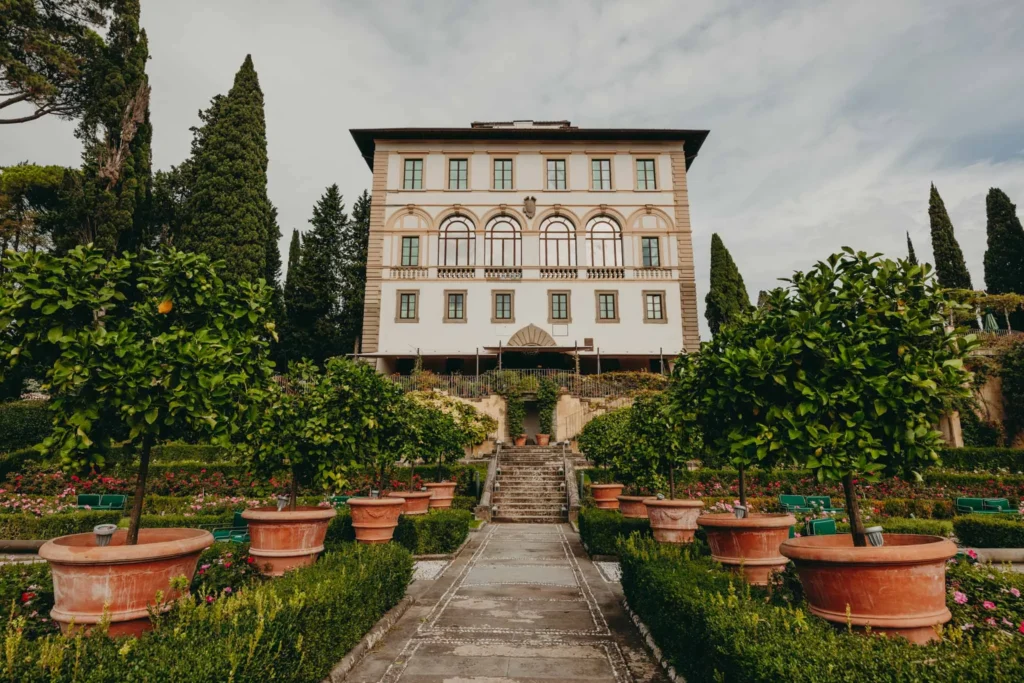
A small town in the hills northeast of Florence, Fiesole offers a peaceful countryside escape close to the city. The shuttle gets you to the center in just 15 minutes, and each evening you return to this peaceful spot with sweeping views of Florence. It feels like the best of both worlds – countryside charm with city convenience.
Scenic views and luxury hotels define this area, with easy shuttle access to the center representing the main benefit. The tradeoff involves not being walkable to central Florence and having fewer dining options nearby. This works best for those seeking a peaceful getaway that still maintains proximity to urban attractions.
Hotels in Fiesole include the 5-star Villa San Michele, a Belmond Hotel; the luxury Il Salviatino; and the mid-range FH55 Hotel Villa Fiesole. Each provides a different level of service and amenities, but all share that elevated hillside location with views that make you understand why wealthy Florentines have been escaping to these hills for centuries.
The lush hills sit just northeast of Florence, making this a great spot for a luxury escape that feels like the Tuscan countryside. Despite the rural atmosphere, you’re still just a quick shuttle ride from the city center, allowing you to enjoy both the serenity of the hills and the cultural richness of Florence’s museums, restaurants, and historic sites.
Personal Experiences Worth Sharing
Multiple trips to Florence over the past five years have meant staying somewhere different each time, from budget-friendly options to luxury escapes. These personal experiences shaped the recommendations throughout this guide, informed by what worked, what didn’t, and what surprised along the way.
Pietrapiana Boutique Apartments in Santa Croce provided exactly what was needed – a truly great location 10 minutes from both the Duomo and Santa Croce, tucked away from the street with apartment-style rooms ranging from studios to two bedrooms. Having found the best food, coffee, and wine in Santa Croce makes this neighborhood particularly appealing for anyone who prioritizes culinary exploration.
Condotta 16 in the Historic Center offered nice serviced apartments literally around the corner from Piazza della Signoria. For a group wanting a place with multiple bedrooms rather than multiple hotel rooms, this fit the bill perfectly. The penthouse features a terrace with a spectacular view of Palazzo Vecchio’s tower, making it memorable for special occasions or when you want that “wow” factor.
IQ Hotel Firenze in San Marco came after having good experiences at their location in Milan. It’s relatively new with great common areas including a terrace, pool, and more, along with modern, well thought-out rooms. Being about 10-15 minutes from the Duomo in the heart of the University area means the vibe outside leans heavily towards students, which some people find appealing for its authentic, lived-in feeling.
Each stay revealed different aspects of Florentine life. The longer stay that had someone reconsidering their stance about Florence being overrated proved that giving the city time reveals layers beyond the surface-level tourist experience. A more recent trip in spring 2025 confirmed that seasonal timing dramatically affects the experience, with spring offering better weather and slightly smaller crowds than peak summer.
The intention behind sharing these personal experiences is ensuring you have everything needed to choose the right place for you and your travel companions. By the end of considering all these options, armed with information about particular styles, budgets, and preferences, the decision becomes much clearer.
Practical Considerations and Final Thoughts
Florence’s compact nature means everything falls within a 5-20 minute walk if you stay near the center. Public transportation has never been necessary during visits, though the ATAF buses and trams prove useful for reaching the train station or airport from certain neighborhoods. Walking remains the best way to experience the city’s rhythm, stumbling upon hidden courtyards, discovering small artisan shops, and feeling how neighborhoods shift character from block to block.
The choice between staying near all the action versus somewhere quieter with better value represents the fundamental decision most travelers face. If you want a convenient spot close to everything, then Centro Storico is your best bet. For a more local vibe, Oltrarno or Santa Croce deliver that authentic experience. Budget-conscious travelers should look at San Marco or Santa Maria Novella for better value without sacrificing too much convenience.
Avoiding areas west of the train station or too far east near Piazzale Michelangelo makes sense – they’re a bit out of the way and less convenient for getting around. Any of the neighborhoods mentioned in this guide represent great options, each with its own character and appeal.
The most beautiful areas in Florence? Oltrarno and Santa Croce top the list, full of beautiful streets, piazzas, and amazing restaurants. Fiesole up in the hills above Florence is stunning too if you’re looking for countryside views. The blend of urban sophistication and natural beauty creates scenes that justify Florence’s reputation as one of the world’s most beautiful cities.
Spending at least 2 days in Florence is always recommended. If you have the time, 3 days proves even better, allowing for a more relaxed pace, time for day trips to nearby towns like Siena or Lucca, and opportunities to revisit favorite spots at different times of day. The city reveals itself gradually, with early mornings and late evenings offering dramatically different experiences than midday when tourist crowds peak.
The debate about whether Florence is overrated misses the point. Yes, it’s inundated with tourists during peak summer months. Yes, the historic center can feel overwhelming. But advocating for visiting and staying for the better part of a week allows you to see the value Florence offers beyond the initial impression. It’s a beautiful city with tons of history – the Medici family drama in real life surpasses anything fictional writers could invent. The huge impact on art history alone justifies the visit, and the great food from Tuscany’s bounty of ingredients transforms meals into memorable experiences.
Each neighborhood covered offers a different blend of vibes, prices, pros, and cons. Being well aware that some people are currently ready to throw their left shoe at the screen demanding to know the best place to stay, the reality is there’s no single answer. The best place depends on your after, your budget, your tolerance for crowds, and whether you want to be in the middle of the action or prefer a quieter, more residential setting.
The philosophy when deciding on a place to stay involves first choosing the neighborhood, then moving on to finding a great hotel, hostel, or apartment in that area. This approach ensures the location matches your needs before getting caught up in amenities or price comparisons. Depending on what you’re looking for, there might be other neighborhoods not included in this guide that could meet your needs, but these represent the best options for 99% of travelers.
General terms suggest that the best places to stay are located within a short walk of the Centro Storico, where you’ll find the Duomo and Piazza della Signoria. However, Florence’s historic center is absolute madness during peak hours in spring, summer, and fall. That’s why several neighborhoods covered offer a less hectic, slightly more residential feeling, which is generally preferred when traveling.
In the end, doing your best to explain why certain neighborhoods work requires showing your work, walking through reasoning, and being honest about tradeoffs. Structure with headings, a helpful summary at the top, and detailed sections helps navigate without reading literally every word, though the details matter for making an informed decision.
Whether it’s your first time or a return visit, whether you’re planning a night or two or settling in for a week, whether you want to avoid the more touristy areas or embrace being in the heart of it all – understanding these neighborhoods and their distinct characteristics empowers you to choose wisely. And in a city as spectacular as Florence, where you stay can dramatically shape not just your convenience but your entire experience of this remarkable Tuscan capital.