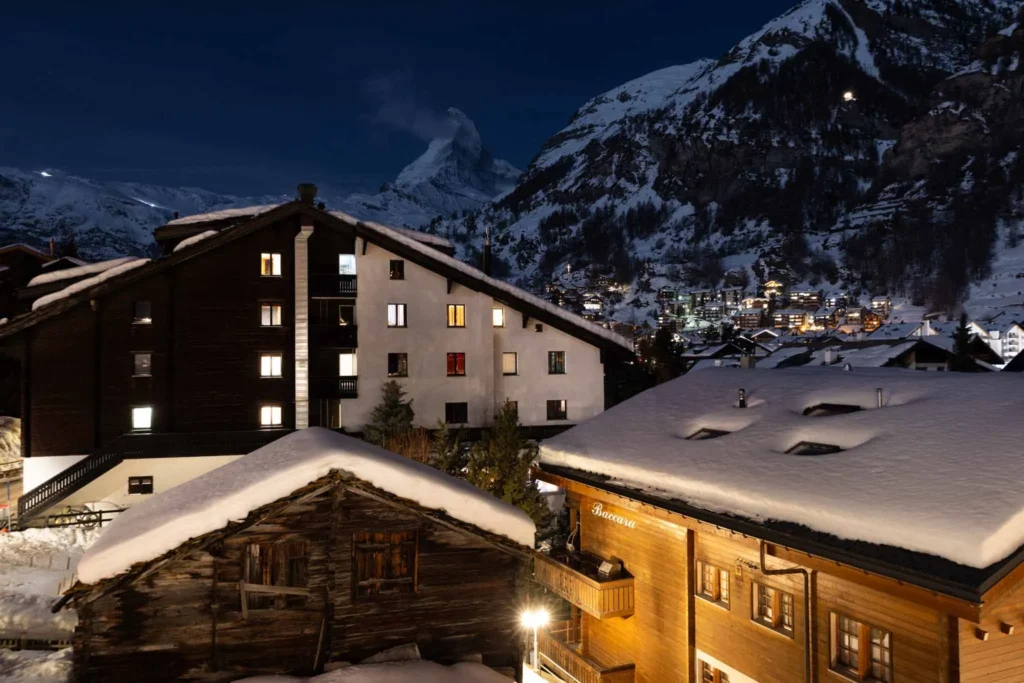
There’s something almost mythical about waking up in a wintry Alpine village where snow-capped views greet you at every turn, and the Matterhorn stands like a sentinel against the sky. This isn’t just another glamorous winter destination tucked high in the Swiss Alps—it’s the kind of place that makes you reconsider everything you thought you knew about a proper ski trip or mountain getaway.
I’ll be honest: planning a winter trip to Zermatt Switzerland felt like tackling one of those dream trips that always seemed just slightly out of reach. My husband and I had been talking about it for two decades—literally—but the cost of flying from Canada’s west coast to the Alps, combined with what seemed like intimidating logistics, kept pushing it further down the list. Then February rolled around, we found ourselves nearby in Spain, and I thought, “If not now, when?” So we did it. We spent five days skiing, taking in the sights, letting the scenery wash over us, indulging in incredible food, and soaking up that cozy mountain vibe that makes Zermatt such an all-around winter destination.
Even if you’re not exactly a winter sports fan, there’s plenty to keep you busy here. You can ride the Matterhorn Glacier Express to the highest station in Europe, wander through the cute village streets, or dedicate an entire day to relaxing at a spa. From ski to après-ski and everything in between, this is your complete guide for making the most of a Zermatt ski holiday.
Why This Mountain Paradise Deserves Your Attention
Table of Contents
ToggleWhen we started looking at options for our first European ski trip—keeping in mind we only had four nights to work with—we wanted something specific: a destination that would deliver memorable experiences even if snow conditions weren’t perfect. France’s Trois Vallées came up in conversation, but ultimately we chose Zermatt Ski Resort, Switzerland.
What drew us in? The idea of a fairytale village nestled beneath the Matterhorn was compelling enough on its own, but add in the scenic train journey to get there, funiculars and gondolas whisking you up to dramatic peaks, cozy fondue spots perfect for long on-piste lunches, and a lively après-ski scene that actually lives up to its reputation—well, it became an easy choice.
Transportation played a bigger role in our decision than I’d anticipated. Landing at Zurich Airport (ZRH) meant we could hop on a train and arrive in Zermatt in roughly three and a half hours. For a first ski trip to Europe, that felt surprisingly doable. The pedestrian-friendly, car-free village—where only small electric taxis and buses shuttle people around—added another layer of appeal. There’s something refreshing about a place where you can’t hear engines revving or smell exhaust fumes.
We weren’t counting on perfect snow conditions, but the high elevation and glacier access at this Switzerland ski resort seemed encouraging. The village sits at 1,620 meters (5,315 feet), while the highest gondola reaches an impressive 3,883 meters (12,740 feet). Zermatt’s Matterhorn Ski Paradise also boasts one of the longest seasons in Europe, typically running from late November through early May. That extended window takes some pressure off timing everything perfectly.
Understanding the Mountain Layout and Terrain
Switzerland’s Zermatt Ski Resort is officially called Matterhorn Ski Paradise, and it’s Europe’s highest ski resort. This isn’t just marketing speak—you’re looking at the world’s highest gondola at 3,883 m, covering 360 km of runs serviced by 54 lifts. The scale can feel overwhelming at first, especially since this is a large ski mountain that can be tricky to navigate your first time out.
Let me break down what you need to know about the terrain. Here, there are two types of skiing: piste and off-piste. Piste refers to groomed, designated ski runs, while off-piste describes natural, ungroomed terrain outside of marked trails. If you’re looking to explore off-piste terrain, consult a professional guide—in most cases, guides are required and must be booked in advance.
When studying the ski map, pay close attention to the color of the runs, which indicates the level of difficulty. Blue means Easy Difficulty, Red signals Medium Difficulty, Black warns of Hard Difficulty, and Yellow marks Off-Piste areas. This color-coding system is consistent across the resort, making it easier to plan your day.
One of the most remarkable things about skiing in Zermatt is that it connects to the Italian ski resort of Cervinia. This area can be included in a day ski pass and is easily accessible from the top of Matterhorn Glacier Paradise. The Italian side of the mountain is quite large and will definitely take a full day to explore. You’ll find mostly red runs, some blues, and a few blacks—an excellent option for intermediate to advanced skiers, and for those of us who want to eat a homemade plate of spaghetti for lunch. An International ski pass can be purchased for just a small premium above a regular pass (tickets available at matterhornparadise).
We chose not to ski over to Italy during our short stay in Zermatt, though it’s something we’d love to have checked off the list. There was a chance the weather could shift and leave us stranded on the Italian side—a risk we weren’t willing to take when we had limited time.
I counted at least 40 restaurants on the Zermatt ski resort map, though from what I’ve read, there may actually be over 50. The beauty of it is that many are independently run, each with its own distinct charm and atmosphere. (I would like to take this moment to throw a little shade at my home resort, Whistler Blackcomb—with its 17 disappointing, overpriced, characterless Vail Resorts-run establishments—Zermatt is a refreshing change.)
Three Distinct Ski Sectors Worth Exploring
The ski area is divided into three main sections, each with its own character, terrain, and access points. Before our trip, I wondered whether we’d even be able to cover it all, but thanks to the resort’s efficient lift system with minimal wait times, it turned out to be no problem at all.
Getting to each of the three base access points from within the village of Zermatt was surprisingly easy. With a valid lift pass, you can ride the town’s electric buses for free. If you’re not staying near your preferred lift, just hop on a bus—it’s only an 8-minute ride between the Sunnegga Funicular at one end of the valley and the Matterhorn Express at the other. The Gornergrat Railway station sits right in between the two.
Each day, we chose our starting point based on where we wanted to end up for lunch. If there’s a particular restaurant you’re hoping to visit—especially one with an epic patio view—make a reservation. It’s worth it.
It should be noted that the Zermatt ski resort trail map is presented horizontally, but the far left (Sunnegga) is in the north and the far right (Matterhorn Express) is in the south. I only mention this because if you’re using Google Maps as you move around Zermatt, the default orientation is north-south. The Matterhorn Ski Paradise trail map is available online for reference.
Sunnegga-Rothorn is accessed via an underground funicular from Zermatt, followed by gondolas to Blauherd and Rothorn (3,103 m). This area offers sunny slopes with a variety of terrain and is especially popular with families and intermediate skiers. If you’re staying in the village, The Sunnegga is one of three main access points to different parts of the mountain. This funicular railway takes you up to the Sunnegga–Rothorn area, where we spent most of our time. There are plenty of red and blue runs, along with some off-piste options—a great part of the mountain for beginner to intermediate skiers. You can also reach the central area of the mountain by skiing the Fluhalp run to Hohtälli, which connects you to the top of Gornergrat.
Gornergrat is reached by the scenic Gornergrat Railway, a cogwheel train that climbs from the village of Zermatt up to 3,089 meters. This central sector is known for its wide, cruising runs and iconic Matterhorn views. It’s a great area for intermediate skiers and those looking for a relaxed alpine experience. The Gornergrat Railway is included in the Zermatt ski pass and serves as both a sightseeing option and ski access. This scenic railway takes you up to the top of Gornergrat, an area mostly made up of blue and red runs with some off-piste options—a great spot for beginner to intermediate skiers.
To reach Gornergrat by cable car, take the Matterhorn Express from Zermatt to Furi, then transfer to another cable car from Furi to Riffelberg. From there, you’ll find plenty of red runs to ski down, or you can hop on the Gornergrat Railway to reach the top.
Matterhorn Glacier Paradise / Schwarzsee represents the highest section of the resort, accessed via the Matterhorn Express gondola and the 3S cable car to Klein Matterhorn (3,883 m). Here you’ll find glacier skiing, snow-sure conditions, and the option to ski over the border into Italy. The Matterhorn Express is a cable car system that gives you access to both Gornergrat and Matterhorn Glacier Paradise.
To reach Matterhorn Glacier Paradise, take the Matterhorn Express from Zermatt to Furi, then continue on a second cable car from Furi to Trockener Steg. From here, you can ski down a few red runs or connect to the Matterhorn Glacier Ride to reach the summit.
If you plan on skiing into Italy, be mindful of the weather—lift closures due to changing conditions can occasionally prevent return access to Switzerland, so plan accordingly if you’re considering a cross-border day.
What Actually Skiing Here Feels Like
One of the biggest surprises for me at Zermatt was how impeccably groomed the runs were. I’ve never experienced anything quite like it in the U.S. or Canada. To be fair, we didn’t have any fresh snow while we were there—we had three incredible bluebird days—but still, I didn’t ski over a single mogul the entire time. I also didn’t see a single person fall, just one slow tip-over that may have been the result of a liquid lunch.
It all felt very safe. Almost too safe, if I’m being honest. Do I secretly enjoy a little element of danger on the slopes? Maybe. But honestly, it was kind of relaxing—long cruiser runs with jaw-dropping views of the Matterhorn. Not a bad trade-off when you think about it.
The lift experience itself proved to be more cultural than anything. This is Switzerland, after all—land of fast, efficient lifts and trains that run like clockwork. What I didn’t expect, however, were the line budgers. I read someone describe the lift lines as more of a “lift scrum.” There are no alternating lanes, and queues do not seem orderly. Instead, people form a kind of semi-circle that gradually shuffles forward. Hesitate for a moment, and someone will inevitably slide in and claim the space. At first, I found this totally offensive. But once I caught on, I embraced it like a new sport.
To try to understand this, I turned to Reddit. From what I gathered, Zermatt skiers aren’t particularly bothered by line budgers—probably because the lift lines move quickly. And honestly, I could see that being true. Once again, I’ll cite my annoyance with Whistler Blackcomb, where 40-minute lines are not uncommon. God forbid anyone tries to budge in front of you there.
Here’s a true story: On just my second lift ride of the day, someone swooped in from behind while I was standing in a perfect row of 4 and stole my chair—mid-sit! I was pushed off to the side a bit stunned while the lift carried on without me. Now, for context, one of my many hobbies is silently judging people who mess up the lift line flow—so imagine my horror when I became one of them.
The Art of Long Mountain Lunches
The phrase “skiing to lunch” perfectly sums up the Zermatt ski experience, in my opinion. All morning long, I’d glide past incredible-looking mountain restaurants, and by 11:00 a.m., lunch was all I could think about. Zermatt offers some of the most unforgettable on-mountain dining experiences in the Alps. A long, leisurely lunch on a terrace with Matterhorn views is an absolute must.
Here’s a tip: The following restaurants are extremely popular—advance reservations are highly recommended, especially during peak ski season. We saw many people without them being turned away, which felt terrible to witness.
@Paradise was a standout for its stylish vibe, fusion-inspired menu, and unforgettable Matterhorn views. It’s modern, relaxed, and always buzzing—perfect for a long lunch in the sun. This was my personal favorite, though there are many great options worth exploring.
Chez Vrony is iconic and beloved for good reason. Vrony serves organic, alpine cuisine in a chic-rustic setting with spectacular scenery. It’s a Zermatt classic that lives up to the hype and comes Michelin recommended. This was one of the best restaurants in Zermatt and our most memorable meal overall. If you want a table, book well in advance—we reserved about a month ahead. The setting is unbeatable, with stunning, unobstructed views of the Matterhorn, and the interiors feel like a refined mountain villa.
Findlerhof sits right next to Chez Vrony in the hamlet of Findeln and offers a warm, welcoming atmosphere with some of the best food on the mountain—particularly if you love Swiss-Italian flavors.
Restaurant Zum See is nestled below the slopes in a charming 350-year-old chalet known for its gourmet Swiss dishes and peaceful ambiance. It’s a wonderful reward after a morning of skiing and also carries Michelin recommendations.
Alphitta delivers great Swiss comfort food, friendly service, and often live music. It’s a local favorite with plenty of character and amazing views that make every bite taste better.
Fluhalp sits high up on the mountain with sweeping views and a festive vibe. It’s known for hearty alpine dishes and live music on the terrace—a top pick for sunny ski days when you want the full Alpine experience.
Bergrestaurant Blatten has history on its side. What used to be a teahouse in 1850 is now a traditional mountain restaurant that’s been family-run for over 40 years. With exceptional service and attention to detail, this is a great place to enjoy a late lunch on the mountain.
When the Skiing Stops and the Party Starts
Unlike lunching in Zermatt, I feel like après ski is something best discovered organically. For us, it happened as we skied down from Sunnegga and spotted a sign that read, “Champagne in 100m.” Moments later, a beautiful patio with Matterhorn views came into sight. With just a glance and a nod, we found ourselves sipping bubbly in the sun.
Champagner Bar Teehäuschen Flor is a charming, low-key hut tucked beside the slope, offering champagne by the glass and cozy alpine vibes. It’s the perfect spot for a bubbly break with Matterhorn views that make you forget about tired legs.
Hennu Stall is a slope-side institution known for wild parties, DJs, and dancing in ski boots just above the village. Be mindful of the fact that you need to ski out when you finish up at this notorious party place—don’t let the schnapps make you forget that detail.
Cervo Mountain Resort operates a chic terrace bar offering craft cocktails, DJ sets, and stunning Matterhorn views. It’s where people go when they want to feel stylish while still wearing ski gear.
Harry’s Bar (also called Harry’s Ski Bar) is an always-buzzing outdoor bar and an après-ski favorite. Come here for low-key vibes, good music, and tavern-style drinks. It’s a casual, energetic hangout in town near the Sunnegga base station—ideal for beer, good company, and dancing in ski boots when the mood strikes.
Adler Hitta features a sun-filled outdoor terrace, live music, and cocktails crafted to perfection, all with a backdrop of picturesque mountain vistas. What more could you ask for after a day on the slopes?
Papperla Pub is a lively, friendly spot in the heart of Zermatt, popular for live music and après vibes that feel authentic rather than forced.
Exploring the Village on Foot
Zermatt is small enough to explore on foot and charming enough to make you want to wander every corner. It doesn’t take long to see the whole village, and it’s definitely worth exploring on a day off from the mountains or when you need a break from the skiing routine.
Bahnhofstrasse starts the moment you step off the train and stretches all the way to the Parish Church of St. Mauritius. It’s considered Zermatt’s main street, where you’ll find a mix of designer stores, local artisan goods, and plenty of hotels, restaurants, and bakeries. Along this charming, car-free strip, you’ll encounter everything from luxury Swiss watches (Breitling, Hublot) and high-end outdoor gear (Moncler, Bogner) to stylish boutiques and artisanal gifts. It can get a bit crowded with tourists, but it’s well worth a stroll.
Hinterdorfstrasse is the old part of the village and, for many, the heart of Zermatt. Ancient barns, homes, and shops line the narrow streets, some dating back to the 16th and 18th centuries. Walking here feels like stepping back in time.
Parish Church of St. Mauritius dates back to 1285 and serves as a central part of the local community. Inside, you’ll find a beautiful mural of Noah’s Ark painted along the ceiling, along with notable altars and a historic baptismal font.
Even a simple trip to a grocery store can be unexpectedly fun. I had set out in search of some top-quality Swiss chocolate to bring home, but somehow my husband and I became hopelessly addicted to these little Kambly Matterhorn cookies made with Swiss chocolate. We ended up bringing about a dozen boxes home. As I write this, we’ve officially run out, and I’m sad about it. They’re the perfect gift to say you’ve just been to Zermatt without actually saying you’ve just been to Zermatt.
Scenic Viewpoints and Ice Activities
Not far from the village center and an easy hike up, there’s a beautiful viewpoint that’s the perfect spot to take in and admire the magnificent Matterhorn. You can find the viewpoint on Google Maps, and it’s worth the short climb for the unobstructed views.
The Gornergrat train is a great activity whether you ski or not. Easily accessible from the village center, this scenic ride takes about 33 minutes to reach the top. Climbing a vertical distance of 1,469 meters, you’ll enjoy some of the best views of Zermatt on the ride. You can catch the train at the Zermatt Gornergrat station in the center of town. If you purchase a ski pass, the Gornergrat train is included. Otherwise, you can buy a separate train ticket online.
The Matterhorn Glacier Paradise is a cable car that takes you to the highest mountain station and viewpoint in Europe. Reaching an altitude of nearly 4,000 meters above sea level, the views from the top are unbeatable on a clear day. We went up on a foggy, windy day and could only stay outside at the viewpoint for a few minutes—it was freezing. Sadly, we didn’t get the panoramic views, but honestly, the ride alone was worth it, even though I couldn’t think too much about how high up we were. Originally, we had planned to do the Matterhorn Alpine Crossing, which takes you over to the Italian side of the resort via the Glacier Express cable car. Unfortunately, the cable car into Italy was closed due to weather conditions. But if you’re looking to combine the viewing platform with a cross-border adventure, it’s a great option on a clear day. The Matterhorn Glacier Paradise is included in the ski pass. If you don’t have a pass, you can purchase tickets separately online.
Located right in the village center, Ice Rink Zermatt is an outdoor rink that’s free to the public from November through mid-March. While skate rentals aren’t available directly at the rink, there are plenty of rental shops nearby where you can find more information about rentals.
Wellness and Relaxation Options
Spending a relaxed day at one of the spas in Zermatt can be the perfect counterbalance to active days on the mountain. Ātman Mountain Spa is inspired by the wisdom of different cultures and takes a holistic approach to wellness with steam baths, Bhutanese herbal baths, Japanese-inspired onsens, and Mongolian yurts.
SCHLOSS Zermatt is centered around the benefits of CBD and adaptogens. This spa offers a range of saunas, baths, relaxation areas, and treatment rooms focused on vital recovery and rejuvenation.
Hotel Alpenhof Zermatt features multiple saunas, baths, and a variety of treatments. This cozy mountain spa is ideal for unwinding after a full day on the slopes.
If your accommodations don’t have wellness facilities, several hotels offer day passes to their wellness areas—complete with saunas, steam rooms, outdoor hot tubs, and Matterhorn views. Two standout options are the Cervo Ātman Mountain Spa and the Spa Nescens at the Mont Cervin Palace.
Beyond Skiing: Museums, Farms, and Mountain Adventures
If you have someone in your party who doesn’t ski or snowboard—or you’re simply taking a day off the slopes—Zermatt has plenty to offer.
The Matterhorn Museum is tucked beneath the village square. This beautifully designed museum brings Zermatt’s mountaineering history to life. Exhibits include artifacts from the dramatic first ascent of the Matterhorn, reconstructed alpine homes, and stories of life in the valley. You can click online for tickets or to learn more.
You don’t have to be a skier or snowboarder to enjoy one of those mountaintop lunches that the Alps are so famous for. Hop aboard the scenic Gornergrat Bahn Railway from town and stop at one of several stations with restaurants just a short walk away. Note that access to the Gornergrat Railway is included in a lift ticket but will otherwise need to be purchased separately.
At the Gornergrat Summit, you’ll find the Glacier Alpine Kitchen, located within the 3100 Kulmhotel, serving a modern Alpine menu with panoramic mountain views. At Riffelalp Station, both Alphitta (Swiss cuisine) and Al Bosco (Italian) offer hearty mountain fare with stunning Matterhorn vistas. For a memorable meal near Riffelberg Station, head to Riffelhaus 1853—a historic hotel with a charming restaurant and sun-soaked terrace.
Visiting the Julen Black Nose Sheep Farm to learn about their Valais Blacknose sheep was my favorite off-mountain activity in Zermatt. The Julens run several hotels in town, the well-known Restaurant Schäferstube, and this charming farm where you can join a guided tour on Wednesday evenings (winter only, departing from the Hotel Julen). The tour is both informative and delicious, with tastings of their farm-produced goods. Guests gain insight into the family’s sustainable farming practices and learn about one of their newest initiatives: a biogas plant that converts over 1,700 tons of the town’s organic waste into clean energy. To learn more or book a tour, visit julen.ch.
Non-skiers can take the Matterhorn Express gondola or the scenic Gornergrat Railway for breathtaking views of the Alps, including the iconic Matterhorn. At the top, you’ll find a panoramic viewing platform and the Glacier Palace—an enchanting ice cave inside the glacier. There’s even the chance to book a paragliding flight for a once-in-a-lifetime descent over the snow-covered peaks. The most highly rated activities include a Matterhorn Tandem Paragliding Flight (20-25min), Mount Gornergrat: Zermatt’s Spectacular Summit (3 hrs), and a Zermatt Guided Walking Tour (2hrs). These are available on Viator.com.
Dining Experiences Around the Village
For a complete list of favorite spots to eat in town, check out dedicated Zermatt Restaurant Guides online, but here are some highlights worth mentioning.
Wallisterstube served the best fondue we had in Zermatt. You can order a variety of side dishes to accompany it—cured meats, pickled vegetables, and potatoes. Their menu is varied, so you can also get dishes like cordon bleu and pasta.
Whymper Stube is a warm, wood-paneled restaurant filled with old antiques and red checkered tablecloths. Come here for Swiss classics. We ordered the fondue, raclette, and schnitzel, and everything was delicious. They’re known for their fondue, so make sure to order it here.
Backzeit Bakery is a small organic bakery and café serving fresh cinnamon and cardamom buns. This quickly became our go-to stop for morning coffee and pastries, and we loved everything we tried.
Petit Royal Café is a charming café in the heart of Zermatt with amazing pastries and hot drinks. We got the Budapest meringue and hot chocolate—highly recommend both. They also have a full breakfast and lunch menu.
Getting There: Trains, Airports, and Transfer Logistics
Getting to Zermatt can take a bit of time, but with a little planning, it’s a pretty straightforward journey. We took the train from Zurich to Visp, then transferred to a smaller train that winds up the canyon to Zermatt. The whole trip took just over three hours.
Once you arrive, the train drops you off at Zermatt Station, right in the center of town. We walked to our accommodation, but there are plenty of electric taxis available if you’d rather not haul your bags. There are also two free electric bus routes (red and green) that pass through the station. You can check the timetables online.
One thing to note: Zermatt is a pedestrian-only town. Aside from the electric taxis and limited buses, there are no cars. That means the only way to get to Zermatt directly is by train. Luckily, since it’s such a popular destination, finding a train from wherever you’re coming from is usually pretty easy.
Popular train routes include Geneva to Zermatt (about 3 hr 53 min), Zurich to Zermatt (about 3 hr 15 min), Milan to Zermatt (4 to 6 hours depending on the route), and Bern to Zermatt (about 2 hr 10 min). You should purchase your tickets ahead of time at SBB, the official Swiss train site.
Since Zermatt is car-free, the closest you can drive is to the town of Täsch, 5 km away, where you’ll transfer to a 12-minute shuttle train or an electric taxi into town. If you’re flying into Switzerland, Zermatt is easily reachable by train in under 4 hours from both Geneva and Zurich airports with one train change along the way. This allows for a pretty seamless start to most Zermatt ski holidays.
The closest airport to Zermatt ski resort that services international flights is actually Milan, Italy’s MXP, located 86 km away, compared to Zurich International’s ZRH at 170 km. However, Italy’s train system is less seamless, requiring at least two transfers, so the journey to Zermatt often takes longer.
From Zurich Airport (station: Zürich Flughafen), our train journey to Zermatt involved a single transfer in the town of Visp. We purchased train tickets from the Swiss Rail (SBB) office at the airport, one floor above the train platform, although kiosks were also readily available. Tickets can also be pre-purchased online at sbb.ch/en.
Honestly, the whole process was quite easy. We were even able to take an elevator straight down to the train platform with our luggage still on our airport luggage cart. The most stressful part of the journey was making the 7-minute train change in the town of Visp.
Here’s a tip: Download the SBB app ahead of time. It provides helpful information like train arrival times, platform numbers, and more. I took photos to help understand how to find the correct letter on the platform for 1st and 2nd class train cars. When you know you only have a couple of minutes to board—with, quite possibly, a bunch of luggage—you want to be in the right place.
Understanding Swiss Rail Discount Options
When you start researching train travel for Zermatt ski trips, you’ll come across a variety of money-saving Swiss Rail passes. I’m not going to lie—it’s all a bit confusing. Let me do my best to explain, with my recommendation for those only visiting Zermatt ski resort at the end.
The Swiss Half Fare Card offers 50% off most trains, plus buses, boats, and mountain lifts for sightseeing, for a full month at 120 CHF. This can be a good value even for short stays, especially if you’re booking 1st class tickets or if your travels include more than just Zermatt. Note that the SBB site defaults to pricing with the Half Fare Card factored in, which can be confusing.
The Saver Day Pass allows unlimited travel on a single day across most of Switzerland’s public transport network. Prices start at CHF 29 (with a Half Fare Card) or CHF 52 (without), increasing closer to your travel date. Prices vary and availability is limited. When I booked a few weeks out, I found very little availability at the lowest price for our travel dates, so this didn’t help us.
The Swiss Travel Pass covers unlimited travel on consecutive days throughout Switzerland, including scenic train routes and free admission to over 500 museums. It’s expensive upfront and only cost-effective if you’re traveling every day and visiting multiple destinations.
For our trip from Zurich Airport Station (Bahnhof Zürich Flughafen) to Zermatt Station (Bahnhof Zermatt GGB), an SBB office agent recommended first-class tickets along with the purchase of the Swiss Half Fare Card (+120 CHF per person) so we’d have extra space for our luggage. Even though we only used the Half Fare Card for one round trip, it still saved us about 25% on regular first-class ticket prices.
Was 1st class worth it? On a quiet Monday, I’d say first class wasn’t worth it. We didn’t notice a significant difference between the first- and second-class train cars on this route. However, on a busy Friday afternoon or during other peak travel times—when space is tight and everyone’s juggling luggage—the upgrade could be worth it, especially if you value a bit of peace of mind.
In most cases, I’d recommend simply buying a regular second-class train ticket. Or, if you’re confident about your travel dates and times, pre-purchase a Saver Day Pass for second class. Then put the money you save toward a special lunch on the mountain. There is an option to reserve a seat in certain cars (like the family car) on certain routes for +5 CHF, but most people do not bother.
Moving Around Once You Arrive
Once in Zermatt, getting around is incredibly easy. The train drops you off in the heart of town, and most hotels offer complimentary electric shuttle pick-up. That said, Zermatt is so compact that many properties are just a short walk from the station—quite manageable as long as you have rolling luggage.
Speaking of luggage: since we were also traveling elsewhere in Europe (Spain) on this trip, we packed light for Zermatt, bringing only our boots, helmets, and ski clothes. We rented skis and poles in town, which was super easy. We chose FlexRent because it was the closest to our hotel, but there are plenty of other options. FlexRent also rents snowboards, boots, helmets, ski jackets, and ski pants.
Your mountain ski pass includes free e-bus transportation within town, and there are also plenty of e-taxis available. In our case, we walked everywhere except for one morning when we wanted to get to the gondola from our hotel—an 8-minute ride. The village is so beautiful you’ll want to experience it at a relaxed, walking pace.
Zermatt is a pedestrian-only town, aside from the electric taxis, buses, and bikers. It’s incredibly walkable and super easy to get around. While most of the main sights in the village are best explored on foot, you can also hop in an electric taxi or use the free electric bus to get around. The bus has two routes, red and green, that connect all the main access points to the ski mountain and key spots in the village.
The Sunnegga funicular railway is centrally located. Our accommodation was close enough to walk there every day, but you can also take a taxi or hop on the bus, which stops right in front of the entrance. The Gornergrat Railway is located right in front of the main train station. Depending on where you’re staying, you can walk, take an electric taxi, or use the bus, which will drop you off at the station. The Matterhorn Express cable car system is located just outside the village center. I’d recommend taking a taxi or the free electric bus—both the red and green routes will get you to the stop.
Choosing Your Accommodation Wisely
I’ll admit to obsessing over where to stay in Zermatt. There were a few things I didn’t fully grasp about the layout of the town and ski terrain until I was actually there. Let me share some tips for booking Zermatt ski resort hotels and other accommodations based on my experience.
I was fixated on being close to a lift, but honestly, the village is small, and with three access points to the ski terrain, you likely won’t be far from one no matter where you stay. And if you’re not, you can take a free e-bus or a hotel shuttle, if offered.
I was also fixated on having a room with a Matterhorn view and was willing to pay quite a bit extra for it. The truth is, though, as long as the weather is clear, you’ll probably see the Matterhorn from different vantage points all throughout the day. At our hotel, for example, we had a view from our room, the hotel restaurant, their patio, and even the pool.
There are a couple of lovely hotels up the mountainside, accessible via the Gornergrat Railway, such as the 3100 Klumhotel Gornergrat and the Riffelhaus 1853. If you’re considering either of these, just keep in mind that the trains run much less frequently in the evening, so you’ll need to work around that schedule. We chatted with a couple one night who had to wait an extra hour for the next train.
Winter is Zermatt’s busiest time, especially around Christmas, New Year’s, and the February ski holidays, so book your accommodations several months in advance for the best selection and rates. The top-rated properties for Zermatt ski resort holidays always book out early. I managed to eventually get the place I wanted, but only after checking back daily for a cancellation for several weeks. In the meantime, I booked a fully refundable room on Booking.com as a backup.
Please always take a few extra minutes to read recent guest reviews carefully. You don’t want to be caught off guard by something like a pool being under renovation—especially since hotels aren’t always quick to disclose those details.
Many hotels enforce 5–7 night minimums over peak winter dates. We were there mid-week in February, and our hotel had a 4-night minimum. I actually had a really hard time whittling down my list of the best Zermatt, Switzerland ski resort hotels because there are so many fantastic options.
Three-Star Properties with Character
Hotel Bella Vista in Zermatt is a charming, family-run hotel that offers a warm and welcoming atmosphere with breathtaking views of the Matterhorn. Located just a short walk from the town center and 500m to the Sunnegga funicular, it provides a perfect balance of comfort and convenience, ideal for skiers and those seeking a peaceful retreat. You can check rates for the Hotel Bella Vista on Booking.com.
Hotel Bristol is a cozy, family-run hotel in central Zermatt, perfectly located between the train station and the Klein Matterhorn cable car. Many rooms offer Matterhorn views, and guests enjoy a relaxed atmosphere, a small spa, and a sunny terrace. Check rates for the Hotel Bristol on Booking.com or Expedia.
Four-Star Options for the Mid-Range Traveler
BEAUSiTE Zermatt is a historic boutique hotel that combines modern elegance with alpine charm. Established in 1907, it offers panoramic views of the Matterhorn and is conveniently located near the Sunnegga funicular. The hotel features newly renovated interiors, a spa with an outdoor infinity pool overlooking the mountains, and several dining options. Its proximity to Zermatt’s attractions makes it an ideal base for exploring the region. Check rates for the BEAUsite Zermatt on Booking.com or Expedia.
Relais & Chateaux Schönegg (Hotel Schönegg) is a stylish, family-run boutique hotel perched on a hillside above Zermatt with ski-in access, offering stunning panoramic views of the Matterhorn. Guests arrive via a private tunnel and elevator, adding to the sense of alpine charm and seclusion. The rooms blend modern comfort with traditional Swiss décor, and the hotel’s gourmet restaurant, lounge terrace, outdoor infinity pool, sauna, and spa are perfect for unwinding after a day on the slopes. Check rates for the Hotel Schönegg on Booking.com or Expedia.
Hotel Tannenhof is a centrally located mid-range hotel with clean, simple rooms and good service, typically priced around $$. Antares Hotel is a comfortable 4-star stay close to the lifts with a wellness area and great value, around $$.
Five-Star Luxury for Special Occasions
The Omnia is perched atop a rocky outcrop 45 meters above Zermatt. This five-star mountain lodge seamlessly blends contemporary design with alpine charm. Accessible via a tunnel and glass elevator, the hotel offers 30 rooms, including 12 suites, each featuring private balconies with views of Zermatt or the Matterhorn. Guests can indulge in the spa’s indoor/outdoor pool, Finnish sauna, and Turkish bath, or savor refined international cuisine by the fireplace in the on-site restaurant. The Omnia’s central location provides easy access to Zermatt’s ski slopes and vibrant village life, making it an ideal retreat for luxury and adventure seekers alike. Check rates for the Omnia Zermatt on Booking.com or Expedia.
Grand Hotel Zermatterhof, established in 1879, is a historic five-star hotel centrally located in Zermatt, offering elegant rooms and suites, many with stunning Matterhorn views. Guests can indulge in the Vita Borni spa, featuring a spacious pool, sauna area, and treatment rooms. The hotel boasts three distinguished restaurants, including the Michelin-starred Alpine Gourmet Prato Borni, the French-inspired Brasserie Lusi, and the traditional Swiss cheese eatery called saycheese! With its blend of classic charm and modern amenities, Grand Hotel Zermatterhof provides a luxurious alpine retreat. Check rates for the Grand Hotel Zermatterhof on Booking.com or Expedia.
Schweizerhof Zermatt is a modern, luxury hotel with a full spa and great dining, priced around $$$–$$$$. Monte Rosa Boutique Hotel is Zermatt’s original lodge, typically $$–$$$. The Grand Hotel Zermatterhof is also a classic 5-star hotel with old-world charm, fine dining, and a full-service spa; expect $$$$.
Cervo Mountain Resort is a sleek, design-forward boutique resort with standout views and a cool alpine aesthetic, around $$$–$$$$. Alpen Resort & Spa is a relaxed mid-range hotel with solid amenities, a wellness area, and family-friendly options, usually $$–$$$. Hotel Walliserhof Zermatt is a traditionally styled 3-star hotel in the village center with good service and reliable quality, priced around $$.
Alternative Accommodation: Vacation Rentals
If you’re looking to self-cater or want a more budget-friendly option (since Zermatt is pricey), vacation rental apartments can be a great choice. There are plenty of good options available on platforms like Airbnb, VRBO, and Expedia.
Here’s a tip: Always check the total price, including cleaning and service fees, as these can add up quickly. For short stays of 2-3 days, you might find that a hotel ends up being about the same price once all the fees are factored in.
Making Connections That Matter
I’ve tried to include everything I could think of in this post to help make your first ski trip to Zermatt as seamless and memorable as possible. But there’s one more thing I’d love to suggest: make an effort to connect with people while you’re there. For many—myself included—Zermatt is a once-in-a-lifetime experience, and I truly believe it’s best enjoyed as a shared one.
Here’s a true story from our first evening. The only seats my husband and I could score at a restaurant we were excited to try were at the bar. As the night wore on, we found ourselves seated between a group of friends. We offered to move so they could all sit together, but they wouldn’t hear of it. They insisted we stay and join their party. Wine was shared, schnapps was passed around, and songs were sung. It was absolutely priceless—the kind of memory that stays with you long after the snow has melted and you’re back to regular life.