Standing at the edge of the Cher River, watching the morning light dance across Renaissance towers, I realized why the Loire Valley has captivated travelers for centuries. This sprawling region, positioned roughly two hours southwest of Paris, holds more than 300 castles scattered across rolling hills and alongside winding rivers. The sheer scale of these châteaux never fails to command gasps of wonder from visitors who journey here, whether on a weekend trip or as part of a longer France itinerary.
Back in the day, during the 14th and 15th centuries, the Hundred Years’ War prompted the construction of numerous fortresses designed to protect against an English invasion. These defensive strongholds eventually transformed into fashionable Renaissance residences where nobles could enjoy a countryside escape while staying close to the king, since the French court was based in Tours during this time. Rich folks from Paris would summer in multi-turreted architectural wonders that still stand today.
My first visit to the region in the 1980s revealed mostly empty shells, with many châteaux stripped of their furnishings during the French revolution and then during World War II. Fast forward forty years to the spring of 2025, and I discovered that a lot had changed. Each château I visited was interesting both inside and outside, offering far more than just bare stone walls.
France has over 45,000 châteaux scattered throughout the country, though most are modestly-sized family homes or converted hotels. The major chateaux—the ones people go out of their way to visit—are mostly located in this fabled Loire Valley. The fabulous châteaux here, combined with gently pretty countryside and great food, make this region worth several days of your time. Yes, you could do a quick day trip from Paris to visit two or three of the biggies, but if at all possible, home base in one of the Loire Valley’s many lovely towns and see a châteaux a day for at least five days.
One thing you’ll quickly realize is that most châteaux, particularly the ones I recommend visiting, are incredibly photogenic. It’s almost impossible not to just keep snapping and snapping photos of both the exteriors and the interiors. During my four days in April 2025, I stayed in an apartment in Chinon and toured five of the six châteaux I describe here.
Château de Chambord
Table of Contents
ToggleThe largest and most visited château in the Loire Valley stands like something from a storybook, its whimsical rooftop bristling with spires and chimneys. Construction began in 1519 and took over 150 years to complete, resulting in one of the most remarkable Renaissance landmarks in France. Located only about 90 minutes from Paris, its position makes it an easy day tour if you don’t have your own wheels.
I visited Chambord on my way driving from Paris to Chinon where I stayed for four nights. If you’re arriving at Chambord by car, you’ll arrive first at the very large car park—an indication of just how popular this major château is with visitors. The paid parking lot costs €6 per car. From the parking lot, you’ll stroll toward the château, and it’s pretty hard to miss.
On your way, you’ll pass a kiosk where you can rent a bike, golf cart, boat, or even a pedal car. If you have lots of time to spare, choose one of these options to explore the vast grounds and waterways of the Chambord estate. If you’re only coming for a short visit, as I was, you don’t need to rent a conveyance to take you the short distance over the bridge and to the château.
Chambord is kind of like a Château Disneyland. Its website bristles with opportunities for family fun. Apart from visiting the château itself—a must-do—you can visit the gardens, watch a horse show, attend a concert, view an art show, sample local products and more. If you’re traveling with children, you’ll find all sorts of activities designed to engage them.
The Château Chambord is HUGE! Its architecture is also unusual compared to other châteaux. When you enter, you’ll find four wide vestibules forming a Greek cross plan with the center of the cross occupied by the famous double-spiral staircase. This ingenious design is often attributed to Leonardo da Vinci, although it has never been definitively confirmed. You could be ascending on one side while someone else climbs on the other, and your paths would never cross—two intertwined staircases that twist around each other but never meet.
The cross-shaped plan results in four similarly sized living quarters on each floor of the keep—the central part of the château. In addition, there are two wings: the royal wing to the east and the chapel to the west. You access these wings either from the courtyard or from galleries on the upper floors. Start on the ground floor and wander from room to room in each of the four parts of the cross, then ascend the double-spiral staircase and keep exploring two more floors and the wings. There is a LOT to see.
Inside, the château is surprisingly sparse. Only a handful of rooms are furnished, so much of your visit is spent wandering through large, empty spaces. The main highlight remains that grand double-spiral staircase that winds through the center of the building. If you aren’t interested in visiting the interiors, you can pay to park and explore the paths surrounding the château for free. But if you want to see the formal gardens and interiors, you’ll need to purchase a ticket.
In addition to several richly furnished quarters, highlights for me included Molière’s theater, the art exhibit by Korean artist Kim En Joong, lots of cool stuffed animals, and a fascinating exhibition about how art was stored at the château in WWII.
As a theater buff—my third novel, A Muse of Fire, is set at Covent Garden Theatre in 1809—I always get excited when I see old theatres. At Chambord, the premiere of Molière’s comedy-ballet Le Bourgeois gentilhomme was played in front of King Louis XIV in 1670. Molière’s Theatre is on the ground floor across from the staircase. The theatre you see today was recreated 350 years after the premiere.
When I visited Chambord, a spectacular exhibition of work by Korean stained-glass artist Kim En Joong was featured. The exhibition runs until the end of August 2025. Several rooms on the second floor of the château are devoted to exhibiting Kim En Joong’s work, which includes stained-glass pieces, ceramics, and paintings. The vibrant colors and contemporary vision create an unexpected contrast with the historic setting.
Several rooms included displays of the critters that roam the estate—from bucks to boars to bunnies. I was particularly taken by the boar, standing massive and impressive in its display case.
During WWII, precious artwork from the Louvre was brought to Chambord to protect it from bombing and from being stolen by the Nazis. The exhibition of how the artworks were transported and stored fascinated me because I’d just read The Stolen Lady by Laura Morelli, who I also interviewed on my podcast, The Art In Fiction Podcast—check it out! If you’re interested in art and WWII, you won’t want to miss this exhibition.
In two hours, I barely scratched the surface of everything there is to see at Chambord. While you can definitely see the highlights in two hours, consider spending the whole day there. That will give you time to roam around the grounds, maybe take in a horse show, and spend even more time exploring the 60 rooms in the château that are open to the public.
You can purchase your tickets online before your visit or purchase tickets at Chambord. I visited in April and, while I did purchase tickets in advance, I didn’t need to. However, during the busy summer months, you should probably get your tickets before your visit to avoid line-ups. For info on opening hours and tickets, visit the official website. If you’re already staying in the Loire Valley and would like a guided tour of Chambord, there are two good options from GetYourGuide.
If you don’t have your own wheels, consider taking a day trip to Chambord from Paris. This tour with GetYourGuide includes the three big C’s: Chambord, Chenonceau, and Cheverny—the Loire Valley stars. It’s a long day, but you’ll at least get to see the highlights.
Château de Villandry
If you love gardens, then put the Château Villandry on your must-see châteaux list. Unlike Chambord, the château itself is quite compact for a château, and the gardens can be toured at a leisurely pace in about an hour. You won’t exhaust yourself visiting Villandry.
The magnificent gardens at the Château de Villandry are some of the most beautiful in all of France. The ornamental kitchen garden, with its checkerboard of cabbages and lettuce, the sculpted hedges, the tree-lined paths, and the rose bushes dotted throughout create a Renaissance daydream. I could spend an entire day wandering through these meticulously planned spaces.
The highlight of Villandry—and why people visit—is the sumptuous gardens, reputed to be among the best of all the Loire châteaux, which is saying something. If you’re lucky enough to visit on a sunny day, as I was, you’ll find lots of fabulous angles to snap—some including the château, and others focusing on the gardens. I appreciated that the gardens, while extensive, are easily walkable and also uncrowded. You can see by the pictures that we had the place almost to ourselves.
You have the option to book a garden-only ticket or a combined ticket to visit both the château and the gardens. We were advised to just book the garden ticket, but we got the combo ticket because I wanted to see it all. Surprisingly, the château’s interiors ended up being my favorite of all the castles we explored.
Various richly decorated rooms give you a sense of how the upper crust lived back in the day. I find that, after a while, one gorgeously appointed room looks pretty much like the next. For me, the highlight is the beautifully staged kitchen. There is so much attention to detail, including a bevy of stuffed bunnies—more bunnies!—gamboling through a woodland centerpiece on the table.
The rooms are tastefully decorated with floral fabrics covering the beds and curtains draping the French doors. Soft pastel wallpapers and plenty of natural light make the spaces feel more like a renovated boutique hotel than a historic fortress. I also enjoyed the exhibition of paintings by a local artist that was mounted on the upper floor.
For more information on opening hours and ticket prices, visit the official website. Parking is available across the street from the château, and it is free of charge.
Château de Chenonceau
It’s a toss-up which château—Chenonceau or Chambord—is more famous and more beautiful. My money’s on Chenonceau. While Chambord is remarkable, Chenonceau is classy. With its picturesque setting spanning the Cher River, Château de Chenonceau is often called the most beautiful château in the Loire Valley. It sits regally on the edge of the Indre River with a large gallery that extends across the river.
As you arrive, a long, tree-lined path guides you to the entrance of this 16th-century Renaissance castle. The approach alone sets the stage for the magnificence that awaits. I love Chenonceau’s simple interiors, like the long gallery, with its black-and-white checkerboard floors. Many of the rooms are furnished with tapestries, antique pieces, and fresh flowers that add life to the historic spaces.
The gardens are traditionally manicured and lovely to wander through. And don’t miss the apothecary in the Orangery, designed by Catherine de’ Medici. It’s a fascinating space and one of my favorite rooms in the entire château. The attention to period detail makes you feel transported back to the Renaissance.
It’s also very popular! If you’re traveling there in high season, get your tickets in advance. Full disclosure: I did not visit Chenonceau on my most recent trip to the Loire Valley in April 2025, but I have been twice before and I do think it deserves a place on any château-hopper’s itinerary.
For more information on opening hours and tickets, visit the official website. There is a large, free parking lot right at the entrance to the property, making access convenient and hassle-free.
Château d’Azay-le-Rideau
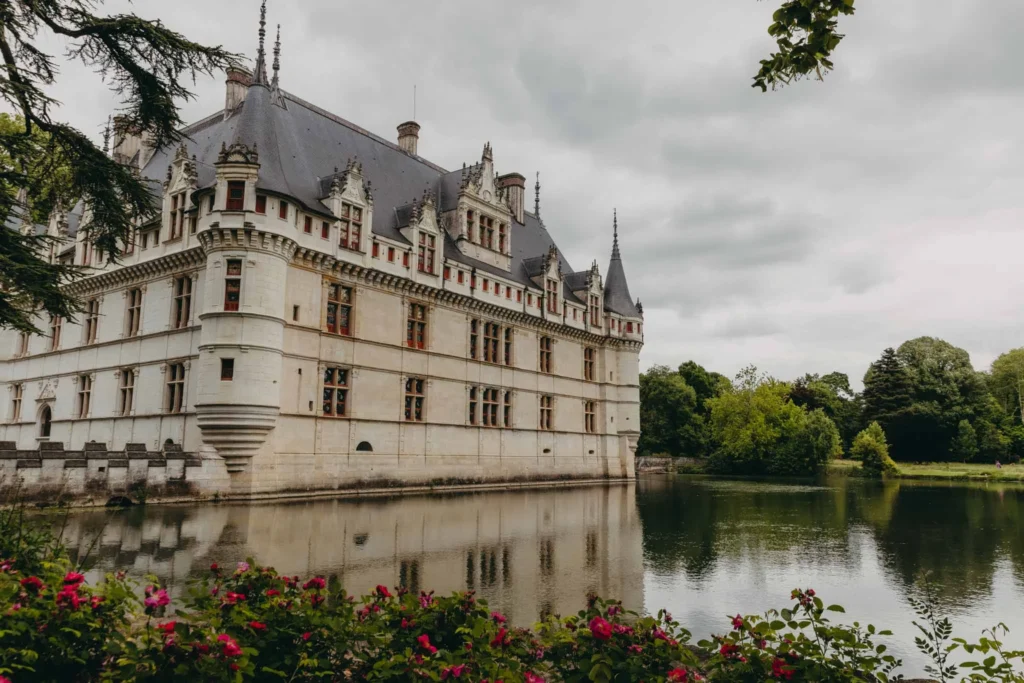
For good reason, Azay-le-Rideau is touted as one of the most beautiful chateaux in the whole of the Loire Valley, if not France. The Château d’Azay-le-Rideau is a 16th century Renaissance castle with an idyllic setting on the banks of the Indre River. Its symmetrical architecture and location surrounded by water make it ridiculously photogenic. I dare you to walk around it and not take photos!
We really enjoyed walking around the grounds and taking a quick tour of the inside. The château is much smaller than many of the others you’ll visit, but the setting and town itself make it worth visiting. There is a nice café in one of the outbuildings—we stopped here for some afternoon tea, which provided a pleasant break in our château-hopping schedule.
When visiting Azay-le-Rideau, you can choose to enter just the grounds for free between 5 and 6 pm. This is what I did. I didn’t feel like touring the interior of the chateau after already touring Chinon, Chambord, and Villandry, and so opted to only view it from the outside. The exterior alone justifies the visit.
If you choose to go inside, you’ll pay €16 and see the usual assortment of sumptuously furnished rooms. You’ll also learn more about the history of the chateau. An hour is sufficient to circumnavigate the château and snap a ton of pictures. During my visit, the late afternoon light made the walls of the château positively glow, creating an almost ethereal atmosphere.
Check out the website for more details. Paid parking is available here. We parked for free across the river here. If you don’t have your own wheels, consider this GetYourGuide guided tour that takes in both Azay-le-Rideau and Villandry in a morning tour.
Chinon Castle
I chose to home-base in a two-bedroom apartment overlooking the Vienne River in Chinon. It turned out to be the perfect location for exploring chateaux in the area. Three of the six châteaux I visited were within a 20-minute drive: Villandry, Azay-le-Rideau, and Ussé, and the castle at Chinon was within walking distance. From Chinon, you could reach Chenonceau, along with many other worthy châteaux such as Ambroise and Blois in under an hour, with Chambord being about 90 minutes away.
Chinon has one of the Loire Valley’s most interesting medieval castles. While many of the châteaux date from the middle ages, quite a few were extensively renovated in the Renaissance and later. Any vestiges of the original fortresses are long gone. Not so Chinon. It still looks like a “real” castle, complete with battlements, towers, and plenty of severe stone-walled rooms that speak to its defensive purpose.
You can walk up to the castle from anywhere in the town of Chinon which meanders picturesquely alongside the Vienne River. That’s what I did—and it’s a stiff walk, albeit with stunning views. Or, you can be smarter than I was and walk through the main square at Chinon and take the thoughtfully provided elevator up to the fortress. Your legs will thank you.
I really enjoyed Chinon Castle because it was different from the fancy dancy châteaux. This was a castle that meant business back in the day. In fact, it’s called the fortress of Chinon, and was the last refuge of Henry II of England, and also hosted such luminaries as Eleanor of Aquitaine, Joan of Arc, and Charles VII. The historical weight of these walls is palpable.
The fortress is actually three castles for the price of one! There’s plenty to see with lots of explanations about the history and its many famous inhabitants. I was quite taken with this massive bed that dominated one of the royal chambers.
I suggest picking up a histopad when you buy your tickets. Histopads were also available at Chambord, and I must say they provide a clever way to enjoy all that a site has to offer. The histopad virtually reconstructs nine rooms in the castle to show you a 360° view of what they looked like in their heyday, complete with sound effects. Here’s how the histopad depicted the kitchen—bringing the medieval space to life in vivid detail.
A highlight of a visit to Chinon are the stunning views over the town of Chinon and the Loire countryside. This area of France really is ridiculously photogenic! The panoramas from the ramparts alone make the climb worthwhile.
I stayed in an apartment in Chinon that was very reasonably priced and included a balcony and a stunning view of the Vienne River. During my four days there, I never tired of watching the light change the river, depending on the time of day. The charming and uncrowded town of Chinon makes a perfect home base if you have a car. There are more options for hotels and apartments in Chinon available for those seeking accommodation.
Château Royal d’Amboise
Once a favorite residence of the French monarchy during the Renaissance, the Château Royal d’Amboise offers some of the best views in the Loire Valley. The gardens overlook the town of Amboise and the Loire River, providing sweeping vistas that capture the essence of this historic region.
Inside, some rooms are decorated with period furniture and tapestries, giving you a glimpse into royal life during the Renaissance. The furnishings and decor help visitors understand how French royalty lived during this golden age.
One of the highlights is the Saint-Hubert Chapel, where Leonardo da Vinci is buried after spending his final years nearby at Clos Lucé. The chapel itself is a beautiful example of Gothic architecture and serves as a fitting final resting place for one of history’s greatest minds.
For info on opening hours and tickets, visit the official website. We parked at Parking Des Tanneurs, just a short walk from Clos Lucé and the center of Amboise.
Château du Clos Lucé
In 1516, Leonardo da Vinci was invited to France by King Francis I. He spent the last three years of his life living just outside Amboise at Clos Lucé, until his death in the spring of 1519. This connection to one of history’s most brilliant minds makes Clos Lucé a particularly special stop.
The château is well preserved and furnished with Renaissance-era pieces. You can visit Leonardo da Vinci’s bedroom and his various workshops, including the spaces where he painted, sculpted, and sketched. His library and study are also open to explore, offering intimate glimpses into his daily life and working methods.
One of the most fascinating parts of the visit is the model room, which showcases 40 different machines designed by Da Vinci and brought to life. It is impressive to see the range of his inventions, including the lifebuoy, early flying machines, and a version of the modern-day car jack. He was truly a man ahead of his time, and seeing these inventions recreated helps you appreciate his genius.
Around the château grounds, you will come across several of Leonardo’s inventions recreated in life-size form. There is also a peaceful terrace café with a fountain, grassy fields, and shaded picnic tables if you plan to bring your own lunch.
Overall, I really enjoyed visiting this château. Getting a glimpse into Leonardo da Vinci’s world made it one of the most memorable stops of the trip. For opening hours and ticket information, visit the official website. We parked at Parking Des Tanneurs, just a short walk from Clos Lucé and the center of Amboise.
Château de Cheverny
Château de Cheverny is a 17th-century castle that has been owned by the same family for more than six centuries. In my opinion, it’s one of the most underrated châteaux in the Loire Valley. The continuity of ownership has allowed the family to maintain and preserve the château in remarkable condition.
The most exceptional room in the castle is the dining room, which features a stunning hand-painted ceiling and detailed wall paneling. The panels tell the story of the Spanish novel Don Quixote and were painted by Jean Monier in the 17th century. The artistry and craftsmanship evident in this room alone justify the visit.
The tour leads you through several other rooms, including the king’s bedchamber, the arms room, and the grand salon. Each space is richly furnished and offers a window into aristocratic life across the centuries.
For more information and current opening hours, you can check the château’s official website. Free parking is available in the château’s parking lot.
Château de Blois
The Château de Blois sits right in the heart of town and combines Gothic, Renaissance, Classical, and medieval styles all in one. This château is a window into French royal history, as it was once home to several kings and queens, including Catherine de’ Medici, Louis XII, and François I. The architectural diversity reflects the different periods of construction and renovation.
Inside, you can explore the royal apartments, decorated with painted walls and ceilings, colorful tapestries, and period furniture. The château also has a Museum of Fine Arts with a collection of paintings and sculptures spanning several centuries. The breadth of art and history contained within these walls is impressive.
Underground parking is available here for visitors arriving by car.
Château de Chaumont-sur-Loire
The Château de Chaumont-sur-Loire sits on a hill overlooking the Loire River and is best known today for its annual International Garden Festival. Built in the 15th and 16th centuries, the château has become a center for the arts, showcasing its Renaissance architecture alongside contemporary art exhibitions throughout the year.
The surrounding park and gardens are a highlight, filled with creative installations that change each season. This blend of historical architecture and modern artistic expression creates a unique experience among Loire Valley châteaux.
You can park at the free car park on the castle grounds.
Ussé Château
The château of Ussé is often called the Sleeping Beauty Castle or, in French, La Belle du Bois Dormant. It certainly has that vibe. Surrounded by peaceful countryside and a bit off the tourist track, Ussé is an excellent choice if you’re looking for a quick and easy château visit—and you’re a fan of Sleeping Beauty, and who isn’t?
The main part of the château has a few nicely furnished rooms, but the real attraction is the Sleeping Beauty turret. Yeah, it’s a wee bit cheesy, but I enjoyed it! You climb up a narrow spiral staircase—warning: it’s pretty narrow so you need to be quite spry—and view various rooms depicting events in the sleeping beauty story. I thoroughly enjoyed it!
A pleasingly laid out formal garden overlooks the Ussé River, and you can also check out the chapel, the stables, and the cellars. Afterwards, relax in the outdoor café near the entrance to the château. The food’s not gourmet, but you can’t beat the view.
Planning Your Loire Valley Visit
I recommend spending at least three days in the Loire Valley. I mapped out all the places I wanted to visit ahead of time, and while we managed to see most of our top château picks, we didn’t get to nearly all the towns and villages on our list. You could easily spend a full week here and still not see it all.
I’ll admit, after three days of château-hopping, I started to feel a bit burnt out. As magical as they are, there’s a point where you find yourself craving something different. If I had more time, I would add on one more day to see a few more towns and explore the local wines more thoroughly.
We visited the Loire Valley during the second to last weekend in May, and it was the perfect time to go. The roses were in full bloom, and the château gardens were absolutely stunning. Late April and early May would also be beautiful, especially if you want to see wisteria and other early spring flowers. The weather is usually mild, though you may get some rain.
Summer and early fall are also great times to visit. You’ll have longer days, plenty of sunshine, and most gardens in full bloom. Just keep in mind that June and July are peak tourist months, so things can get a bit busier. Right at the start of peak season, at the end of May when we visited, we had no issues purchasing tickets on arrival. With that being said, it’s always a good idea to double check the official website for each château, especially if you’re visiting during high season from June to September.
For instance, Château de Chenonceau and Château de Clos Lucé are both very popular, and during busy periods, there may be a long line to get tickets. Purchasing a timed-entry ticket in advance can help avoid long wait times.
Getting Around
The best way to get around the Loire Valley is by car. Unless you book a guided tour, it is nearly impossible to visit all the places on this itinerary using public transportation in the same amount of time. Parking is free at most châteaux and easy to find in the towns. The region is spread out and fairly rural, so traffic is light and the drives are scenic.
We visited the Loire Valley on a weekend trip to Paris. We took the train to Saint-Pierre-des-Corps station just outside of Tours and rented a car from Sixt through Discover Cars. Tours is 30-60 minutes from most of the Loire Valley’s main sights, so if you’re arriving from Paris, I recommend doing the same thing we did.
You can also rent a car in Paris, Nantes, Orléans, or Angers, depending on your trip itinerary. Each of these locations offers convenient access to different parts of the Loire Valley.
If you are arriving by train, I recommend taking the train to Saint-Pierre-des-Corps station in Tours. From there, you can easily pick up a rental car and start your trip. It is the most centrally located station for exploring the Loire Valley. You can also take the train to Angers or Orléans and rent a car from those cities, depending on where you plan to begin your itinerary. All three options are well connected to Paris and other major cities in France.
Nantes Atlantique Airport is the closest major airport to the Loire Valley. It is about a two-hour drive from Nantes to Villandry, making it a convenient starting point if you plan to rent a car and begin your trip right away. The major airports in Paris are your next best option. From Paris, you can either rent a car and drive to the Loire Valley or take a train to a nearby station such as Saint-Pierre-des-Corps, Angers, or Orléans and pick up a rental car from there.
Where to Stay
We chose to stay in the same hotel for two nights during our trip, and I would recommend doing the same. It simplifies things—no need to pack up and check in and out each day. And with such a packed itinerary, the less you have to worry about, the better.
We stayed in the town of Bléré, which is close to Chenonceau and not too far from Amboise. It’s also pretty central, making it a convenient base for exploring the region. I would recommend staying somewhere in this area or near Amboise.
While you could stay in larger cities like Tours or Blois, I don’t recommend it. The Loire Valley countryside is incredibly charming, and staying in a small town or village is the best way to experience it.
La Maison Leonard in Bléré is a characterful hotel run by Fabrice and his partner. This 5-bedroom guesthouse was cozy and the homemade breakfast was a highlight. The location couldn’t have been better—we were minutes from Chenonceau, an hour from Chambord, and 30 minutes from Villandry.
In Amboise, Le Manoir de Saint Thomas offers elegant accommodations. Near Chambord, Chateau des Grotteaux Près Chambord provides convenient access to the famous château. In Cheverny, Les Sources de Cheverny combines luxury with proximity to the underrated Château de Cheverny. For those staying near Azay-le-Rideau, Hôtel Grand Monarque offers comfortable lodging in a charming setting.
If possible, stay awhile in the Loire Valley so you can tour at least three or four châteaux without rushing. Also take time to sample the great local wines, take walks in the beautiful countryside and just hang out. The region rewards slow travel and unhurried exploration.
If I had an unlimited budget, I may consider taking a balloon tour of the Loire Valley with GetYourGuide. The aerial perspective of these architectural wonders and the surrounding countryside must be spectacular. Find great Loire Valley Hotels or rent an Apartment in the Loire Valley. You can also Book a Tour in the Loire Valley for a more structured experience.