Last spring, I found myself wandering down a nondescript entryway on the left-hand side of the Royal Mile, completely by accident. What I discovered behind that unassuming entrance changed how I see Edinburgh forever. This city isn’t just about the castle towering over Princes Street or the bustling Royal Mile packed with tourists—it’s about the secret staircases, the hidden garden spaces, and the tranquil shores where locals actually spend their time.
Dunbar’s Close Garden
Table of Contents
TogglePretty gardens exist all over Edinburgh, but few can match the contemplative moments you’ll find at Dunbar’s Close. Free to enter and open to the public every day, this hidden gem sits right on the Royal Mile, yet attracts visitors in far smaller numbers than you’d expect. The 17th-century knot gardens here were first created in the 18th century when it was common for wealthy inhabitants to grow their own supply of fruit and vegetables behind their townhouse.
Edinburgh writer David Dunbar once owned the adjoining tenements, and by the end of the 18th-century, even Robert Burns found beautiful streets in the centre of the medieval Old Town where he could compose poems. Today, the garden has been revived and boasts 8 garden rooms full of plants and benches offering tranquillity. It’s the perfect escape and an easy way to duck into one of the many closes, wynds, and courtyards that branch off the Royal Mile. Among my favourite closes accessible to the public, this is where year-round beauty meets medieval charm.
The Shore in Leith
Leith serves as Edinburgh’s port area and was once an industrious hub for dockers, glassworks, storage warehouses, and ship-building. Now it’s transformed into a trendy neighbourhood filled with bustling bars, Michelin-starred restaurants, and cosy cafes. One of my favourite places in Leith is The Shore, the main waterfront along the Water of Leith.
Follow the Water of Leith walkway to learn about the history of Leith’s harbour workers near Victoria Bridge. Then visit one of the pubs and restaurants along the waterfront—my favourites include The King’s Wark, built in 1705, and Teuchters Landing. Custom Lane sits at one corner of The Shore on Leith’s cobbled waterfront near the docks. This beautifully converted wharf building by Edinburgh-based architects GRAS now serves as a centre for design. On the ground floor, visitors can access Williams & Johnson café, a gallery, and a workshop area to shop for unusual, handmade objects. The neighbouring Bard is a sensitively styled gallery space dedicated to Scottish craft—check their official website for current exhibitions.
Duddingston
Skirting the south-eastern edge of Holyrood Park, Duddingston remains a quaint, history-steeped village with timber-framed cottages dating back to the 12th-century. The Sheep Heid Inn is said to be Scotland’s oldest pub, and if you’re looking for great food around the corner, you should try the historic establishment.
Hidden within the village lies Dr Neil’s Garden, known to a privileged few as Edinburgh’s secret garden. This tranquil space was started by Drs. Andrew and Nancy Neil, who were convinced that spending time outdoors, immersed in nature with hands in the soil, was beneficial for their patients’ mental and physical wellbeing. They were right—it’s a beautifully restorative space with a small network of paths and benches to rest while enjoying views of Duddingston Loch.
Nearby, Duddingston Loch is the capital’s last remaining freshwater lake, drawing herons, swans, and wading birds to its tranquil shores. Edinburgh has no shortage of relaxing green spaces, but this historic village garden and wildlife haven for birds creates something special. Free to visit, it’s a great place to escape the hustle and bustle of the touristy city centre.
Water of Leith Walkway, St. Bernard’s Well, Dean Village
Follow the leafy walkway along the Water of Leith between Stockbridge and Dean Village, and a Greco-Roman pavilion emerges from the trees. Encircled by classical columns, this elegant structure houses a well once believed to hold healing powers. Fittingly, a statue of Hygeia, the ancient Greek goddess of wellbeing, stands at its centre.
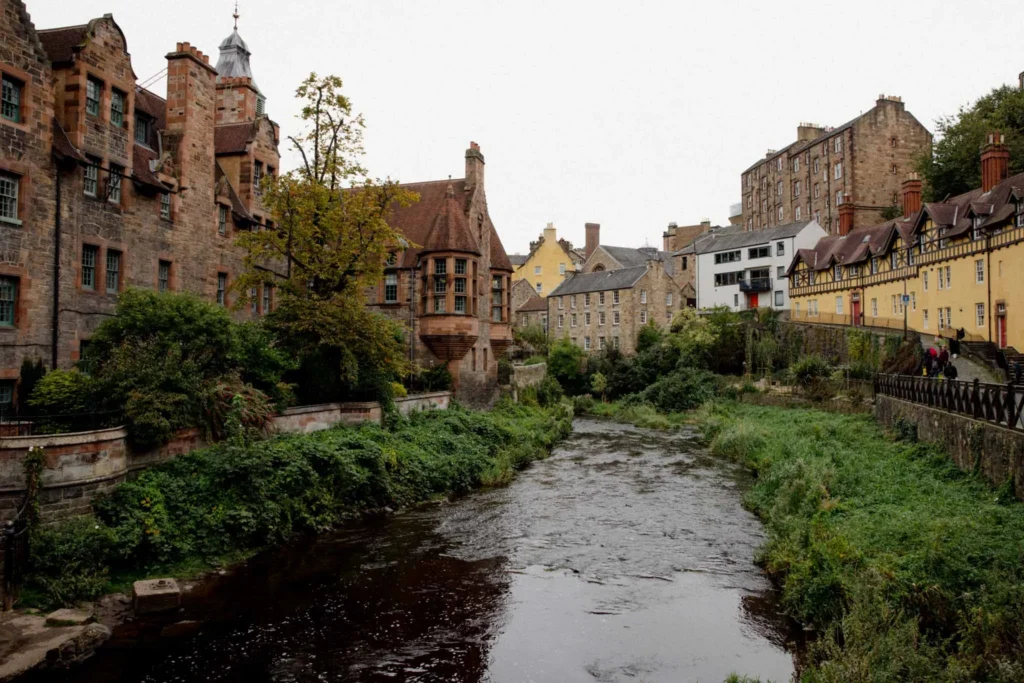
Set aside some time to get lost in the fairy-tale lanes and explore the centuries-old bridges of Dean Village. This area started life as a 12th-century grain milling community, and you’ve probably heard it’s a quaint area and photo-perfect spot. The Victorian and Tudor-style architecture, combined with historic bridges over the Water of Leith, make it unforgettable.
What you might not know is that you could continue to walk the Water of Leith Walkway in either direction. Walk north and continue through the leafy Stockbridge neighbourhood to eventually reach Leith. Walk south and you’ll come past the Scottish National Gallery of Modern Art, the murals at Colinton Tunnel (see below), and eventually reach the village of Balerno at the foot of the Pentland Hills. It’s the most scenic walk in Edinburgh where you can spot historic architecture, eery sculptures by Antony Gormley, and plenty of wildlife. Download the Audio Trail to guide the way.
Cramond
Combine a visit to Lauriston Castle with a stroll along Cramond’s white sandy beach. Check the tide times in advance—you might be able to walk all the way across the Drum Sands to Cramond Island, thought to be an early medieval stronghold. Cramond village itself is brimming with coastal charm, where whitewashed houses tumble down towards the mouth of the River Almond. Elegant swans glide past yachts moored in the harbour. If you’re travelling with your dog, this is a wonderful place to stretch their legs.
Lauriston Castle
This Edinburgh castle sits in a coastal setting overlooking the Firth of Forth, surrounded by Italian gardens and Japanese gardens popular with dog walkers seeking picnics in the tranquil grounds. William Playfair extended the structure in the 1840s, though parts date to the 16th century. The current layout preserves the interior charm left by its final residents, antique collectors Mr and Mrs W. R. Reid, along with Mrs Reid’s brother, Mr William Barton.
The guided tour reveals secret staircases, the old laird’s office, and a cosy library with views of the Forth—the whole place feels like a warm hug. Tours run twice daily, except Monday. The Edwardian interiors have been maintained across centuries, creating an atmosphere that transports you back through time. Don’t miss exploring the woodlands surrounding the estate, and afterwards, grab something sweet at Mimi’s Bakehouse. Check their official website for updated hours.
Colinton Tunnel
On the outskirts of the city lies a quaint village that’s easily one of the most unusual places to visit in Edinburgh. Forget about Dean Village for a moment—make your way to Colinton instead. This settlement once was a bustling village that benefitted from its location along the Water of Leith. You could find several mills here that produced textiles, snuff, tobacco, and paper. There was even a busy train line running through the village.
With time, industries moved on and eventually the train line was closed in the mid-1900s. For a while, the Victorian railway tunnel lay empty. In recent years, the tunnel has been transformed by painter Chris Rutterford and hundreds of school children who created Scotland’s longest historical mural. The paintings pay tribute to Colinton’s cultural heritage and capture the essence of Robert Louis Stevenson’s poem, “From a Railway Carriage.”
Royal Botanic Garden Edinburgh
The sprawling Royal Botanic Garden is easily my favourite place to escape the crowds in Edinburgh. The garden is a feast for the senses where you can wander among tall chestnut trees and blooming rhododendrons, discover California redwoods, and soak up the sweet scents of the herb garden.
The botanic garden was founded in the 17th century and features an impressive plant collection on display. Behind the scenes, the garden doubles down on researching rare Scottish plants and safeguarding important seed collections. Free to visit, the Royal Botanic Garden has a visitor centre, cafe, and shop at the West Gate. During the summer, join daily garden tours. Note that the glasshouses are currently under renovation—find more info here on their official website.
Cammo Estate
Located on the city’s north-western outskirts, Cammo Estate retains a rural, lost-to-time feel with ancient forests, enchanting meadows, and crumbling ruins. Wander through wheat fields past an old water tower that looks like something out of a Scottish storybook. Explore the walled gardens and the estate’s former stables. Ideally, the first three of these locations should be visited with a car, though public transport options are available.
Blackford Hill
Rivalling Arthur’s Seat for the best views in Edinburgh, Blackford Hill sprawls across woodland and gorse-covered meadows south of the city centre. Easy-to-follow trails lead to the summit, which overlooks Edinburgh Castle, the Old Town’s distinctive skyline, Calton Hill, and extends as far as the rolling Pentland Hills.
The Royal Observatory, nestled just below the main peak, hosts astronomy and star-gazing evenings in its Victorian telescope dome. Check their official website for event schedules.
Craigmillar Castle
You’ve heard about Edinburgh Castle, but did you know Edinburgh had two more castles in the city? To the west, near the Royal Infirmary hospital, awaits Craigmillar Castle. To the east, not far from Silverknowes Beach, you’ll find Lauriston Castle (mentioned earlier).
Craigmillar Castle was once a quiet countryside retreat outside the crammed city walls of medieval Edinburgh. Mary Queen of Scots was a frequent visitor here before being arrested in 1567. The oldest parts of the castle date to the 1300s, and its most impressive feature is the battlements, where you can enjoy fantastic views of Edinburgh and Arthur’s Seat.
Mansfield Traquair Church
Also known as Edinburgh’s Sistine Chapel, this former church—now the Mansfield Traquair Centre—is easily one of Edinburgh’s best-kept secrets. The walls and ceilings of Mansfield Traquair are covered in colourful murals painted by Phoebe Traquair. She was hired by the Catholic Apostolic Church in the late 19th century to paint biblical imagery with a hopeful interpretation of the second coming of Christ.
Today, the building is no longer a church and is mostly used as an event space and wedding venue. However, volunteers from the Friends of Mansfield Traquair offer informative tours once a month or on request.
Chapel of Saint Albert the Great
Tucked away in the leafy streets around the University campus near Meadows park, you’ll find a small chapel like no other. The Chapel of Saint Albert the Great is an architectural masterpiece and a great secret spot in Edinburgh. Built for the Catholic Chaplaincy at the University of Edinburgh, it creates a simple space for worship surrounded by nature.
Glass features make it appear as if the roof is floating in the air, while large windows bring in lots of daylight. The chapel is surrounded by a lush garden with lots of flowers, bird feeders, and trees. Please note this is a place of worship where mass is held daily. Find more info here on their website.
Scotsman Steps
This hidden spot in Edinburgh lets you walk over the rainbow. The Scotsman Steps, built between 1899 and 1902, connect the busy Royal Mile to the entrance of Edinburgh Waverley station. The steps run along the back of a building that once housed The Scotsman newspaper—hence the name. Today that’s the Scotsman hotel.
Back in the day, before the big bridges connecting the Old and New Town were built, this stairway would have been a busy place. By the late 20th century, the steps had become increasingly seedy, prompting a revamp. The old steps were replaced with marble steps, each unique and boasting a different-coloured marble from all over the world. It’s a sight you simply have to see.
Gladstone’s Land
Some unusual things to do in Edinburgh hide in plain sight, and Gladstone’s Land on the Royal Mile is one of them. This townhouse near the top of the Royal Mile is special in a multitude of ways. The arches on the facade are the oldest remaining original arches like these on the entire Royal Mile. The architectural style was really popular in the 17th century.
Since the building is close to Edinburgh Castle, in medieval times this would have meant that only the wealthiest people could afford to own it and live here. Across three floors, Gladstone’s Land shows what life would have been like in the building throughout the 17th, 18th and early 20th centuries.
Note in particular the colourful ceiling paintings from the 17th century, which were covered up for centuries before the National Trust of Scotland discovered them. That’s why they’re so vibrant and well-preserved. It pays off to join one of the guiding tours at Gladstone’s Land to learn more about this fascinating property.
The Georgian House
Edinburgh is filled with grand townhouses, but the Georgian Townhouse on Charlotte Square has been meticulously restored to its 18th-century glory by the Scottish National Trust. Inside you’ll find four-poster beds draped in Regency era fabric and a covetable mahogany tea table in the old parlour.
Originally designed by acclaimed Scottish architect Robert Adam, this ornately decorated home is impressive from the outside and even more spectacular inside. Visit their official website for visiting hours and tour information.
Writers’ Museum
Squirreled away in a small courtyard off the Royal Mile, the Writers’ Museum is set within Lady Stair’s House, a particularly photogenic Old Town building thanks to its 17th-century turret. Entry is free, and exhibits showcase the lives and works of Robert Burns, Sir Walter Scott, and Robert Louis Stevenson—three of Scotland’s most prominent writers.
You’ll see letters, manuscripts, engravings, and even Burns’ very own writing desk. Check their official website for current exhibitions and opening times.
Chessel’s Court
This adorable assortment of mansion houses was built by Wright and Merchant Chessel in 1748. Chessel’s Court is a little-known courtyard on the south side of the Royal Mile, just opposite New Street. In spring, cherry blossom trees frame the cream-coloured houses and fill the courtyard with sweet fragrance. The ivy in the shape of a heart can be admired and photographed year round.
Scottish Poetry Library
The Scottish Poetry Library lies down a quiet lane branching off the Royal Mile. For a while, it was the location of Edinburgh’s biggest literary mystery. One day, a box appeared at the door of the library containing a carefully crafted sculpture made from books. A note said it was a gift to the library’s contributions to Scottish poetry, but it wasn’t signed by the artist.
Over time, many more sculptures in the same style appeared at other literary institutions across Edinburgh. The name of the artist is still not known to the public today, though she has come forward anonymously and created even more sculptures for auctions supporting charitable causes. You can see multiple of her book sculptures at the library—pick up a leaflet to find all the other ones around the city.
Physic Garden
Fewer crowds seem to find their way to the Physic Garden compared with the Royal Botanic Garden, yet the setting is equally idyllic. Located in the Palace of Holyroodhouse’s courtyard and set against the rugged backdrop of Arthur’s Seat, this 17th-century garden displays medicinal plants historically used by apothecaries, doctors, and herbalists to treat any number of ailments.
Planted in a geometric pattern, the flower beds are tidily arranged, and soft scents of herbs fill the air. It’s a peaceful retreat that connects you to centuries of medical history.
Dovecot Studios
Originally founded by the Marquess of Bute in 1912 to commission tapestries for his home on the Isle of Bute, this tapestry studio has been working with talented weavers on hand-spun creations and gun-tufted rugs for over a century. Renowned names in the art world have used the studios over the years, including Henry Moore, David Hockney, and Graham Sutherland.
Visitors can enjoy rotating exhibitions alongside weaving and embroidery workshops. Check their official website for current programs and visiting information.
Flodden Wall & Vennel Steps
Built in the 16th-century after the Battle of Flodden—a crushing defeat for the Scots at the hands of the English—remnants of the original stonework from this defensive wall can still be seen around the Old Town, particularly around Greyfriars Kirkyard.
Follow the wall down towards the Grassmarket and you’ll come to the Vennel Steps, a narrow staircase offering spectacular views of Edinburgh Castle framed by old street lamps. When you reach the bottom of the steps, join the queue at Mary’s Milk Bar for some of the city’s best ice cream.
St. Stephen Street
The charming village of Stockbridge attracts its fair share of visitors—it’s one of the city’s most sought-after postcodes to live in. A bustling farmers market is held each Sunday and is popular with tourists and locals alike. But don’t miss the independent offerings on nearby St. Stephen Street.
Peruse Scottish-made fragrances at the chic Jorum Studio, browse fine Scottish jewellery at ætla, explore consciously curated fashion brands at treen, or pop into Golden Hare Books to raid their well-stocked shelves while being kept warm by a wood-burning stove. The street runs parallel to Circus Lane, which is also worth a ramble with your camera in tow.
Rooftop Terrace at the National Museum of Scotland
The National Museum of Scotland is one of the most popular museums in Scotland, but what does it do on this list of hidden gems in Edinburgh? Head upstairs to the seventh floor and you’ll find one of the most wonderful viewpoints in Edinburgh. The rooftop terrace at the National Museum of Scotland offers stunning views over the roofs of the Old Town towards Edinburgh Castle.
Beyond just the view, the museum has turned the terrace into a green space and filled it with plants from all over Scotland—salty coastal grasses, delicate bog flowers, and more. Thanks to clever planning, there’s always something of interest in the garden, making it a lovely spot to visit all year-round.
Thistle Chapel at St Giles’ Cathedral
St Giles’ Cathedral on the Royal Mile is about as obvious as it gets for a list of hidden gems in Edinburgh. But one part of the church is lesser known: the Thistle Chapel, used for worship exclusively by the Order of the Thistle. This order of chivalry consists of the Sovereign and sixteen Knights and Ladies, with many prominent members including other members of the Royal family, Scottish billionaires, politicians, and landholders.
The chapel is furnished with enormous seats featuring artistic woodwork and colourful crests of the members. Each seat is topped by a carved statue representing the member. The chapel might be open if there are enough volunteers around, but the best way to visit and learn about it is through a free guided tour.
Another reason St Giles’ Cathedral makes this list of secret spots in Edinburgh is the candlelit concert series by London Concertante. It’s a unique experience to attend a concert in this historic setting—find all upcoming events here on their website.
Holyrood Distillery
If you want to learn about whisky in Edinburgh, you may think about visiting the Scotch Whisky Experience on the Royal Mile. But did you know there’s a unique whisky distillery in Edinburgh that offers tours? Holyrood Distillery is a young distillery whose spirit is not even old enough to be called Scottish whisky yet.
They’re not idle while waiting for their whisky to mature. In the meantime, they experiment with a variety of types of yeast to achieve a complex and varied flavour profile in their new spirit—the stuff that comes out of the still before it gets put into casks. A tour at Holyrood Distillery explains the process and history of whisky making in Edinburgh while introducing you to experimental techniques and flavours you won’t come across at other distilleries. Tasting is included.
Another great distillery in Edinburgh is the uniquely-designed Port of Leith Distillery, which is also worth visiting.
Tour the Scottish Parliament
From the early 13th century until 1707, the Scottish Kingdom had its own Parliament, also called the Estates of Scotland. When Scotland and England merged into the United Kingdom, the Scottish parliament became obsolete. It wasn’t until the Scotland Act of 1998 that Scotland got back its very own parliament—a democratically elected Scottish government that can decide on legislature across a vast range of areas.
The Scottish Parliament building sits at the bottom of the Royal Mile, just across from the Royal Palace of Holyroodhouse. You can visit the public areas by yourself, but I highly recommend joining a free guided tour for a glimpse behind the scene of this young Scottish nation. Tours are available every Monday, Friday and Saturday.
Colonnades at The Signet Library
The Signet Library, located behind St Giles Cathedral, is one of the finest examples of Georgian architecture in the Old Town. Built in the early 19th century for the Society of Writers to His Majesty’s Signet—an exclusive club of Scottish attorneys and lawyers—it still houses an exquisite library with dramatic halls and spaces for events, weddings, and celebrations.
At the heart of the building lies the Colonnades. Here, surrounded by tall Corinthian columns and bookshelves from the Lower Library, you can enjoy one of the finest afternoon teas in Edinburgh. Indulge in luxurious cakes, fluffy scones, and finger-licking finger sandwiches. It’s an exclusive treat to make your time in Edinburgh extra special.
Top tip for Outlander fans: The Colonnades at the Signet Library was used as a film location in Outlander.
Views from the Scott Monument
The Scott Monument dominates the skyline of Edinburgh’s New Town and towers high above Princes Street Gardens. What you might not know is that you can actually climb to the top. The Scott Monument offers one of the best viewpoints in Edinburgh.
Join a tour of the Scott Monument to learn about the life and work of Sir Walter Scott, whose memory the monument was built to honor. A winding staircase leads up to an external viewing platform with sweeping views of Princes Street, the medieval Old Town skyline, and Edinburgh Castle. There’s no need to pre-book—just buy tickets for this tour at a small kiosk at the foot of the monument.
ScotBeer Tours
Edinburgh has a long history of beer brewing and distilling. Learn everything about Edinburgh’s history of beer on a walking tour with ScotBeer Tours. Founder Sara Robertson and her team of guides take you on a laid-back pub crawl that perfectly marries history with drinks.
Travel from the humble beginnings of bathtub brew to the establishment of the city’s first public houses. Along the way, your tour guide takes you to hand-picked pubs to try some of the best local beer. They also offer brewery tours at Pilot Beer in Leith and tastings in taprooms across the city.
Edinburgh Farmer’s Market
How do you like the sound of fresh produce, sweet home-baking, and delicious treats to take home? You’ll find all that and more at Edinburgh Farmer’s Market. The market is held at Castle Terrace every Saturday from 9 am to 2 pm, come rain or shine.
Browse up to 50 stalls at the bottom of Castlehill while enjoying stunning views of the castle above. On offer, you’ll find anything from freshly brewed coffee and scrumptious sausage rolls to freshly baked focaccia, locally made cheese, loose-leaf teas, and a selection of fruit jams. It’s one of the best things to do in Edinburgh for foodies.
Black History Walks
Join Lisa Williams on a fascinating walk through the city centre to learn about Black history in Edinburgh. Lisa, of Grenadian descent, has lived in Edinburgh for many years and is an expert in Scottish-Caribbean and Scottish-African links. Inspired by her own research into outstanding Black Scottish people, she started to offer Black History Walks.
The walking tour takes about 2 hours and includes stories of people like Henry Dundas, who opposed the end of the trans-Atlantic slave trade, Ignatius Sancho—the first person of African descent to ever vote in a British election—and Malvina Wells, whose grave can be found in a graveyard on Princes Street.
Edinburgh Black History Walks take place on most Saturdays during the summer season, though Lisa is also available for private tours. Book Lisa’s tour here or drop her an email to enquire about private tours.
Invisible Cities Tours
Tours are a great way to discover even more hidden gems in Edinburgh, and Invisible Cities is a social enterprise founded by Zakia Moulaoui. They train people affected by homelessness to become walking tour guides of their own cities. The tours showcase Edinburgh’s historical landmarks while exploring the social projects that make the city what it is.
Many of the tours were developed by the guides themselves and include stops relevant to their own stories. I highly recommend their tour of the Royal Mile as well as their Women in Edinburgh tour. Beyond Edinburgh, Invisible Cities also offers walking tours in Glasgow, Manchester, York, Cardiff, and Liverpool.
Edinburgh Walking Tour with Travel Kat Tours
People can be hidden gems too, especially when they help you see Edinburgh through their eyes. Want to dive deeper into the history of Edinburgh and hear the stories behind the stories? Look no further than Kat Milne, a city guide exceptionelle with Travel Kat Tours.
As an experienced tour guide and history lover with special interests in the history of Scottish witchcraft, Scottish film tourism, Harry Potter, Outlander, and Mary Queen of Scots, Kat offers something unique. Join one of her regular Harry Potter tours through the Old Town, discovering many Harry Potter locations in Edinburgh while listening to her stories behind the books and films. You can also hire Kat for a private Edinburgh walking tour tailored to suit your needs and interests.
Whisky & Trad Music at The Ensign Ewart
The Ensign Ewart is my favourite pub on the Royal Mile in Edinburgh. It doesn’t look like much from the outside, but step inside and you’ll feel transformed back in time. Located in a building that dates back to the early 17th century, you can drink among old wooden beams, dark stained glass windows, and candlelight.
This historic pub radiates medieval charm. The bar has over 200 whiskies to choose from, and the really knowledgeable staff will help you pick the right dram. There’s free live trad music every night at 9 pm.
Drinks at Cocktail Mafia
UPDATE: This bar is now sadly closed. Check out other amazing Edinburgh cocktail bars like 1820 Rooftop Bar at Johnnie Walker—there’s no shortage of trendy cocktail bars in Edinburgh. Dive into the speakeasy atmosphere at Panda & Sons, bring your friends for an evening at Tigerlily, or sip on unusual creations at the Johnnie Walker rooftop bar.
If you ask me about one of the most fun cocktail bars in Edinburgh (when it was open), Cocktail Mafia was a small bar tucked away behind Charlotte Square. The bar had a sophisticated feel without being cold or bougie, and you were guaranteed to have a fun night out. You knew you were in the right place when the bartender could whip up a delicious cocktail that wasn’t on the menu.